This week’s Friday’s Five covers five huge misconceptions about California employment law that can land employers into huge legal trouble:

1. Meal and rest breaks seem so trivial.

The topic may seem trivial for companies that have not faced this litigation before, or for out of state employers who wrongly believe California cannot be much different than federal requirements.  However, with the penalty owed to employees of one hour of pay for each missed meal or rest break (i.e., up to two hours of penalty pay per day) these violations add up to significant amounts of liability very quickly.  A verdict against Wal-Mart for $172 million is a good example of the liability that even small employers face in this regard.

2. My payroll company understands the laws about wages and itemized pay statements.

Payroll companies are not law firms and they will not notify you if you are not paying your employees properly, calculating overtime correctly, tracking and reporting paid sick leave appropriately, or even ensure that the paystubs they generate for your employees comply with the law.  It is the employer’s responsibility to ensure the employment laws are being complied with, and it is wise to have an experienced employment lawyer review these practices and audit the practices of the payroll company.

3. The employee’s title determines if they are owed overtime.

An employee’s title is not determinative of whether they qualify as an exempt employee and do not need to receive overtime pay.  See my previous article on the various exemptions that employees may qualify for, and the requirements necessary for employees to meet those exemptions.

4. Employees can be provided “comp time” instead of paid overtime.

While it is true employers may provide employee’s comp time in lieu of overtime, there are many technical restrictions that must be met in order for comp time plans to be legal under California law.  Labor Code section 204.3 only authorizes employers to provide nonexempt employees with compensated time off instead of paying for overtime if the following requirements are met:

  • Payment for comp time must be at the overtime rate of pay (i.e., not less than one and one-half hours for each hour of employment, or double time if applicable)
  • Must be in writing before work begins
  • Employees cannot accrue more than 240 hours of compensation time off
  • Employee has to make a written request for comp time in lieu of overtime
  • Employee must be scheduled to work at least 40 hours a week
  • Employee must be paid at rate of pay in effect at time of payment
  • Payment at termination must be at high of current or three-year average rate of pay
  • Employee must be permitted to use comp time within reasonable period
  • Employer must keep records of comp time accrued and used

5. My company does not need employment counsel to review our policies on a regular basis, we have it under control.

If you have been a reader of this blog for any time period, you understand that every employer in California needs to understand their legal duties when it comes to employing workers.  And with competent employment law counsel [:)] it is not hard to comply with the law, but it is difficult to keep current with the law and ensure all legal obligations are being met.  California employment law is regularly changing.  In addition, employers need to make sure they are complying with intricacies that may arise in their work place, such as:


Also, in case you missed it, my Podcast is live:

Youtube: https://www.youtube.com/watch?v=WUbLzjwuUao&t=2s

iTunes: https://itunes.apple.com/us/podcast/zaller-talk/id1405859405?mt=2

Spotify: https://open.spotify.com/show/6zpZovQKMeZ5l2DYL0nh3q?si=KggpsQ6pSIGf1-PCMdM8dw

Have a great weekend.

Cheesecake Factory restaurants in Southern California were cited for $4.57 million for wage and hour violations and penalties by the Labor Commissioner earlier this week.  What may come as a surprise to many is that the citation was based on alleged wage violations for employees of contractors hired by Cheesecake Factory, not its own employees.  The investigation focused on the janitorial subcontractors who performed work at the restaurants.  The Labor Commissioner found that the janitorial employees were not paid for all minimum wage, overtime, not provided meal and rest breaks, and not paid for split shifts.

The subcontractor janitorial company was Americlean Janitorial Services Corp., a Minneapolis company doing business as Allied National Services, Inc. The workers were managed by a San Diego-based company, Magic Touch Commercial Cleaning.  The Labor Commissioner alleged that the workers had to work additional hours when asked to complete tasks or wait for approval of their work by the Cheesecake Factory managers.  This Friday’s Five focuses on key takeaways for California employers from the Labor Commissioner investigation and citation:

1. Cheesecake Factory is being held jointly liable for the subcontractor’s wage violations under Labor Code section 2810.3.

Effective January 1, 2015, Labor Code section 2810.3 expanded the liability of “client employers” that obtain workers through temporary agencies or other labor contractors.  The law requires that the client employer who obtains the workers through the agency must share in the liability for any wage and workers compensation issues.  The law also provides that a client employer cannot shift all of the liability for wage and workers’ compensation violations.  However, the law does provide that the client employer can seek indemnity from the labor contractor for violations.  Therefore, it is important for employers who are covered by Labor Code section 2810.3 and who obtain workers through a labor contractor to ensure the labor contractor is meeting all wage and workers compensation requirements.  The hiring company should also consider negotiating an indemnity provision in the contact with the labor contractor to protect itself should any liability arise.

2. Companies contracting for services need to ensure the subcontractors follow all applicable wage and hour laws and pay the employees properly.

With the joint liability created by Labor Code section 2810.3, companies contracting for labor at their establishments need to take steps to ensure that the contractors are following wage and hour laws.  This may entail reviewing the contractor’s pay practices, and negotiating a contract with the company providing that the contractor indemnifies the hiring company for any wage and hour violations.  The hiring company should also ensure that there are some assets or potential insurance that would be available should indemnity be required.

3. Review split shift policies to ensure compliance.

The Labor Commissioner found that the janitorial employees worked split shifts without being paid the split shift pay.  A split shift is defined in the California IWC Wage Orders as:

…a work schedule, which is interrupted by non-paid non-working periods established by the employer, other than bona fide rest or meal periods.

See Cal. Code Regs., tit. 8, § 11040, subd. 2(Q). If the employee works two shifts separated by more than a rest or meal period, they are entitled to receive one hour’s of pay at the minimum wage rate in addition to the minimum wage for that work day. See Cal. Code Regs., tit. 8, §11040, subd. 4(C). Any additional amounts over minimum wage paid to the employee can be used to offset the split shift pay due to an employee.  Additional information about split shifts can be read here.

4. Review meal break policies to ensure compliance.

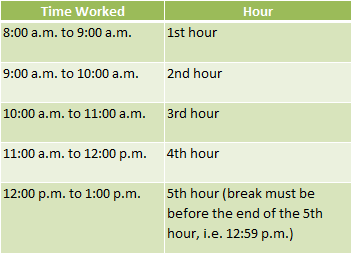
The California Supreme Court made clear in Brinker Restaurant Group v. Superior Court that employers need to provide an employee their first meal break “no later than the end of an employee’s fifth hour of work, and a second meal period no later than the end of an employee’s 10th hour of work.”  The following chart illustrates the timing requirements for meal breaks:

Meal breaks must be recorded.  Generally, meal breaks can only be waived if the employee works less than six hours in a shift. However, as long as employers effectively allow an employee to take a full 30-minute meal break, the employee can voluntarily choose not to take the break and this would not result in a violation. In Brinker, the Supreme Court explained that:

The employer that refuses to relinquish control over employees during an owed meal period violates the duty to provide the meal period and owes compensation [and premium pay] for hours worked. The employer that relinquishes control but nonetheless knows or has reason to know that the employee is performing work during the meal period, has not violated its meal period obligations [and owes no premium pay], but nonetheless owes regular compensation to its employees for time worked.

Employers should also establish a complaint procedure and provide that the company has a system in place to correct any violations. If during an investigation, the employer confirms that the employee in fact missed the break because of the rush of business or some other factor, the company should pay the employee the one hour “premium pay” penalty at the employee’s regular rate of pay. Also, the company should record these payments made to employees to be able to establish it has a complaint procedure in place to address missed breaks.  The employee is entitled to receive up to two hours of premium pay per day – one hour for missed meal breaks and one hour for missed rest breaks.  If the employee missed two meal breaks in one day, they would only be entitled to one hour of premium pay.  The same applies to rest breaks.  See UPS v. Superior Court.

5. Review rest break policies to ensure compliance.

In terms of rest breaks, the California Supreme Court held in Brinker that, “[e]mployees are entitled to 10 minutes’ rest for shifts from three and one-half to six hours in length, 20 minutes for shifts of more than six hours up to 10 hours, 30 minutes for shifts of more than 10 hours up to 14 hours, and so on.”  The following chart sets forth the number of rest breaks employees are entitled to based on the number of hours worked:

The Wage Orders generally require that employers must provide a 10-minute rest period per every four hours worked and the break should, whenever practicable, fall in the middle of the work period. (See Wage Order 4, subd. 12(A).  The rest period must also be paid, and the law does not require that employers record when the employee takes the rest period (unlike an employer’s obligation to record when 30-minute meal breaks are taken).  The California Supreme Court made it clear in Augustus v. ABM Security Services, Inc. that employers must relieve employees of all work-related duties and they must be free from control of the employer during the rest breaks.  For more information about rest breaks, see my prior post here.

Happy New Year.  I started the Friday’s Five articles in the summer of 2014, and the interest in the articles has been more than I expected.  I appreciate everyone who has read them and provided comments and feedback. If you have any topics you would like me to address, please let me know. With that said, here is a list of five resolutions for California employers in 2018:

1. Relax – Still need to make sure your employees are taking their meal and rest breaks.

2. Train – All supervisors must be trained to comply with California’s required sexual harassment prevention training for employers with 50 or more employees.

Since 2015 the training must discuss bullying in the workplace to be legally compliant, and as of January 1, 2018, the training also needs to cover harassment based on gender identity, gender expression, and sexual orientation.

3. Read – Update employment handbook policies on a yearly basis.

2018 has a few new laws that should be addressed the employee handbook and new hire packets.

4. Run – Sorry, no play on words with this one, you just need to get outside and run a bit.

5. Organize – and keep employment files, time records and wage information for at least the length of any applicable statute of limitations.

Employers should review their systems to ensure there is a process in place on how to organize and maintain employment information for the required time periods, it is required under the law and can help defend the company should litigation ensue.

A final more bonus resolution:
Learn – more by attending my webinars on California employment laws to stay up to date.

In the next month, I will be hosting a seminar on the new laws facing employers in 2018 and what steps should be taken to comply. The date is still to be determined, but drop me an email if you are interested and I make sure you are notified once we set the date and location.

Wishing you the best in 2018!

In speaking to a few groups of California employers this week, a common question kept coming up about what are the essential Booksemployment policies California employers must have?  While there are more than five, this week’s Friday’s Five starts with what I consider to be critical policies that every California must have in place.

1. At-will policy

Under California law, it is presumed that all employment is terminable at-will. California Labor Code section 2922 provides: “An employment, having no specified term, may be terminated at the will of either party on notice to the other.” The at-will doctrine means that the employment relationship can be terminated by either party at any time, with or without cause, and with or without advanced notice. There are some major exceptions to this rule, but generally California law recognizes that employers and employees may, at any time, and for any legal reason, terminate the employment relationship.

2. Anti-harassment, discrimination and retaliation policy

California’s Fair Employment and Housing Council published new regulations pertaining to anti-discrimination and anti-harassment requirements effective April 1, 2016.  Employers need to review and potentially update their policies in order to meet the new requirements.  The full text of the regulations can be obtained here.

3. Timekeeping policy

California law requires employers to track start and stop times for hourly, non-exempt employees. The law also requires employer to track the start and stop times for the employee’s thirty minute meal periods. The time system needs to be accurate, and the employer needs to be involved in the installation and setup of the system. Do not simply use the default settings for the hardware and software. Understand what the system is tracking and how it is recording the data. Since the statute of limitations for California wage and hour violations can extent back four years, it is recommended that employers take steps to keep these records at least four years.  Employers should also have a complaint procedure in place and regularly communicate the policy to employees in order to establish an effective way to remedy any issues.

4. Meal and rest break policy

As I’ve written about many times previously, employers must have a compliant meal and rest break policy.  Indeed, given the California Supreme Court’s ruling in Augustus v. ABM Security Services in December 2016, employers should review their rest beak policy to ensure it complies with this ruling.

5. Paid sick leave policy

Many local governments in Southern California have passed laws increasing the minimum wage and amount of paid sick leave that must be provided to employees.  Employers must ensure they are complying with the law that provides the most benefits to employees.  Here is a brief summary of some of the local laws in Southern California:

State/City Minimum Wage Paid Sick Leave
1) California $10/hr January 1, 2016; $10.50 January 1, 2017; $11/hr January 1, 2018; $12/hr January 1, 2019; $13/hr January 1, 2020; $14/hr January 1, 2021; $15/hr January 2022* Current: 3 days or 24 hours
2) Los Angeles – City (click here for more information about Los Angeles City’s minimum wage and paid sick leave laws) July 1, 2016: $10.50/hr; July 1, 2017 $12; July 1, 2018 $13.25; July 1, 2019 $14.25; July 1, 2020 $15.00 * (click here for more information about Los Angeles’s minimum wage ordinance) July 1, 2016: 48 hours*
3) Los Angeles – County (applies to unincorporated cities in LA County) Same as LA City (see above) No specific requirement – state law applies
4) San Diego City July 2016: $10.50 (date not set yet – likely effective in first half of July 2016); January 1, 2017 $11.50; January 1, 2019 $11.82; January 1, 2020 $12.15; January 1, 2021 $12.49; January 1, 2022 $12.84 5 paid sick days
5) Santa Monica (click here for Santa Monica’s website for details of the law) $10.50 July 1, 2016; July 1, 2017 $12.00; July 1, 2018 $13.25; July 1, 2019 $14.25; July 1, 2020 $15.00* January 1, 2017: 32 hours for small businesses, 40 hours for large businesses; January 1, 2018: 40 hours for small business, 72 hours for large businesses*
*Employers with 25 or fewer employees the implementation is delayed one year.

Happy Memorial day weekend!

In Augustus v. ABM Security Services, Inc., the California Supreme Court issued a ruling on employer’s obligations to permit employees to take “off-duty” rest periods.  The Court’s ruling ends 2016 with a major ruling on issues surrounding rest periods under California law.

The plaintiffs worked as security guards for defendant ABM.  The employer required to the guards to keep their pagers and radio phones on at all times, even during rest periods, and to potentially respond to calls when needed.   The guards’ duties included when a building tenant wished to be escorted to the parking lot, a building manager had to be notified of a mechanical problem, or the occurrence of emergency situations.

The trial court “reasoned that a rest period subject to such control was indistinguishable from the rest of a workday; in other words, an on-duty or on-call break is no break at all,” and granted Plaintiff’s motion for summary judgment.  The trial court awarded approximately $90 million in statutory damages, interest, and penalties.    ABM appealed the trial court’s ruling, and was successful in having the trial court overturned, but the California Supreme Court granted review of the case.

The company argued that it provided the required rest breaks under California law because it only required that the guards keep their radios and pagers on in case they were needed to respond to a call.  For the last Friday’s Five article of 2016, here are five key lessons for California employers from the Supreme Court’s decision:

1. Generally, what are employer’s obligations to provide rest breaks under California law?

Employer’s obligations to provide rest breaks is found in Labor Code section 226.7, enacted in 2000.  As enacted, subdivision (a) provided:  “No employer shall require any employee to work during any meal or rest period mandated by an applicable order of the Industrial Welfare Commission.”  The Wage Orders generally require that employers must provide a 10-minute rest period per every four hours worked and the break should, whenever practicable, fall in the middle of the work period. (See Wage Order 4, subd. 12(A).  The rest period must also be paid, and the law does not require that employers record when the employee takes the rest period (unlike an employer’s obligation to record when 30-minute meal breaks are taken).

2. Does California law require employers to authorize off-duty rest periods? 

Yes.  The Supreme Court held that employers must provide employees with a paid rest break in which the employee is relieved from all work-related duties and free from employer control.  The Court examined the wage order at issue in the case, Wage Order 4, which provides, “Every employer shall authorize and permit all employees to take rest periods…. Authorized rest period time shall be counted, as hours worked for which there shall be no deduction from wages.”

The Court ruled that:

The most reasonable inference we can draw from the wage order and its context is instead that we should give the term its most common understanding – a reading consistent with requiring that employers authorize off-duty rest periods…. So, ordinarily, a reasonable reader would understand ‘rest period’ to mean an interval of time free from labor, work, or any other employment-related duties.

We accordingly conclude that the construction of Wage Order 4, subdivision 12(A) that best effectuates the order’s purpose and remains true to its provisions is one that obligates employers to permit –– and authorizes employees to take –– off-duty rest periods.  That is, during rest periods employers must relieve employees of all duties and relinquish control over how employees spend their time.

3. Can employers satisfy the obligation to relieve employees from duties and control during rest periods if the employer requires the employee to remain on call? 

No.  The Court ruled that “one cannot square the practice of compelling employees to remain at the ready, tethered by time and policy to particular locations or communications devices, with the requirement to relieve employees of all work duties and employer control during 10-minute rest periods.”  The Court made clear that the employee must be “free from labor, work, or any other employment-related duties.  And employees must not only be relieved of work duties, but also freed from employer control over how they spend their time.”

4. If employees are required to carry a pager or phone during a rest break and must monitor the device during the rest break, is the employee provided a compliant rest break? 

No.  If an employee “must fulfill certain duties [such as] carrying a device or otherwise making arrangements so the employer can reach the employee during a break, responding when the employer seeks contact with the employee, and performing other work if the employer so requests,” the employee does not have the freedom to use the rest period for their own purpose.  The court used examples that employees should be permitted to take “a brief walk – five minutes out, five minutes back,” take care of personal matters like “pumping breast milk… or completing a phone call to arrange child care.”

5. Is there some flexibility for employers to reschedule rest breaks when needed?

Yes.  The Court provided, “[n]othing in our holding circumscribes an employer’s ability to reasonably reschedule a rest period when the need arises.”  However, the Court failed to provide any other clarification of what is reasonable in rescheduling a rest period.  The Court did explain, however, that employers have “several options” when employers find it burdensome to relieve their employees of all duties during rest periods.  As examples of these options, the Court stated that employers can provide employees with another rest period to replace the one that was interrupted, or pay the premium pay of one hour at the employee’s regular rate of pay for missing the rest period.

Looking for more information about California employers obligations to provide rest and meal periods?  See my prior post on five reminders about rest breaks here, and the timing of meal and rest breaks under California law here.

The DOL’s change in the federal overtime rules requiring a higher salary threshold ($47,476 paid annually) for employees to qualify as an exempt employee takes effect December 1, 2016.  This Friday’s Five discusses five final checklist items California employers should consider when reclassifying from exempt employees to nonexempt employees.

1. The DOL rule changes are still going into effect December 1, 2016.

This week, a few people asked me if the DOL changes are still going into effect since Donald Trump was elected as president.  Mr. Trump is unable to change the DOL’s rule that requires exempt employees be paid $47,476 in an annual salary until he is inaugurated as president.  Therefore, employers still must comply with this deadline.

2. Notice to Employee may be required.

Section 2810.5 of the California Labor Code requires employers provide notice to employees of their rate(s) of pay, designated pay day, the employer’s intent to claim allowances (meal or lodging allowances) as part of the minimum wage, and the basis of wage payment (whether paying by hour, shift, day, week, piece, etc.), including any applicable rates for overtime.

The law requires that the notice is provided to employees at the time of hiring or within 7 days of a change if the change is not listed on the employee’s pay stub for the following pay period. The notice must be provided in the language the employer normally uses to communicate.

Employers should carefully review the need to provide the notice to employee given any reclassification of employees from exempt to a nonexempt employee.  A template Notice to Employee can be downloaded from the DIR’s website here.

3. Consider how the change will be communicated and documented with employees.

Employers should explain to employees who are being reclassified from exempt to nonexempt about how they will be paid.  The notice should inform workers they will be paid overtime for work over 8 hours in a day and over 40 hours in a week.  The communication should also explain any changes in bonuses (don’t forget that nondiscretionary bonuses must be figured into the employee’s regular rate of pay for overtime purposes) and benefits.  Finally, the communications should set out the different duties the employee may be required to perform given the change in classification.

4. Meal and rest breaks.

In addition to communicating the change in pay to employees, the company should also distribute its meal and rest break policy.  The company should distribute any meal and rest break forms to the employees who are being converted to nonexempt that are normally given to new hires.

5. Off the clock and timekeeping policies.

Finally, employers need to implement compliant timekeeping policies to ensure that all nonexempt employees clock in and out for all work time.  In addition, California requires that employers record when nonexempt take their meal breaks, and any reclassified employees must understand this requirement.  Employers need to be careful about allowing employees who are reclassified as nonexempt to continue to use a company cell phone or laptop, as now any work performed once they leave the office must be compensated.  Employers should consider limiting nonexempt employees’ access to company cell phones, e-mail, and computers to avoid off the clock claims.

Any reclassification and audit regarding the proper classification of employees should be done with caution, as there are many different issues to consider that are outside of the scope of this article.

This week’s Friday’s Five covers five misconceptions about California employment law that can land employers in a lot of hot water:

  1. Meal and rest breaks seem so trivial.

The topic for the uneducated (or out of state) employer does seem trivial.  However, with the penalty owed to employees of one hour of pay for each missed meal or rest break (i.e., up to two hours of penalty pay per day) these violations add up to significant amounts of liability very quickly.  Wal-Mart’s 2005 verdict in California for meal and rest break violations for $172 million is a good example.

  1. My payroll company understands the laws about wages and itemized pay statements.

Payroll companies are not law firms and they will not notify you if you are not paying your employees properly, calculating overtime correctly, or even ensure that the paystubs they generate for your employees comply with the law.  It is the employer’s responsibility to ensure the employment laws are being complied with, and it is wise to have an experienced employment lawyer review these practices and audit the practices of the payroll company.

  1. The employee’s title determines if they are owed overtime.

An employee’s title is not determinative of whether they qualify as an exempt employee.  See my previous article on the various exemptions that employees may qualify for, and the requirements necessary for employees to meet those exemptions.

  1. Employees can be provided “comp time” instead of paid overtime.

While it is true employers may provide employee’s comp time in lieu of overtime, there are many technical restrictions that must be met in order for comp time plans to be legal under California law.  Labor Code section 204.3 only authorizes employers to provide nonexempt employees with compensated time off instead of pay for overtime if the following requirements are met:

  • Payment for comp time must be at the overtime rate of pay (i.e., not less than one and one-half hours for each hour of employment, or double time if applicable)
  • Must be in writing before work begins
  • Employees cannot accrue more than 240 hours of compensation time off
  • Employee has to make a written request for comp time in lieu of overtime
  • Employee must be scheduled to work at least 40 hours a week
  • Employee must be paid at rate of pay in effect at time of payment
  • Payment at termination must be at high of current or three-year average rate of pay
  • Employee must be permitted to use comp time within reasonable period
  • Employer must keep records of comp time accrued and used
  1. My company is too small to be a target for employment litigation.

If you have been a reader of this blog for any time period, you understand that every employer in California needs to understand their legal duties when it comes to employing workers.  And with competent employment law counsel [:)] it is not hard to comply with the law, but it is difficult to keep current with the law and ensure all legal obligations are being met.

I apologize for the long post in advance, but I’ve been receiving many questions about exempt vs. non-exempt classification of employees lately. This article is the first in a series of articles to help employers tread through this technical area, hopefully in a manner that makes it at least somewhat easier for employers to understand.

California law presumes that all employees are non-exempt employees, meaning that they are not exempt from the Labor Code requirements, such as overtime pay, meal and rest breaks, and minimum wage. Exempt employees are designated as such because they are “exempt” from certain wage and hour requirements due to their duties and pay. However, the employer bears the burden when classifying an employee as exempt, and simply providing a title to an employee does not make them exempt. The employee must meet very specific requirements for each applicable exemption, and if the requirements are not met the employer must comply with all wage and hour requirements – such as overtime pay, etc…. It is also important to note that some exemptions only exempt the employee from specific Labor Code provisions (for example, the inside sales exemption only exempts the employee from overtime pay requirements, but the employer is still required to provide meal and rest breaks).

There are many exemptions, and many nuances to each exemption, so employers should perform this analysis very carefully and receive advice from an experienced attorney or HR professional when classifying employees as exempt.

In my experience, here are the most common exemptions that arise in a workplace under California law and the requirements to meet each one:

1. Executive/managerial exemption
In order to meet the executive (managerial) exemption, the employee must meet all of the following requirements:

  1. Employee’s duties and responsibilities involve the management of the enterprise in which he or she is employed or of a customarily recognized department or subdivision of the enterprise;
  2. Employee customarily and regularly directs the work of two or more other employees;
  3. Employee has the authority to hire or fire other employees, or whose suggestions and recommendations as to the hiring or firing and as to the advancement and promotion or any other change of status or other employees is given particular weight;
  4. Employee customarily and regularly exercises discretion and independent judgment in performing his or her duties;
  5. Is “primarily engaged” in duties that meet the test of the exemption;
  6. Earns a monthly salary equivalent to no less than two times the state minimum wage for full-time employment.

The term “primarily engaged in” means that more than one-half of the employee’s work time must be spent engaged in exempt work and differs substantially from the federal test which simply requires that the “primary duty” of the employee falls within the exempt duties. Therefore, to qualify for this exemption, the employee must spend more than 50% of their work time on exempt duties.

2. Administrative exemption
To meet the administrative exemption, an employee must meet all of the following requirements:

  1. Employee spends more than one-half of their work time performing office or non-manual work directly related to management policies or general business operations for the employer or the employer’s customers;
  2. Employee “customarily and regularly” exercises discretion and independent judgment in carrying out job duties as to matters significant to the employer’s business;
  3. Performs his or her job only under general supervision and works along specialized or technical lines requiring special training, experience, or knowledge; and
  4. Is paid a salary equivalent to no less than two times the state minimum wage.

3. Computer professional exemption
To be an exempt computer professional, the employee must meet the following requirements:

1. The employee is primarily engaged in work that is intellectual or creative and requires the exercise of discretion and independent judgment.

“Primarily” is defined as requiring more than 50% of the employee’s work time be spent on these types of duties.

2. The employee is primarily engaged in duties that consist of one or more of the following:

  • The application of systems analysis techniques and procedures, including consulting with users, to determine hardware, software, or system functional specifications.
  • The design, development, documentation, analysis, creation, testing, or modification of computer systems or programs, including prototypes, based on and related to, user or system design specifications.
  • The documentation, testing, creation, or modification of computer programs is related to the design of software or hardware for computer operating systems.

3. The employee is highly skilled and is proficient in the theoretical and practical application of highly specialized information to computer systems analysis, programming, and software engineering.

4. The employee’s hourly rate of pay, or annual salary if paid on salaried basis, meets a minimum threshold amount set by California’s Division of Labor Statistics and Research (DLSR). For 2015, the DLSR set the amounts at $41.27 per hour or annual salary of not less than $85,981.40 for full time employment, and paid not less than $7,165.12 per month.

4. Commissioned inside sales exemption
To qualify as an exempt commissioned inside sales employee, an employee must meet the following requirements:

  1. Employee’s earnings must exceed one and one-half times the California minimum wage; and
  2. More than half of the employee’s compensation must be commissions.

Employers must note that this exemption is only for the overtime requirement, and other wage and hour requirements such as minimum wage, meal and rest breaks, time recording requirements still must be met.

5. Outside salesperson exemption
To qualify as an exempt outside salesperson the employee must:

  1. Be at least 18 years old;
  2. Must customarily and regularly work more than 50% their work time away from the employer’s place of business; and
  3. Must be engaged in selling tangible items or obtaining orders or contracts for products, services, or use of facilities.

Happy New Year.  I started the Friday’s Five articles at the beginning of last summer, and the interest in the articles has been astounding, so I appreciate everyone who has read them and provided comments and feedback. If you have any topics you would like me to address, please let me know. With that said, here is a list of five resolutions for California employers in 2015:

1. Relax–make sure your employees are taking their meal and rest breaks.

2. Train – your supervisors to comply with California’s required sexual harassment prevention training for employers with 50 or more employees.

As of 2015 this training now must also discuss bullying in the workplace to be legally compliant.

3. Read – and update employment handbook policies on a yearly basis.

2015 has a few new laws that should be addressed the employee handbook and new hire packets.

4. Run. Sorry, no play on words with this one, you just need to get outside and run a bit.

5. Organize – and keep employment files, time records and wage information for at least the length of any applicable statute of limitations.

Employers should review their systems to ensure there is a process in place on how to organize and maintain employment information for the required time periods, it is required under the law and can help defend the company should litigation ensue.

Ok – one more bonus resolution:
Learn – more by attending my webinars on California employment laws to stay up to date.

In February, I will be presenting on what documents should be in new hire packets to employees. Date is still to be determined, but drop me an email if you are interested and I will forward you information as we set the date.

1. Classifying all employees as independent contractors
To qualify as an independent contractor, the employer has the burden of proof to establish that the worker is actually an independent contractor and not an employee. I’ve discussed the parameter of this “economic realities” test here.  In addition to owing unpaid minimum wages and potential unpaid overtime, the employer also faces steep penalties for misclassifying independent contractors.

2. Treating all employees as exempt employees and not paying overtime.
An employee cannot agree to work without being paid overtime unless they qualify as an exempt employee. To qualify as an exempt employee, generally, the employee must perform certain duties, and must be paid a certain threshold in wages (usually at least two times the equivalent pay of minimum wage based on a 40 hour week).

3. Not having a handbook and written policies.
Even if startup companies have no money, the Labor Code still applies. They still have to pay more than minimum wage, provide and record meal and rest breaks, issue wage notices to new employees, and otherwise comply with California law. A handbook, new hire packet, and standardized set of written policies is a good place to start.

4. Not providing clear offer letter with at-will provisions and clear understanding of who owns social media accounts and passwords.
Companies should providing a writing setting forth the employee’s compensation, stock option rights, at-will status, as well as who owns the rights to social media accounts and the passwords to access the accounts. Much better to have this set out early in order to avoid costly litigation and disruption in your business later.

5. Not having the right employment law counsel.
Startup owners should have a relationship with an attorney that actually practices California employment law. Have an agreement with them that for basic quick questions there will be little if no charge. I often tell my clients that if it takes a quick phone call to review a decision about an employment issue, there will be no charge. Of course this has to be within reason, as your lawyer sells his or her time to make a living.  So to make this easier on your lawyer, do the work before you call, and just double check that the decision you have made, or the letter you drafted is good-to-go. Otherwise, calling your lawyer and asking him to draft the letter will take him time (usually more time that the client could have done it in) and will increase the cost of legal services.