At the start of 2020, it is a good time to conduct a California employment law practices audit to ensure that policies are compliant, managers are properly trained, and the company is maintaining the required records for the necessary length of time.  Here are five areas to start with in conducting an audit and a few recommended questions for each topic:

1. Hiring Practices

  • Are applications seeking appropriate information?
    • Ensure compliance with state and local ban the box regulations.
  • Are new hires provided with required policies and notices?
  • Are new hires provided and acknowledge recommended policies?
    • For example: meal period waivers for shifts less than six hours
  • Are hiring managers trained about the correct questions to ask during the interview?
  • Does the company provide new hires (and existing employees) with arbitration agreements with class action waivers?

 2. Records

  • Are employee files maintained confidentially and for at least four years?
  • Are employee time records maintained for at least four years?
  • Are employee schedules maintained for at least four years?
  • Do the managers have set forms for the following:
    • Employee discipline and write-ups
    • Documenting employee tardiness
  • How is the employee documentation provided to Human Resources or the appropriate manager?
  • Who is involved in reviewing disability accommodation requests?
  • How are employee absences documented?

3. Wage and Hour Issues

  • Does the company have its workweeks and paydays established?
  • Are paydays within the applicable time limits after the pay period as required under the law?
  • Are employees provided with compliant itemized wage statements?
  • Are employees provided a writing setting out their accrued paid sick leave each pay period?
  • Are employees properly classified as exempt or nonexempt?
    • For exempt employees, review their duties and salary to ensure they meet the legal requirements to be an exempt employee.
  • Any workers classified as independent contractors, and if so, could they be considered employees under AB 5?
  • Are nonexempt employees properly compensated for all overtime worked?
  • Is off-the-clock work prohibited?
    • Policy in place?
    • Are managers trained about how to recognize off-the-clock work and what disciplinary actions to take if find employees working off-the-clock?
  • Does the company’s time keeping system round employee’s time?
    • If so, is the rounding policy compliant with the law?
  • Are meal and rest period policies set out in handbook and employees routinely reminded of policies?
    • Does the company pay “premium pay” for missed meal and rest breaks? If so, how is this documented on the employee pay stub?
    • Do employees record meal breaks?
    • Are managers trained on how to administer breaks and what actions to take if employees miss meal or rest breaks?
  • Is vacation properly documented and tracked?
  • Are all deductions from the employee’s pay check legally permitted? (use caution, very few deductions are permitted under CA law)
  • Are employees reimbursed for all business expenses, such as uniforms, work equipment, and miles driven for work?

 4.End of Employment Issues

  • Are employees leaving the company provided their final wages, including payment for all accrued and unused vacation time?
  • Does the employer deduct any items from an employee’s final paycheck?
    • If so, are the deductions legally permitted?

5. Anti-harassment, discrimination and retaliation

  • Are supervisors provided with sexual harassment training every two years? (If employer has 50 or more employees, supervisors are legally required to have a two-hour harassment prevention training that complies with AB 1825 and amendments to this law).
  • Are there steps in place to provide nonsupervisory employees with 1 hour sexual harassment prevention training by January 1, 2021 and once every 2 years thereafter? (required for employers with 5 or more employees)
  • Are supervisors and managers discussing the company’s open-door policy to employees at routine meetings with employees? Is this being documented?

With the start of 2019, I’m writing a series of posts covering employment law areas that employers should audit on a routine basis.  The first two articles covered hiring practices and records retention practices.  This post covers five wage and hour considerations that every California employer should review on a routine basis:

1. Payroll

  • Are the company’s workweeks and paydays established?
  • Are paydays within the applicable time limits after the pay period as required under the law?
  • Are employees provided with compliant itemized wage statements?
  • Are employees provided a writing setting out their accrued paid sick leave each pay period?
  • Is vacation properly documented and tracked?

2. Wages

  • Are all deductions from the employee’s pay check legally permitted? (use caution, very few deductions are permitted under CA law)
  • Are employees reimbursed for all business expenses, such as uniforms, required cell phone use, work equipment and miles driven for work?
  • Are employees provided their final wages according to California requirements?  For example, employees terminated must receive their wages (including all accrued and unused vacation) at the time of termination.  More information on the timing requirements for final paychecks can be read here.

3. Employee Classifications

  • Are employees properly classified as exempt or nonexempt?
    • For exempt employees, review their duties and salary to ensure they meet the legal requirements to be an exempt employee.
  • Any workers classified as independent contractors, and if so, could they be considered employees?

4. Timekeeping

  • Are nonexempt employees properly compensated for all overtime worked?
  • Is off-the-clock work prohibited?
    • Policy in place?
    • Are managers trained about how to recognize it and what disciplinary actions to take if find employees working off-the-clock?
  • Does the company’s timekeeping system round employee’s time?
    • If so, is the rounding policy compliant with the law?

5. Meal and rest breaks

  • Are meal and rest period policies set out in handbook and employees routinely reminded of policies?
    • Are meal and rest breaks provided on a timely basis?
    • Does the company pay “premium pay” for missed meal and rest breaks? If so, how is this documented on the employee pay stub?
    • Do employees record meal breaks?
    • Are managers trained on how to administer breaks and what actions to take if employees miss meal or rest breaks?

The next article in this series will addresses end of employment issues.  Have a great weekend.

California employment law is a mind field that carries huge exposure for employers not proactively monitoring legal developments and potential legal issues.  There are some statements employers in California should never make, and this Friday’s Five reviews misaligned statements that can create significant liability for an employer.

1. My company has employment practices liability insurance, so there cannot be much exposure from employment lawsuits.

In California, it is very common for insurance companies to exclude wage and hour claims from the employment practices liability (EPLI) coverage.  This applies to single plaintiff and class action claims and representative claims under California’s Private Attorney General Act (PAGA).  This is a significant area of potential exposure for employers, and therefore, the costs and benefit analysis of an EPLI policy must take these considerations into account.

Moreover, under California law an insured cannot buy insurance to cover willful acts.  See Insurance Code section 533.  Therefore, if the employment lawsuit alleges willful acts, it is also likely not going to be covered by insurance.

Employers should seek coverage counsel to assist in reviewing the exclusions and limitations of any EPLI policies prior to purchasing in order to completely understand the coverage that is being purchased for the cost of the policy.

2. I’m busy right now, can you tell me about your workplace complaint tomorrow?

California employers have a legal obligation to conduct workplace investigations.  California Government Code section 12940(j) provides that it is “unlawful if the entity, or its agents or supervisors, knows or should have known of this conduct and fails to take immediate and appropriate corrective action.”  The law also provides that employers are liable if they “fail to take all reasonable steps necessary to prevent discrimination and harassment from occurring.”  Gov. Code section 12940(k).  If the employer fails to take the preventative measures, they can be held liable for the harassment between co-workers.  If the harassment occurs by a manager, the company is strictly liable for the harassment.  If the harassment occurred by a non-management employee, the employer is only liable if it does not take immediate and appropriate corrective action to stop the harassment once it learns about the harassment.  Investigations must follow certain parameters in order to be deemed adequate under the law.  Click here for more information about conducting adequate investigations.

3. There is no need for our company to record meal breaks, all of the employees know that they can take breaks whenever they want.

Meal breaks taken by the employees must be recorded by the employer. However, there is no requirement for employers to record 10-mintute rest breaks.  For more information about meal and rest break obligations, see my previous article.

4. Our company’s handbook is current, it was updated four years ago.

Any California employer can attest, the employment legal landscape changes on a yearly (if not more often basis).  Employers should have someone well versed on employment law reviewing the employee handbook on at least a yearly basis.

5. I’m sure my payroll company is issuing compliant pay stubs.

Employers are cautioned not to rely on their payroll companies for compliant itemized wage statements, as these companies often times do not understand the legal requirements of the Labor Code. Ensuring the required information is properly listed on the itemized wage statements is an item that employers should review at least twice a year for compliance.

Labor Code Section 226(a) requires the following information to be listed on employees’ pay stubs:

  1. Gross wages earned
  2. Total hours worked (not required for salaried exempt employees)
  3. The number of piece-rate units earned and any applicable piece rate if the employee is paid on a piece rate basis
  4. All deductions (all deductions made on written orders of the employee may be aggregated and shown as one item)
  5. Net wages earned
  6. The inclusive dates of the period for which the employee is paid
  7. The name of the employee and the last four digits of his or her social security number or an employee identification number other than a social security number
  8. The name and address of the legal entity that is the employer
  9. All applicable hourly rates in effect during the pay period, and the corresponding number of hours worked at each hourly rate by the employee

Here is an example of an itemized wage statement published by the DLSE.

Also, do not forget that under California’s paid sick leave law that went into effect on July 1, 2015 employers have additional reporting information regarding employees’ accrued paid sick leave and usage. Employers must show how many days of sick leave an employee has available on the employee’s pay stub or a document issued the same day as a paycheck.

Companies are ultimately liable for these violations, so it is best to double check your payroll company’s work to ensure compliance.

Happy Friday.  Through my defense of wage claims this year, I found that employers need to establish and periodically review issues pertaining to employees’ timekeeping.  This Friday’s Five is a list of the top five timekeeping issues that employers should routinely audit:

1. Establish and communicate a time keeping policy

Employers should establish and regularly communicate a time keeping policy to employees.  The policy should set forth that employees always have an open door to complain to their supervisors and other managers or human resources about missed meal and rest breaks, unpaid wages, or unpaid overtime.  If employees routinely acknowledge that they understand the time keeping policy and are agreeing to record their time through the employer’s system, this can go a long way in defending any off-the-clock claims.

2. Rounding

Employers need to review whether their time keeping system or payroll company is rounding employees’ time.  While rounding can be legal under California law, employers must still meet certain requirements to have a compliant rounding practice.  In See’s Candy Shops Inc. v. Superior Court, a California court held that the employer’s rounding policy that rounded both up and down from the midpoint of every six minutes was permitted under California law.  The employers’ policy did not result in a loss to the employees overtime.  Therefore, the court found it to be lawful.  Employers need to review:

(1) Do they have a rounding policy?

(2) If they do round, is the policy compliant with the law?

(3) Is a rounding policy necessary or is it easier to pay the exact time the employee clocks in and out?

3. De minimis time

Employers need to review if they are compensating employee for all time worked.  The de minimis doctrine may permit employers a defense for claims by employees that they were not compensated for very small amounts of time that are difficult to track.  The de minimis doctrine holds that “alleged working time need not be paid if it is trivially small: ‘[A] few seconds or minutes of work beyond the scheduled working hours … may be disregarded.’” Troester v. Starbucks Corporation (this decision is currently under appellate review).   More information about the de minimis doctrine can be read here.  While this defense may be available to California employers, employers should not rely upon the defense when it is known the employee is working time that is not compensated.

4. Record meal breaks

In addition to recording the start and stop times for employee’s work, employers are required to record when employees take meal breaks.  The Wage Orders require that California employers keep “[t]ime records showing when the employee begins and ends each work period. Meal periods, split shift intervals and total daily hours worked shall also be recorded. Meal periods during which operations cease and authorized rest periods need not be recorded.”  IWC Wage Order 5-2001(7)(a)(3).

5. Time records

Under Labor Code section 1174, employers are required to keep time records showing the hours worked daily and the wages paid, number of piece-rate units earned by and applicable piece rate paid.  These records must be maintained in the state or at the “plants or establishments at which employees are employed.”  The records must be kept for at least three years.  Labor Code section 1174(d).  The statute of limitations for wage claims can extend back to four years, so employers generally keep the records for four years.

Happy Friday!  This Friday’s Five covers five areas that employers can start with in conducting an employment practices Checklistsaudit.  Coming up on the mid-point of the year, it is a good time to conduct an employment law practices audit to ensure that policies are compliant, managers are properly trained, and the company is maintaining the required records for the necessary length of time.  Here are five areas to start with in conducting an audit and a few recommended questions for each topic:

1. Hiring Practices

  • Are applications seeking appropriate information?
    • For example: Be careful about local ban the box regulations.
  • Are new hires provided with required policies and notices?
  • Are new hires provided and acknowledge recommended policies?
    • For example: meal period waivers for shifts less than six hours
  • Are hiring managers trained about the correct questions to ask during the interview?
  • Does the company provide new hires (and existing employees) with arbitration agreements with class action waivers?

 2. Records

  • Are employee files maintained confidentially and for at least four years?
  • Are employee time records maintained for at least four years?
  • Are employee schedules maintained for at least four years?
  • Do the managers have set forms for the following:
    • Employee discipline and write-ups
    • Documenting employee tardiness
  • How is the employee documentation provided to Human Resources or the appropriate manager?
  • Who is involved in reviewing disability accommodation requests?
  • How are employee absences documented?

3. Wage and Hour Issues

  • Does the company have its workweeks and paydays established?
  • Are paydays within the applicable time limits after the pay period as required under the law?
  • Are employees provided with compliant itemized wage statements?
  • Are employees provided a writing setting out their accrued paid sick leave each pay period?
  • Are employees properly classified as exempt or nonexempt?
    • For exempt employees, review their duties and salary to ensure they meet the legal requirements to be an exempt employee.
  • Any workers classified as independent contractors, and if so, could they be considered employees?
  • Are nonexempt employees properly compensated for all overtime worked?
  • Is off-the-clock work prohibited?
    • Policy in place?
    • Are managers trained about how to recognize it and what disciplinary actions to take if find employees working off-the-clock?
  • Does the company’s time keeping system round employee’s time?
    • If so, is the rounding policy compliant with the law?
  • Are meal and rest period policies set out in handbook and employees routinely reminded of policies?
    • Does the company pay “premium pay” for missed meal and rest breaks? If so, how is this documented on the employee pay stub?
    • Do employees record meal breaks?
    • Are managers trained on how to administer breaks and what actions to take if employees miss meal or rest breaks?
  • Is vacation properly documented and tracked?
  • Are all deductions from the employee’s pay check legally permitted? (use caution, very few deductions are permitted under CA law)
  • Are employees reimbursed for all business expenses, such as uniforms, work equipment and miles driven for work?

 4.End of Employment Issues

  • Are employees leaving the company provided their final wages, including payment for all accrued and unused vacation time?
  • Does the employer deduct any items from an employee’s final paycheck?
    • If so, are the deductions legally permitted?

5. Anti-harassment, discrimination and retaliation

  • Are supervisors provided with sexual harassment training every two years? (If employer has 50 or more employees, supervisors are legally required to have a two-hour harassment prevention training that complies with AB 1825 and amendments to this law).
  • Are supervisors and managers mentioning the open-door policy of the company to employees at routine meetings with employees? Is this being documented?

Please let me know if you have any other items your company considers during review of employment policies – it would be great to update this list to share with readers.  Have a great weekend.

Let me start with the lawyer’s disclaimer up-front: this Friday’s Five list has no scientific or statistical backing whatsoever, I generated it based on the cases I’ve been litigating in 2014. My experience may be (and probably is) skewed a bit, but nevertheless California employers should pay attention to the following areas of potential litigation.

1. Meal and rest break litigation.

Meal and rest break class action litigation is still very prevalent in California. While employers are becoming more sophisticated in ensuring compliance with their obligations, the litigation has turned to more nuanced issues, such as the employer’s failure to record meal breaks or provide a full 30 minutes for the meal break. Meal and rest break policies and procedures should always been under review by employers to ensure compliance.

2. Rounding policies.

There have been a number of cases I’ve litigated this year involving time rounding policies. It is important for employers to simply no use the default settings provided by their time keeping software, but instead ensure that the rounding complies with California law.
The Division of Labor Standards Enforcement (DLSE) provides the following guidance for California employers in regard to time rounding:

…the federal regulations allow rounding of hours to five minute segments. There has been practice in industry for many years to follow this practice, recording the employees’ starting time and stopping time to the nearest 5 minute s, or to the nearest one-tenth or quarter of an hour. Presumably, this arrangement averages out so that the employees are fully compensated for all the time they actually work. For enforcement purposes this practice of computing working time will be accepted by DLSE, provided that it is used in such a manner that it will not result, over a period of time, in failure to compensate the employees properly for all the time they have actually worked. (See also, 29 CFR § 785.4 8(b))

3. Private Attorneys General Act claims.

In 2014, the California Supreme Court held that class action waivers in arbitration agreements are enforceable. Click here to read more about the holding, Iskanian v. CLS Transportation Los Angeles, LLC. This holding provided a tool for employers to reduce their class action liability by entering into arbitration agreements with their employees. However, Plaintiffs continually challenge class action waivers on numerous grounds, and it is critical employers’ arbitration agreements are properly drafted and up-to-date. In addition, while courts will uphold class action waivers, the California Supreme Court held that employee may still bring representative actions under the Private Attorneys General Act (PAGA). PAGA claims are limited to specific penalties under the law, and have a much shorter one year statute of limitations compared to potentially a four year statute of limitations for most class actions. Given that the California Supreme Court found that the arbitration agreements could not have employees waive their rights to bring “representative actions” under PAGA, the PAGA claims are more prevalent and being litigated harder by both plaintiffs and defendants.

Click here to read more about PAGA and what do to in response to receiving a Private Attorney Generals Act notice.

4. Required information on pay stubs/itemized wage statements.

Employers are cautioned to rely on their payroll companies for compliant itemized wage statements, as these companies often times do not understand the legal requirements. Ensuring the required information is properly listed on the itemized wage statements is an item that employers should review at least twice a year for compliance.

Labor Code Section 226(a) requires the following information to be listed on employees’ pay stubs:

1. Gross wages earned
2. Total hours worked (not required for salaried exempt employees)
3. The number of piece-rate units earned and any applicable piece rate if the employee is paid on a piece rate basis
4. All deductions (all deductions made on written orders of the employee may be aggregated and shown as one item)
5. Net wages earned
6. The inclusive dates of the period for which the employee is paid
7. The name of the employee and the last four digits of his or her social security number or an employee identification number other than a social security number
8. The name and address of the legal entity that is the employer
9. All applicable hourly rates in effect during the pay period, and the corresponding number of hours worked at each hourly rate by the employee

Here is an example of an itemized wage statement published by the DLSE:

Also, do not forget that with California’s paid sick leave law taking effect July 1, 2015, employers will have additional reporting information regarding employees’ accrued paid sick leave and usage. Employers must show how many days of sick leave an employee has available on the employee’s pay stub or a document issued the same day as a paycheck.

5. Off the clock claims.

Litigation alleging that employees were not paid for all time worked was continuing strong in 2014. This claim arises in various scenarios. The basic claim is that the employee clock out from work and was required to or voluntarily continued to work. This type of claim is usually very difficult to have certified as a class action because the employer’s liability for not paying for off the clock work is whether the employer knew or should have known that the work was being performed and that the employee was not compensated for the work. Anther common scenario given rise to an off the clock claim is when employees have to do some task before or after clocking or out for their work. While the U.S. Supreme Court recently held that security screenings of employees at the end of their shifts to ensure they were not stealing product was not compensable time, employers need to review their practices to avoid these types of situations in their workplace.

This past week’s Zaller Law Group masterclass on AI in the Workplace walked California employers through what they need to know right now about AI in the workplace. The conversation covered everything from a federal court ruling on AI and attorney-client privilege to California’s new automated hiring regulations to practical tools employers can start using today.

Here is a recap of five key takeaways every California employer, CEO, business owner, HR professional, and in-house counsel should be thinking about on how AI will impact their business:

1. The AI Revolution Is Happening Right Now — And the Window to Adapt Is Closing

We opened the masterclass with a reference to an article by Matt Schumer, CEO of Otherside AI, that has gone viral in the AI community. Schumer has spent six years building in the AI space, and his message is blunt: the gap between what insiders know is coming and what the general public understands has gotten too wide to keep sugar coating.

His comparison that stuck with me is this: we’re in a moment similar to February 2020, right before COVID. Most people weren’t paying attention, and then three weeks later the entire world changed. The pace of AI development is staggering. In 2022, AI couldn’t do basic math. In 2023, it passed the bar exam. By 2024, it was writing software and explaining graduate-level science. In late 2025, some of the best engineers in the world said they were handing over most of their coding work to AI. And the CEO of Anthropic has publicly predicted AI will eliminate 50% of entry-level white-collar jobs within one to five years.

Even if you think those predictions are overblown, here’s what matters for employers right now: if AI stopped developing today, it has already changed the competitive landscape. Businesses that are leaning into it are operating more efficiently, making better decisions, and gaining advantages over those that aren’t. The window to get ahead of this curve is closing fast.

What to do: Sign up for paid AI subscriptions—Claude Pro, ChatGPT Plus, or the $100 Pro plans if your budget allows. The difference between free and paid models is dramatic. Stop treating AI like a search engine. Push it with real business tasks you don’t think it can handle, and you’ll be surprised by what comes back. And build the habit of staying current—this technology is changing week to week.

2. Your AI Conversations Are Not Confidential — A Federal Court Just Made That Clear

One of the most important legal developments we covered is U.S. v. Heppner, a federal case out of New York that is making its way around the legal community. A CEO charged with fraud was using Claude to research his own criminal case. The FBI seized his computer, and when prosecutors sought access to his AI chat history, his attorneys objected, arguing the conversations were protected by attorney-client privilege.

The court disagreed. Chatting with an AI platform about legal issues does not create a confidential attorney-client relationship, and the content is not privileged. Users should treat AI like any other research tool—no different from typing a legal question into Google or drafting notes in a Word document. If it’s not a communication with your actual attorney, it’s not privileged.

This has significant implications for employers. When your HR team is using ChatGPT to figure out how to handle a performance issue, those conversations could be obtained by an opposing party in discovery. It feels private when you’re chatting with AI, but it isn’t.

There is a narrow opening the court left: if an attorney directs a client to perform AI research as part of the attorney’s work product, there could be an argument for protection. But that’s untested and narrow. On the flip side, AI chat history could also help justify employment decisions. If an HR professional used AI to research how to coach an underperforming employee—focusing on business reasons and best practices—that could be evidence the employer was focused on legitimate, non-discriminatory reasons.

While some AI software provides “incognito” modes, this does not make the conversations private, and there still is likely a record of that chat.  AI providers may still retain data for 30 days or longer, even when incognito is enabled. Much like a Google search, that data is going to be out there somewhere.

What to do: Treat AI conversations like any other company document—assume they are discoverable. If you’re handling truly confidential information, use a private system like Microsoft Copilot tied to your organization’s secure environment, not a public-facing platform. And develop an AI usage policy that makes clear to employees what can and cannot go into public AI systems.

3. California’s AI Hiring Regulations Are Already Here — And More Are Likely Coming

California already has regulations on the books governing AI in hiring. In October 2025, the Civil Rights Council issued regulations explaining that employers are liable for discrimination arising from automated decision systems (ADS) used in the hiring process.

The core principle is straightforward: existing discrimination laws apply when you use AI in hiring. You cannot deflect liability by saying “the software did it.” If your AI screening tool filters out candidates based on a protected characteristic—race, gender, age, disability, national origin—you are responsible, not the vendor. The definition of ADS is broad and covers many different tools that employers can use in the hiring process, such as any software that prioritizes, ranks, or filters candidates.

And the Legislature is potentially adding new AI-employment related laws in 2026. SB 947 proposes additional requirements for automated decision systems. SB 951 would require employers who displace an employee because of technology adoption to provide at least 90 days’ advance notice. These bills are making their way through the California State Legislature right now.

There is also a federal issue. The Trump administration has signaled interest in preempting state-level AI regulation to prevent a patchwork of 50 different state frameworks, which the AI industry strongly opposes. Whether federal preemption actually happens remains to be seen, but California employers need to comply with what’s on the books today.

What to do: Audit your hiring process now. Identify every tool that touches candidate screening, ranking, or selection—including applicant tracking systems and resume-screening software. Build transparency clauses into your vendor contracts. And most importantly, maintain a human in the loop for all hiring decisions. Don’t abdicate decision-making to software.

4. Your Data Is Your Greatest Asset — Use It Before Opposing Counsel Does

California employers don’t have many advantages when it comes to employment litigation, but here’s one they often overlook: their own data. Your time records, payroll data, break logs, and scheduling records are not just administrative paperwork—they’re evidence that can either protect you or sink you in a PAGA case, class action, or wage and hour claim.

We walked the masterclass through Scaled Comp, a software tool we developed out of a real litigation pain point. For years, when a PAGA case or class action came in, our paralegals and support staff would spend weeks manually analyzing time records—often across scattered formats like PDFs, CSVs, and sometimes even paper records going back years. We’d take a sample and extrapolate. That’s how most firms still do it.

Scaled Comp can now review the time records and produce a comprehensive analysis in days rather than weeks. It reproduces time entries in easy-to-read format, flags shifts with potential meal and rest break issues, and provides business intelligence into employer’s wage and hour compliance.

But the bigger point for employers is this: after the 2024 PAGA reform, employers who can demonstrate they took “reasonable steps” to comply can cap penalties at 15% of the maximum. One of the most powerful ways to show “reasonable steps” is proactive time record auditing. If you’re running monthly or quarterly meal break audits, and a PAGA letter arrives, you’re not scrambling—you already know where you stand.

What to do: Know your data before opposing counsel forces you to. Run proactive compliance audits on your time records—at minimum quarterly. Understand where your meal and rest break compliance stands across every location and every manager. Store your data properly and think about how you’ll use it defensively. And if a PAGA letter arrives, get your data analyzed immediately rather than going to mediation without understanding your actual exposure.

5. AI Can Transform Your Employee Training and Compliance Programs — Starting Today

Employers can take their  meal and rest break policy and have AI repurpose it into formats employees can fully engage with. It can simplify legal language into plain English. It can create quizzes for training sessions. Tools like Google’s NotebookLM can convert written policies into podcast-style audio that employees can listen to on their own time.

Compliance isn’t just having a policy—it’s making sure employees actually understand it and can access it in a format that works for them. And from a litigation defense perspective, being able to show that you didn’t just have a policy but that you actively trained on it, reinforced it, and made it accessible in multiple formats is powerful evidence of “reasonable steps” under the PAGA reform.

What to do: Start with one policy—meal and rest breaks is a great place to begin. Record a five-minute best-practice demonstration and use AI to turn it into reusable training content. Build a library over time. And think about your employees as an internal audience that needs to be marketed to—because the more they understand your policies, the more defensible your organization becomes.

The Bottom Line

AI is not coming to the California workplace—it’s already here. Your employees are using it whether you have a policy or not. California regulators are already holding employers accountable for how AI is used in hiring. And the federal courts have made clear that your AI conversations are not confidential.

But this is not just a story about risk. Employers who lean into AI strategically—who use it to train employees, audit compliance, analyze their data, and strengthen their litigation posture—are going to be in a fundamentally stronger position than those who ignore it or try to ban it. The employers who engage with this technology now, with eyes open and proper guardrails in place, will have a significant competitive advantage.

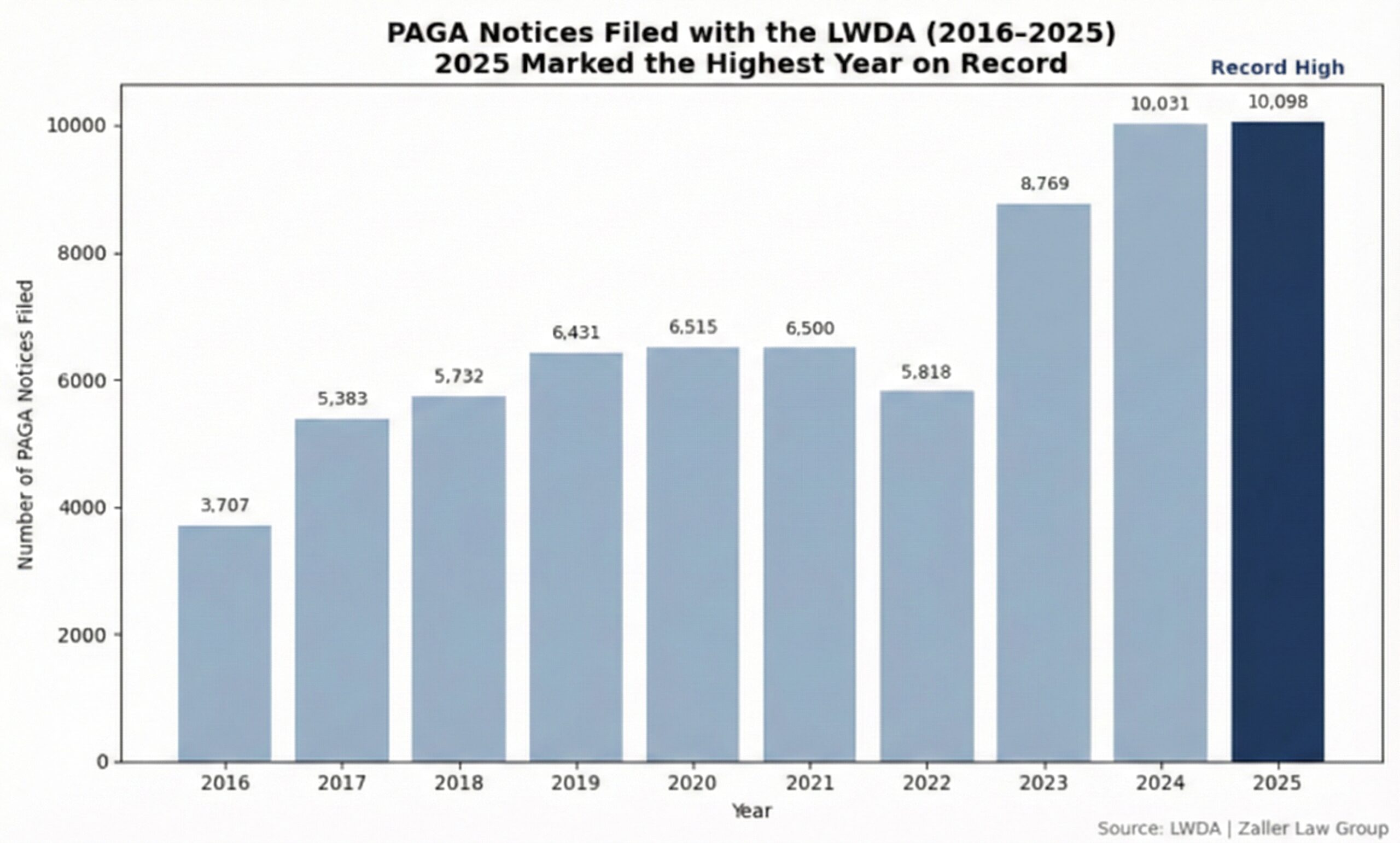
As California employers enter 2026, one thing is clear: PAGA risk is not going away—and it is not plateauing.

The numbers tell the story. Despite the highly publicized 2024 PAGA reforms, 2025 became the largest year yet for PAGA filings. That reality should reset expectations for California employers. Reform did not reduce filings—it changed how employers must defend them.

The new dividing line is no longer simply whether a violation occurred.
It is whether the employer can prove it took “all reasonable steps” to comply.

The 2026 Reality: PAGA Reform Rewards Preparation, Not Intent

The reformed PAGA statute gives employers something they never truly had before: meaningful penalty reduction for demonstrated compliance efforts.

  • Employers that took reasonable steps before receiving a PAGA notice may cap penalties at 15%.
  • Employers that take reasonable steps within 60 days after receiving a notice may cap penalties at 30%.

But these caps are not automatic. Courts evaluate reasonableness under the totality of the circumstances, considering:

  • employer size and resources,
  • the nature, severity, and duration of the alleged violations, and
  • whether systems existed to prevent, detect, and correct issues.

Critically, the statute also recognizes that violations can occur even when reasonable steps are taken. That language matters—but only if employers can prove those steps with evidence.

“Reasonable Steps” Is Not a Checkbox—It’s an Evidence Standard

The statute makes clear that courts must evaluate reasonableness based on the totality of the circumstances, including:

  • the size and resources of the employer,
  • the nature, severity, and duration of the alleged violations, and
  • whether the employer made good-faith efforts to comply.

Importantly, the law also states that the mere existence of a violation does not mean the employer failed to take reasonable steps. That language is critical. It recognizes that even compliant employers can experience errors—and shifts the focus to whether the employer had systems in place to prevent, detect, and correct problems.

What “Reasonable Steps” Must Look Like in 2026

As we start 2026, employers should think of reasonable steps as an operating system, not a compliance memo. Below is what that system should include.

1. Conduct Periodic Payroll and Wage-Hour Audits—and Act on the Results

Audits alone are not enough. What matters is what the employer does after issues are identified.

Strong examples include:

  • Regular wage-hour audits focused on high-risk areas such as meal and rest periods, off-the-clock work, time rounding, regular rate calculations, premiums, and expense reimbursements.
  • Exception reporting that flags patterns (missed meals, late meal breaks, frequent time edits) before they become systemic.
  • A documented remediation process showing when issues were found, how they were corrected, and how recurrence was prevented.

From a PAGA perspective, an audit without documented corrective action is weak evidence. An audit paired with a remediation trail is powerful.

2. Maintain Lawful, Up-to-Date Written Policies—and Actually Use Them

Written policies matter, but only if they are current, distributed, and aligned with how the business operates.

Reasonable steps include:

  • Wage-hour policies that clearly address timekeeping, meal and rest periods, premium pay, time edits, off-the-clock prohibitions, and reimbursements.
  • Version control showing when policies were updated and why.
  • Proof of dissemination—signed acknowledgments or digital confirmations.
  • Integration of policies into onboarding and manager guidance, not just an employee handbook that sits on a shelf.

Courts and agencies look skeptically at policies that exist on paper but are ignored in practice.

3. Train Supervisors on Wage-Hour Compliance

Many PAGA claims are driven by front-line management behavior, not by payroll or back office managers. Training supervisors is a core component of the reasonable-steps analysis.

Effective training includes:

  • Role-specific instruction for managers who schedule employees, approve time, or make payroll adjustments.
  • Training on meal and rest period timing, time edits, off-the-clock risks, and premium pay.
  • Documentation of attendance, materials used, and follow-up training when issues arise.

Training that is documented and refreshed over time carries significantly more weight than a one-time presentation years earlier.

4. Take Corrective Action When Supervisors Cause Violations

Reasonable steps also require accountability.

When audits, complaints, or data show that supervisors are contributing to violations, employers should be able to show:

  • Coaching and retraining efforts,
  • Escalating discipline where appropriate,
  • Removal or limitation of time-edit authority for repeat offenders, and
  • Compliance metrics built into management performance expectations.

This is often decisive in countering claims that violations are “systemic” or “intentional.”

5. Respond Strategically Within 60 Days of a PAGA Notice

For employers who did not already have these systems in place, the reform still provides an opportunity. Employers who take reasonable steps within 60 days after receiving a PAGA notice may still qualify for a reduced penalty cap.

A disciplined 60-day response typically includes:

  • Immediate preservation and review of records tied to the alleged violations,
  • A focused audit of affected locations, job classifications, and time periods,
  • Prompt correction of payroll or scheduling practices,
  • Targeted policy updates and supervisor retraining, and
  • A clean documentation package showing what changed and when.

This window is short—and preparation before a notice is received dramatically improves outcomes.

The Takeaway for California Employers

The 2024 PAGA reforms reward employers who invest in process, documentation, and accountability. The question is no longer simply whether a violation occurred. It is whether the employer can show it acted reasonably before and after issues arose.

Employers who build their compliance systems now will be in a far stronger position when—not if—a PAGA notice arrives.

At Zaller Law Group, we help California employers build and document PAGA-ready compliance systems designed to meet the “reasonable steps” standard. If you want to reduce PAGA exposure and take advantage of the new penalty caps, now is the time to act.

After more than twenty years defending California employers, I have seen a consistent pattern: even companies with sophisticated systems struggle with one of the most fundamental compliance obligations in California employment law—maintaining, accessing, and analyzing employee time records. These challenges are not merely operational inconveniences. They routinely lead to unnecessary legal exposure, inflated PAGA penalties, and missed opportunities to extract meaningful business insights. Scaled Comp was built to solve these exact problems.

Here are the five reasons I founded Scaled Comp:

1. Employers were struggling just to keep and store basic time records.
California law requires employers to maintain accurate employee time and payroll records, yet many organizations still rely on systems that scatter data across PDFs, screenshots, or outdated exports. Time records were difficult to store in an organized manner, hard to preserve over time, and even harder to retrieve years later—particularly when litigation arose. What should have been a basic compliance function was becoming a persistent liability.

2. Accessing time records during litigation or audits was far more difficult than it should be.
When a claim was filed, employers were often scrambling: Where are the records? Are they complete? Are they readable? Too often, the answer was no. I watched clients spend weeks hunting down files, reconstructing data, and manually preparing materials just to respond to a lawsuit or a PAGA notice. This was especially true when employers had changed payroll providers; obtaining historical time data from former providers was often difficult, if not impossible. The result was increased risk, higher legal fees, and unnecessary stress.

3. Even when records were available, they were nearly impossible to analyze at scale.
Time records are one of the most critical data sets an employer possesses, yet most companies cannot run even a basic compliance-rate analysis without significant manual effort. Determining whether employees took compliant meal or rest breaks, identifying missed premiums, or estimating potential exposure often required hours of spreadsheet work and hand-coding. The lack of clean, structured data prevented employers from proactively managing risk—and in litigation, it slowed defense strategies and drove up costs.

4. Clean, analyzable time records are essential to reducing PAGA penalties—and unlocking operational insights.
Under California’s 2024 PAGA reforms, employers that can demonstrate reasonable and consistent efforts to comply with wage-and-hour obligations may reduce penalties to as low as 15 percent. But compliance cannot be proven without reliable, well-organized time data. Centralizing and structuring time records allows employers to demonstrate good-faith compliance, quantify true exposure, and negotiate from a position of strength.
Beyond compliance, structured time data reveals valuable operational insights, including manager performance trends, scheduling efficiency, productivity patterns, and workforce behaviors that would otherwise remain hidden.

5. With AI-ready time data, employers can finally use information strategically—not just defensively.
Once time and payroll data is standardized and loaded into an AI-driven platform, employers can begin asking more sophisticated questions:

  • Can we predict labor needs weeks in advance?
  • What happens to labor costs under different scheduling scenarios?
  • Can we identify early indicators of compliance risk before claims arise?
  • What insights exist that we have not yet considered?

This is the future of workforce management—moving from reactive to predictive, from manual cleanup to automated intelligence, and from fragmented systems to accessible, actionable data.

Scaled Comp was founded to address a problem I encountered daily: employers already had the data they needed to protect themselves and improve operations, but that data was locked in formats that made it difficult—or impossible—to use. By transforming time records into clean, structured, AI-ready data, employers gain a powerful compliance tool, a litigation shield, and a new source of operational insight.

We have been working with a select group of clients and recently completed our beta phase. The feedback has been extremely positive. In addition, the platform has enabled my legal team to analyze client records more quickly, efficiently, and comprehensively—resulting in stronger assessments of legal defenses and litigation strategy.

If you would like help evaluating whether your current timekeeping data is litigation-ready or AI-ready, visit Scaled Comp’s website or I am always happy to discuss, you can sign up for a call here.

As we move toward 2026, California employers—especially in hospitality—are navigating one of the most complex wage-and-hour landscapes in the country. The 2024 PAGA reform brought meaningful relief, but only for employers who take their compliance obligations seriously and can prove it.

At the same time, technology and AI are beginning to transform what compliance looks like. Our firm has been developing an AI-powered compliance platform designed specifically for California wage-and-hour rules, and early feedback from the first companies using it has been extremely positive. More on that below.

For now, here are the five compliance priorities every employer should be focused on as we head into the new year:

1. PAGA Reform Only Helps Employers Who Can Prove Compliance

The 2024 PAGA reform allows employers to dramatically reduce potential penalties—down to 15% of what plaintiffs could otherwise seek. But this benefit is not automatic.

To qualify, employers must show they took meaningful “reasonable steps,” including:

  • Regular payroll and timekeeping audits
  • Updated policies and employee handbooks
  • Supervisor training
  • Prompt corrective action

Documentation is now everything.
If it’s not documented, it didn’t happen.

2. PAGA Filings Are Still at Record Levels

Many assumed PAGA lawsuits would drop after the reform. They didn’t.

In fact:

  • 2024 saw the highest number of PAGA filings in history
  • 2025 is tracking at nearly identical levels
  • A handful of plaintiff firms now file over 25% of all PAGA cases statewide

High-volume plaintiff firms are moving quickly, and state enforcement remains aggressive.
Reform changed the rules—but it did not reduce the risk.

3. Routine Payroll & Timekeeping Audits Are Your Strongest Protection

Meal and rest periods, accurate timekeeping, paystub formatting, overtime calculations, split-shift rules, and off-the-clock issues continue to drive the majority of wage-and-hour claims.

The best defense entering 2026 is a recurring audit process, ideally quarterly. These audits should review:

  • Meal and rest break compliance
  • Paystub formatting (Labor Code § 226)
  • Overtime and double-time calculations
  • Local and state minimum wage updates
  • Timecard edits, patterns, and approvals

When a PAGA notice arrives proving compliance will be critical.

If you don’t have that documentation, you lose access to the 15% penalty cap.

We’ve created a simple model employers can use to set up their own audit process—a 5-step, 30-minute payroll audit. Download it here.

4. Supervisor Training Is Now Essential—Not Optional

To qualify for reduced PAGA penalties, employers must show that supervisors were trained on wage-and-hour compliance.

Effective training must cover:

  • Scheduling legally compliant meal and rest periods
  • How to handle late, short, or missed breaks
  • Preventing off-the-clock work
  • Overtime rules
  • Documentation and communication requirements

Employers should maintain records of:

  • Attendance
  • Training length
  • Topics covered
  • Learning management system completions or signed acknowledgments

A well-trained supervisor can prevent more violations than any policy manual.

5. AI Will Transform Compliance in 2026—and We’re Building the Tools

One of the most important developments heading into 2026 is the arrival of AI-driven wage-and-hour compliance software.

Our firm has partnered with a developer to build a platform specifically for California employers that can:

  • Analyze thousands of time records in minutes
  • Detect missed, short, or late breaks
  • Identify missing premiums
  • Flag potential violations or patterns
  • Run automated payroll audits
  • Produce summaries employers can use as evidence of “reasonable steps”

Several employers are already using early versions of the software, and the feedback has been extremely encouraging. Many report that it provides compliance visibility they could never realistically achieve on their own.

If you’d like to join the waitlist for early access, sign up here.

Final Thoughts for 2026

California’s regulatory environment isn’t getting simpler—but employers have more tools than ever to protect themselves. Heading into 2026, success depends on:

  • Staying current on wage-and-hour requirements
  • Building consistent systems—not one-off fixes
  • Documenting every compliance effort
  • Training supervisors thoroughly
  • Leveraging technology and AI to stay ahead of violations

If you’d like help conducting a privileged wage-and-hour audit, strengthening your compliance systems, or training your managers before the new year, my team and I are here to support you.