
It has been a week now since the California Supreme Court issued its decision in Brinker Restaurant Corp. v. Superior Court. I’ve been getting a lot of questions, and have spoken on the topic a few times, and thought a couple of charts illustrating the Court’s holding would assist in understanding the decision. For a more general discussion of the Brinker decision, please see my previous article.

Meal Periods

The California Supreme Court made clear in Brinker that employers need to give an employee their first meal break “no later than the end of an employee’s fifth hour of work, and a second meal period no later than the end of an employee’s 10th hour of work.” The Court said that contrary to Plaintiff’s argument, there are no additional timing requirements for the meal breaks.

I’ve created this chart to help illustrate this point:
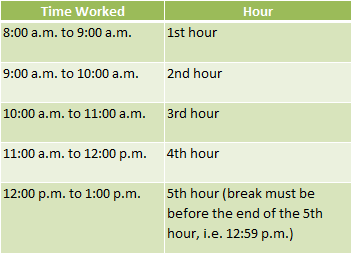
 

If an employee begins work at 8:00 a.m., the employee must start his break by 12:59, which is before the end of the 5th hour of work.

Another issue in the case was Brinker’s policy of “early lunching.” Early lunching is when employers allow the employees to take their meal break within the first hour or two of arriving for work. Once the employee is given this first meal period, then they would continue to work for six, seven, eight, or more hours without an additional meal break. The Court rejected Plaintiff’s argument that this policy violated the law. The Plaintiff argued that the law required employers had a duty to provide meal breaks on a “rolling five” hour basis, or every five hours.

Here is a chart that provides an example of an early lunching practice:
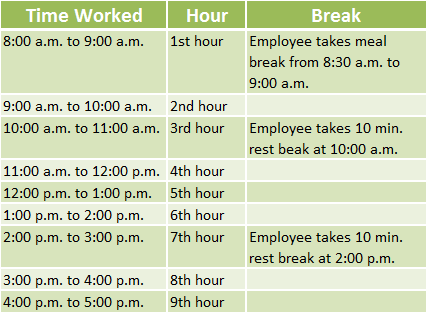
 

Before employers begin to employ an early lunching policy, they should do so with caution and some guidance. As Court cautioned employers that: “in the context of an eight-hour shift, ‘[a]s

a general matter,’ one rest break should fall on either side of the meal break. Shorter or longer shifts and other factors that render such scheduling impracticable may alter this general rule.”

Rest Breaks

As for of rest breaks, the Court set forth that, “[e]mployees are entitled to 10 minutes’ rest for shifts from three and one-half to six hours in length, 20 minutes for shifts of more than six hours up to 10 hours, 30 minutes for shifts of more than 10 hours up to 14 hours, and so on.” The Court’s holding can be summarized as follows:


In regards to when during the shift rest breaks should be taken, the Court held that “the only constraint of timing is that rest breaks must fall in the middle of work periods ‘insofar as practicable.’” The Court stopped short of explaining what qualifies as “insofar as practicable”, and employers should closely analyze whether they may deviate from this general principle.

Brinker Restaurant Corp. v. Superior Court (Hohnbaum) was finally decided by the California Supreme Court. The decision was anxiously awaited by many due to its clarifications of California employment laws regarding the duties employers have regarding offering meal and rest breaks, and when the breaks need to be taken.  The primary holding of the case is that employers do not need to ensure that no work is performed during meal breaks.  The Court, however, cautioned employers that they cannot undermine formal policies by pressuring employees to work during breaks.  Also of interest, as explained below, the Court provided a clarification of the rate that employees accrue rest breaks, which varies from how most employers interpreted the rest break requirement.

Meal Periods
Employers Have No Duty To Ensure Meal Breaks Are Taken

The Plaintiff in the case argued that Brinker had to “ensure that work stops for a the required thirty minute[]” meal period. Alternatively, Brinker argued that under California law employers only had to provide meal periods and would not incur any liability if the employee did not take the break. The Court explained:

[Plaintiff] Hohnbaum contends an employer is obligated to “ensure that work stops for the required thirty minutes.” Brinker, in a position adopted by the Court of Appeal, contends an employer is obligated only to “make available” meal periods, with no responsibility for whether they are taken. We conclude that under Wage Order No. 5 and Labor Code section 512, subdivision (a), an employer must relieve the employee of all duty for the designated period, but need not ensure that the employee does no work.

The Court clarified that employers do not need to ensure that employees do not perform any work during their break:

The difficulty with the view that an employer must ensure no work is done—i.e., prohibit work—is that it lacks any textual basis in the wage order or statute. While at one time the IWC’s wage orders contained language clearly imposing on employers a duty to prevent their employees from working during meal periods, we have found no order in the last half-century continuing that obligation. Indeed, the obligation to ensure employees do no work may in some instances be inconsistent with the fundamental employer obligations associated with a meal break: to relieve the employee of all duty and relinquish any employer control over the employee and how he or she spends the time.

The Court also provided further clarification as to what meal period obligations employers have:

[T]he wage order’s meal period requirement is satisfied if the employee (1) has at least 30 minutes uninterrupted, (2) is free to leave the premises, and (3) is relieved of all duty for the entire period.

Therefore, the Court held:

To summarize: An employer’s duty with respect to meal breaks under both section 512, subdivision (a) and Wage Order No. 5 is an obligation to provide a meal period to its employees. The employer satisfies this obligation if it relieves its employees of all duty, relinquishes control over their activities and permits them a reasonable opportunity to take an uninterrupted 30-minute break, and does not impede or discourage them from doing so. What will suffice may vary from industry to industry, and we cannot in the context of this class certification proceeding delineate the full range of approaches that in each instance might be sufficient to satisfy the law.
On the other hand, the employer is not obligated to police meal breaks and ensure no work thereafter is performed. Bona fide relief from duty and the relinquishing of control satisfies the employer’s obligations, and work by a relieved employee during a meal break does not thereby place the employer in violation of its obligations and create liability for premium pay under Wage Order No. 5, subdivision 11(B) and Labor Code section 226.7, subdivision (b).

However, the Court also provided a warning to employers that, “On the other hand, an employer may not undermine a formal policy of providing meal breaks by pressuring employees to perform their duties in ways that omit breaks.”

Meal Period Timing Requirements

The Court also clarified when meal periods must be provided. The Court rejected Plaintiff’s argument that Brinker’s policy of “early lunching” violated the Labor Code. Early lunching is which is when employers allow employees to take their meal break within the first hour or two of arriving to work, and then have the employees continue to work to the end of their shift without taking another meal period. The Plaintiff argued that the Labor Code requires that employees take a meal period every five consecutive hours of work. In rejecting the Plaintiff’s argument, the Court stated:

Hohnbaum contends section 512 should be read as requiring as well a second meal period no later than five hours after the end of a first meal period if a shift is to continue. The text does not permit such a reading.

The Court explained the timing requirements of meal periods as follows:

We conclude that, absent waiver, section 512 requires a first meal period no later than the end of an employee’s fifth hour of work, and a second meal period no later than the end of an employee’s 10th hour of work.


Rest Periods
Rate Rest Periods Accrue To Employees

The Court began its explanation of the rate at which rest breaks must be given to employees by examining Wage Order No. 5. The Court focused in on subdivision 12(A) of the wage order, which provides:

Every employer shall authorize and permit all employees to take rest periods, which insofar as practicable shall be in the middle of each work period. The authorized rest period time shall be based on the total hours worked daily at the rate of ten (10) minutes net rest time per four (4) hours or major fraction thereof. However, a rest period need not be authorized for employees whose total daily work time is less than three and one-half (3½) hours.

The Court explained that “major fraction thereof” as applied to the four hour period referenced in the Wage Order means “any amount of time in excess of two hours – i.e., any fraction greater than half.” Therefore, by applying this calculation under the wage order, the Court held:

Employees are entitled to 10 minutes’ rest for shifts from three and one-half to six hours in length, 20 minutes for shifts of more than six hours up to 10 hours, 30 minutes for shifts of more than 10 hours up to 14 hours, and so on.

Timing Of Rest Breaks

The Court disagreed with the Plaintiff’s argument that rest breaks had to occur before meal breaks under the law. The Court held that the only “constraint on timing is that rest breaks must fall in the middle of work periods ‘insofar as practicable.’” The Court explained:

Hohnbaum asserts employers have a legal duty to permit their employees a rest period before any meal period. Construing the plain language of the operative wage order, we find no such requirement and agree with the Court of Appeal, which likewise rejected this contention.


Either the rest period must fall before the meal period or it must fall after. Neither text nor logic dictates an order for these, nor does anything in the policies underlying the wage and hour laws compel the conclusion that a rest break at the two-hour mark and a meal break at the four-hour mark of such a shift is lawful, while the reverse, a meal break at the two-hour mark and a rest break at the four-hour mark, is per se illegal.


The entire decision can be read here.

The California Supreme Court announced today that the opinion in Brinker v. Superior Court (Hohnbaum) will be published tomorrow at 10:00 a.m. The opinion will address many issues surrounding meal and rest break requirements under the California Labor Code, such as whether employers need to ensure or simply provide meal breaks, and when breaks should be taken during a shift.

For more information on the decision we will be holding a webinar next Wednesday at 10:00 a.m. PST. Registration information is here.

There has been a lot of debate and legal action about the NLRB’s new posting requirements. However, as it now appears, most employers (union and non-union) will be required to post a new NLRB poster by April 30, 2012.

For more information about the new poster, visit the NLRB’s website here. Of particular importance is to determine if your company is required to post the poster, and that information can be found here.  Employers can simply print the poster from the NLRB’s website. 

There has been a lot of discussion about the legality of this new posting requirement, but I generally agree with Daniel Schwartz of the Connecticut Employment Law Blog that this poster is just another one to put on the wall. Daniel points out that employees are probably more likely to Google some question before they go to the lunch room wall full of notice requirements. Will it really change things much? Probably not given that employees can access all of this information, and more on their smart phone.

Be among the first in California to understand the complete impact the monumental decision in Brinker v. Superior Court will have on employers. The Court’s decision is expected on April 12, and Anthony Zaller and Daniel Turner will analyze and discuss the impact of the decision. The webinar will explain the decision and what it means for employers and wage and hour class actions, discussing among other items:

  • Can meal periods be offered to employees, or do they need to be ensured?
  • When during the shift can meal and rest periods be taken?
  • What does the Court’s ruling mean for the status of meal and rest break class actions and class certification issues?
  • What is the impact for cases currently being litigated?

The cost is $150 per connection. 

Date: Wednesday, April 18
Time: 10:00 a.m. PST

Click here to register.  Existing clients can email us here to have the fee waived. 

The recent (and not too recent) flurry of attention that has been given to the issue regarding whether employers can ask applicants and employees for their Facebook passwords is a good review of what is appropriate conduct for employers, but it is also a good reminder to employees that what they do online is of critical importance to their employment. Asking employees for passwords to social media account may cross the line. But how about Googling an applicant’s or employee’s name to find out more about them? This is not even an issue – or should not be one – given that this information is open to the public. I’ve even argued in the past that it could be negligent for an employer not to do this basic background internet check.

The Internet affords employers the ability to see beyond a resume to make better informed hiring decisions. If fact, Dorie Clark of the HBR Blog Network makes the point that everyone’s online presence is critically important to their professional careers. Dorie notes:

Sure, they probably have a Facebook account, and they may even be on Twitter. But they don’t recognize that these are no longer personal communication tools, or a means of strengthening weak ties across their networks. Instead, they are the criteria by which you will be evaluated in the future. Just as Michael Deaver ensured that Ronald Reagan always stood in front of a perfect, picturesque backdrop — and set the standard for all subsequent leaders — you’re now responsible for curating your image.

Dorie makes the observations that with the Internet: (1) your reputation always precedes you, (2) if you’re invisible online, you’re probably a fraud, (3) you progress or you stagnate (i.e., you create a valuable source of content through your twitter feed, blogging, etc…).

My interview with Guy Kawasaki last year discussed many of the same points. Guy noted that if you don’t have a Facebook page, or any other online presence, it will raise some questions about you. Are you not technical enough to get onto social media platforms? Are you hiding something?

I would love to be able to tell my clients that the Internet and social media has created a very complex set of legal issues that requires them to hire me in order to help develop all new handbook policies, change the way they conduct background checks on applicants, and monitor their employees. However, unfortunately, this is not the case. Employers and employees need to calm down a bit. I cringe when I hear employment lawyers (and Facebook’s Chief Privacy Officer recent comments about employers asking to have employee’s Facebook passwords) advising people to refrain from using the Internet to do background checks on applicants because it may reveal that they are in a protected category, and then this could (possibly) be grounds for a discrimination case. Are these same lawyers advising their clients not to conduct interviews because during a face to face interview the employer will learn the same information? And just because the employer knows that an applicant or employee is in a protect class does not mean that discrimination occurred if it takes an adverse employment action against the applicant or employee. Sure, all employers are subject to frivolous legal actions. But, as I tell my clients, there are only two things my clients and I can control: (1) the advice I give them about how to act according to the law, and (2) whether my clients listen to my advice and act accordingly. The one thing we cannot control, no matter how hard we wish we could, is being able to stop people from filing a baseless lawsuit.

We’ve had the Internet since the 1970’s, and it became mainstream in the 1990’s. I would argue that most people (at least in the U.S.) have had experience on the Internet for at least a decade now. There has not been a lot of case law that has changed the way employment lawyers advise their clients on new human resources policies given the advent of the Internet and social media.

Have the courts simply not caught up with these "new" developments?

As typical lawyers always suggests at this point – courts are slow to deal with emerging technology issues, but I don’t think that is a play here. Courts are slow, but we’ve been actively using the Internet for a decade now. They are not that slow, and I think rather that the rules that were already in place and governed employer’s and employee’s activities were and still are sufficient in addressing the vast majority of the employment issues involving the Internet and social media. Sure, on the fringes there are a few technical items that may be the exception to this, but for the vast majority of employers the Internet and social media does not change much about how HR should conduct itself. The basic analysis regarding monitoring and employee’s off work conduct and right to privacy – the issues usually at play in these types of cases – is the same if the conduct at issue was done off the Internet. I would even argue that privacy cases usually are easier when it involves a posting on the Internet, as no one has any reasonable expectation of privacy in such a public disclosure.

What about social media policies?

That usually leads to the next question, “What about social media policies?” Again, most employers probably don’t need a specific social media policy.  And a basic policy (if you really think a social media policy is necessary) that the employer may terminate or discipline an employee for anything they do on the Internet if the employer could terminate or discipline the employee if the conduct at issue did not occur on the Internet would normally be sufficient.

Employers, lawyers, and employees need to take a step back and realize that even though we have these great new technological advances, the law developed before this technology does a pretty good job at resolving these issues in the employment context.

When faced with a hearing before the California Labor Commissioner in a Berman hearing, employers and employees alike expect to get a fair, consistent hearing to settle wage disputes. However, as Brian Sumers of the Daily Journal points out this is not always the case. His article (subscription required) provides an analysis of the inconsistencies that arise in holdings of cases heard by the Labor Commissioner’s office. It found that on average the deputy labor commissioners favor employees in about 80% of the cases they hear. In addition, the article analyzes how often specific deputy labor commissioners rule for employers or employees, and notes that the outcome varies drastically on the office and the deputy labor commissioner hearing the case. I’m quoted in the article as saying my experience has been consistent with this statistical analysis. The Labor Commissioner’s office states that it is focusing on additional training for the deputy labor commissioners to ensure a consistent enforcement of the wage laws.

Employers facing labor commissioner hearings need to ensure they are well prepared for the Berman hearings. Even though the same rules of evidence do not apply in Berman hearings as in civil court, the hearings are recorded and the parties testify under oath. Therefore, even if the deputy labor commissioner’s findings are against the employer, it is important to develop a record at this stage of litigation in order to establish the positions on appeal before a judge in superior court. For more information about hearings before the Labor Commissioner and how to prepare for them, see my previous posts here and here.
 

There are more reports of employers requiring applicants and employees to provide their passwords to their Facebook pages so that the employers can get a more accurate view of the employee’s character. I wrote about this issue a couple of years ago regarding the City of Bozeman requiring passwords from applicants. Apart from being a bad recruiting move, I believe it could arguably run afoul of California law as well.

Legality aside, employers that require this information will simply not get qualified applicants. I expect that most applicants or employees would simply refuse to provide this information. In addition, only people that don’t use social media much would have no problems with turning over their passwords. But companies need employees who understand social media these days, not someone who lacks initiative and some basic curiosity to at least log on to Facebook to see what the rest of the world is talking about.

In addition, there may be some real challenges against employers in California who require this information. First off, in California, Article I, Section I of the California Constitution guarantees citizens a right of privacy:

All people are by nature free and independent and have inalienable rights. Among these are enjoying and defending life and liberty, acquiring, possessing, and protecting property, and pursuing and obtaining safety, happiness, and privacy.

This right to privacy carries over to the workplace, but is even more protected when the employee is conducting personal activities during non-working hours. A person’s privacy expectation in their Facebook posts is very low since it is on the Internet. But one could argue that off-work conduct (which includes Facebook activity) is part of the employee’s privacy right recognized in the California Constitution.

Furthermore, section 96(k) of the Labor Code provides that the California Labor Commissioner may assert on behalf of employees:

Claims for loss of wages as the result of demotion, suspension, or discharge from employment for lawful conduct occurring during nonworking hours away from the employer’s premises.

For example, in Barbee v. Household Automotive Finance Corp. (2003), a court provided some guidance about the ramifications of section 96(k). Barbee was dating a subordinate at work, which violated the company’s policy and created a conflict of interest. The company gave Barbee and the employee with whom he was involved the option that one of them had to resign or to end the relationship. Barbee refused to resign, and they did not end the relationship, so the company terminated Barbee. Barbee sued, arguing that the company violated Labor Code section 96(k) in that his employer was regulating his lawful conduct during personal time. The court rejected Barbee’s argument in stating:

We conclude that Labor Code section 96, subdivision (k) does not set forth an independent public policy that provides employees with any substantive rights, but, rather, merely establishes a procedure by which the Labor Commissioner may assert, on behalf of employees, recognized constitutional rights. Therefore, in order to prevail on his wrongful termination claim, Barbee must establish that his employment was terminated because he asserted civil rights guaranteed by
article I of the California Constitution. We conclude that Barbee cannot make this showing and therefore he cannot establish the first necessary element of his wrongful termination claim.

While the court held that the company’s actions in that case did not violate section 96(k), the facts were very favorable to the employer, and there are other arguments available to employees. For example, an employee may also argue violation of Labor Code Section 98.6 which states in part that “no person shall discharge any employee … because the employee … engaged in any conduct delineated in this chapter, including the conduct described in subdivision (k) of Section 96 ….”
Unfortunately, there are not many reported cases dealing with these issues. However, with the ubiquity of Facebook and other social medial sites, legislatures and courts will undoubtedly need to weight into these issues.

The National Labor Relations Board (NLRB) recently held in D.R. Horton, 357 NLRB No. 184, that a class action waiver in an arbitration agreement was unenforceable as it violates employees’ rights under the National Labor Relations Act (NLRA). Specifically, it held that employees have “the right ‘to engage in…concerted activities for the purpose of collective bargaining or other mutual aid or protection…” under section 7 of the NLRA and therefore any waiver to participate in class actions violates this right.

However, since the D.R. Horton decision courts have upheld class action waivers in the employment context and have rejected the NLRB’s reasoning in D.R. Horton as inconsistent with the United States Supreme Court’s holding in AT&T Mobility v. Concepcion, which permitted class action waivers in arbitration agreements. For example, in LaVoice v. UBS Financial Services, Inc. (S.D.N.Y.), the plaintiff brought a putative class action alleging various wage and hour violations of the Fair Labor Standards Act and New York labor laws. In rejecting the reasoning of D.R. Horton, the court held that:

Given that the Supreme Court held in AT&T Mobility that ‘[r]equiring the availability of classwide arbitration interferes with fundamental attributes of arbitration and thus creates a scheme inconsistent with the FAA,’ this Court must read AT&T Mobility as standing against any argument that an absolute right to collective action is consistent with the FAA’s ‘overarching purpose’ of ‘ensur[ing] the enforcement of arbitration agreements according to their terms so as to facilitate streamlined proceedings. To the extent that [plaintiff] relies…on the recent decision of the National Labor Relations Board (‘NLRB’) in D.R. Horton, Inc. and Michael Cuda, Case 12-CA-25764, January 2, 2012, as authority to support a conflicting reading of AT&T Mobility, this Court declines to follow [that] decision[].

As I’ve written about previously, this area of the law is quickly changing. There is no doubt that new decisions this year will continue to add to the development of this area of the law.