This Friday’s Five is a bit of a break from the legal updates and a focus on running a business.  Through my profession of defending employers, I get to see a lot of different businesses and a lot of different types of business owners, CEOs, COOs, and Human Resource directors.   There are common characteristics of managers and companies that are successful.  Here are five that predominately standout:

1. You are scrappy.

Gary Vaynerchuk, the successful businessman and digital marketer, has been ranting over the last few years that people need to stop complaining.  He has reminded people that their success is not dependent on their zip code, but instead on their work ethic:

The thought of people saying, “Well, America is an entrepreneurial paradise,” is the same conversation that’s happening within the US to be great in tech, you need to be in San Francisco, and let me just remind everybody that Facebook was invented in Boston. I myself am from the former Soviet Union.

Let me remind everyone that Microsoft came from very humble beginnings as well.  Their first office was located at 6328 Linn Ave. N.E. Albuquerque, New Mexico.  The picture above is a recent picture of the building where Microsoft started.  This was the office of MITS, Inc., the company that invented the first personal computer, the Altair 8800.  Paul Allen and Bill Gates saw the computer on the cover of Popular Electronics and realized that they had to jump at the opportunity and start writing code for the Altair.  Allen and Gates did not complain that the company was in Albuquerque and the office was in a bad part of town on top of it – they flew to Albuquerque and just started working (I’m not sure how many entrepreneurs would do this today).  Also, don’t think that MITS had the luxurious office where the smoke shop is currently – the company had the three offices in the back of the building.  There is a plaque at the site commemorating the office as the start of Microsoft.

I often times think that the new shared work spaces with lunchtime Yoga, juice machines and networking mixers every night of the week may actually have prevented some entrepreneurs from starting the next Microsoft.  Working in a strip mall in Albuquerque, New Mexico may not be glamorous, but it is distraction free.

2. You don’t stop working.

As I often say to clients in litigation, we cannot control the actions of the opposing party, we can only control what we do.  One of the biggest factors that an entrepreneur, business owner, or HR manager can do to be successful is to keep working.  This by no means will guarantee success, but not working hard will necessarily lead to failure.  Setbacks and failure are inevitable, the only response is to keep working.  This is easy to say, but probably the hardest to execute.

3. You don’t care what others think.

Successful business operators have the ability to disregard what everyone else around them is saying.  They disregard the critics who say their task is impossible, or the market that shows them evidence that multiple businesses like theirs have failed in the past.  The reality is the entrepreneur/business owner did what everyone else is doing, they would not be successful – they would be like everyone else.

4. Yet, you still listen to feedback.

However, while being able to block the critics, successful entrepreneurs/business owners are not operating in a vacuum.  They still value the feedback from a select few people they trust, and use this feedback to change directions if needed.

5. You seek counsel early.

Successful entrepreneurs/business owners also realize what they are not good at, and rely on other expects for this guidance.  To be successful you have to focus on your strengths and avoid getting marred down in the issues that you don’t prefer doing, and most likely are not the best at performing.  Accountants, lawyers and other professionals bring years of experience to the problem and save a lot of time and resources in the long run.

It has been a few years that the California Supreme Court issued its groundbreaking ruling in Brinker Restaurant Group v. Superior Court.  With the end of the year approaching and employers preparing for the new year and the new legal obligations that come with it, now is a good time for employers to audit meal and rest break policies and practices. Regular readers of the blog are familiar with these issues, but it is always a good practice to review these issues at least once a year and audit meal and rest break policies and practices.  This Friday’s Five covers five issues employers should not forget regarding about meal and rest breaks.

1. Timing of breaks.
Meal Breaks
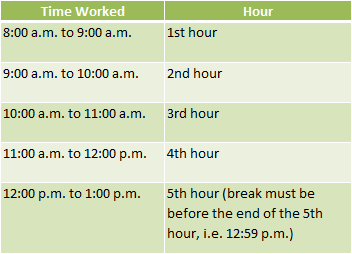
The California Supreme Court made clear in Brinker Restaurant Group v. Superior Court that employers need to give an employee their first meal break “no later than the end of an employee’s fifth hour of work, and a second meal period no later than the end of an employee’s 10th hour of work.” Here is a chart to illustrate the Court’s holding:

Rest Breaks
As for of rest breaks, the Court set forth that, “[e]mployees are entitled to 10 minutes’ rest for shifts from three and one-half to six hours in length, 20 minutes for shifts of more than six hours up to 10 hours, 30 minutes for shifts of more than 10 hours up to 14 hours, and so on.” This rule is set forth in this chart:

In regards to when rest breaks should be taken during the shift, the Court held that “the only constraint of timing is that rest breaks must fall in the middle of work periods ‘insofar as practicable.’” The Court stopped short of explaining what qualifies as “insofar as practicable”, and employers should closely analyze whether they may deviate from this general principle.

2. Rule regarding waiver of breaks.
Meal Breaks
Generally meal breaks can only be waived if the employee works less than six hours in a shift. However, as long as employers effectively allow an employee to take a full 30-minute meal break, the employee can voluntarily choose not to take the break and this would not result in a violation. The Supreme Court explained in Brinker (quoting the DLSE’s brief on the subject):

The employer that refuses to relinquish control over employees during an owed meal period violates the duty to provide the meal period and owes compensation [and premium pay] for hours worked. The employer that relinquishes control but nonetheless knows or has reason to know that the employee is performing work during the meal period, has not violated its meal period obligations [and owes no premium pay], but nonetheless owes regular compensation to its employees for time worked.

Rest Breaks
Rest breaks may also be waived by employees, as long as the employer properly authorizes and permits employees to take the full 10-minute rest break at the appropriate times.

3. Timekeeping requirements of meal breaks.
Meal breaks taken by the employees must be recorded by the employer. However, there is no requirement for employers to record 10-mintute rest breaks.

4. Implementing a procedure for employees to notify the company when they could not take a break.
If employers have the proper policy and practices set up for meal and rest breaks, the primary issue then becomes whether the employer knew or should have known that the employee was not taking the meal or rest breaks. Therefore, many allegations that the employer was not providing the required breaks can be defended on the basis that the employer had an effective complaint procedure in place to inform the employer of any potential violation, but failed to inform the employer of these violations.

5. Implementing a policy of paying employees for missed breaks and recording these payments.
Employers should show that in addition to the complaint procedure mentioned above, that the company has a system in place to correct any violations. If during an investigation, the employer confirms that the employee in fact missed the break because of the rush of business or some other factor, the company should pay the employee the one hour “premium pay” penalty at the employee’s regular rate of pay. Also, the company should record these payments made to employees in case it needs to prove later on that it has an effective remedial process in place to address missed breaks.

California employers cannot forget about detailed employment provisions such as reporting time pay.  Given the natural disasters facing California recently, I was interviewed on public radio about employer’s obligations during times of emergencies and natural disasters.  So I thought this Friday’s Five would be a good reminder about when employers need to pay reporting time pay to employees:

1. What is reporting time pay?

California law requires an employer to pay “reporting time pay” under the applicable Wage Order.  This requires that when an employee is required to report for work and does report, but is not put to work or is furnished less than half of the employee’s usual or scheduled day’s work, the employee shall be paid for half the usual or scheduled day’s work, but in no event for less than two (2) hours nor more than four (4) hours, at the employee’s regular rate of pay, which cannot not be less than the minimum wage.

In addition, if an employee is required to report to work a second time in any one workday and is furnished less than two hours of work on the second reporting, he or she must be paid for two hours at his or her regular rate of pay.

California’s Labor Commissioner provides the following example:

For example, if an employee is scheduled to report to work for an eight-hour shift and only works for one hour, the employer is nonetheless obligated to pay the employee four hours of pay at his or her regular rate of pay (one for the hour worked, and three as reporting time pay). Only the one-hour actually worked, however, counts as actual hours worked.

Employers must remember, when an employee is scheduled to work, the minimum two-hour pay requirement applies only if the employee is furnished work for less than half the scheduled time.

2. Time paid as reporting time pay does not trigger overtime pay.

Reporting time pay for hours in excess of the actual hours worked is not counted as hours worked for purposes of determining overtime.

3. Reporting time pay and meetings.

There has been significant litigation over reporting time pay that is owed when employees are called in for meetings.  If an employee is called in on a day in which he is not scheduled, the employee is entitled to at least two hours of pay, and potentially up to four hours if the employee normally works 8 hours or more per day. See Price v. Starbucks.

However, if the employer schedules the employee to come into work for two hours or less, and the employee works at least one half of the scheduled shift, the employer is only required to pay for the actual time worked and no reporting time is owed.  See my prior post on Aleman v. AirTouch for a more detailed discussion.

4. Exceptions to the reporting time requirements – “Acts of God”.

The Wage Orders provide that employers are not required to pay overtime pay during the following circumstances:

  1. When operations cannot begin or continue due to threats to employees or property, or when civil authorities recommend that work not begin or continue; or
  2. When public utilities fail to supply electricity, water, or gas, or there is a failure in the public utilities, or sewer system; or
  3. When the interruption of work is caused by an Act of God or other cause not within the employer’s control, for example, an earthquake.

5. What if the employee voluntarily leaves early?

Employers are not required to pay reporting time pay if the employee voluntarily leaves work early.  For example, if the employee becomes sick or must attend to personal issues outside of work and leaves early, then the employer is not obligated to pay reporting time pay (however, this may trigger paid sick leave or other legal obligations for the employer).

AB 168 was approved by Governor Brown on October 12, 2017 which prohibits employers from seeking or taking into consideration an applicant’s prior compensation and benefits when determining whether to hire the applicant, and in setting the applicant’s compensation and benefits.  The new law creates Labor Code section 432.3.  This Friday’s Five covers five issues of the new law that employers must understand:

  1. The law applies to all employers, regardless of size, effective January 1, 2018.
  2. Employers may not rely on salary history information of an applicant in determining whether to offer employment and in determining the about of compensation to offer.
  3. Employers may not seek salary history information, which includes compensation and benefits, about the applicant.
  4. Upon a reasonable request, an employer must provide the “pay scale” for the position to an applicant.
  5. Nothing in the law prohibits employees from voluntarily disclosing salary history to a prospective employer.

Employers should start taking steps to comply with the new law by the beginning of the new year to ensure compliance.  Some steps to consider include:

  • Train hiring managers about new law and that they are not to seek information from applicants regarding prior salary and benefits history.
  • Remove any requests or questions about salaries at prior employment on applications or other documents provided to candidates.
  • Prepare a set “pay scale” for the positions the employer is hiring for. The law does not set forth what information must be included on the pay scale.  In addition, the law does not explicitly require that this information must be provided in writing to the applicant.  However, employers should consider whether the pay scale should be done in writing in case there is a dispute about whether the pay scale was provided to the applicant and what information was conveyed to the applicant.

In addition to the “sanctuary state” legislation signed into law by Governor Brown yesterday, the Governor also signed AB 450 into law.  The law is effective January 1, 2018, and requires, among other items, employers to verify that immigration officials have a judicial warrant or subpoena prior to entering the workplace and for employers to provide notice to employees if there has been a request to review the employer’s immigration documents, such as Form I-9s.  The new law puts employers in a difficult situation of having to comply with federal immigration law obligations on one hand and state law requirements on the other, with large penalties that could result for violations of either law.  This Friday’s Five discusses five key aspects California employers must understand about the new obligations created by AB 450.

1. Employers may not voluntary consent to an immigration enforcement agent to enter any nonpublic areas of “a place of labor” without a subpoena or judicial warrant.

The new law provides that employers cannot provide voluntary consent to an immigration enforcement agent to “access, review, or obtain the employer’s employee records without a subpoena or judicial warrant.”  This prohibition does not apply to I-9 Employment Eligibility Verification form and “other documents for which a Notice of Inspection has been provided to the employer.”

2. Employers must give notice to employees of any immigration review of employment records.

Employers are required to post information about any inspections of I-9 Employment Eligibility Verification forms or other employment records conducted by an immigration agency within 72 hours of receiving notice of the inspection.  The notice must be posted in the language the employer normally uses to communicate employment-related information to the employee.  In addition, the notice must include the following information:

(A) The name of the immigration agency conducting the inspections of I-9 Employment Eligibility Verification forms or other employment records.

(B) The date that the employer received notice of the inspection.

(C) The nature of the inspection to the extent known.

(D) A copy of the Notice of Inspection of I-9 Employment Eligibility Verification forms for the inspection to be conducted.

The Labor Commissioner is required to publish a template for employers to use by July 1, 2018.

3. An employer, upon reasonable request, shall provide an “affected employee” a copy of the Notice of Inspection of I-9 Employment Eligibility Verification forms.

An “affected employee” is an employee identified by the immigration agency inspection results to be “an employee who may lack work authorization, or an employee whose work authorization documents have been identified by the immigration agency inspection to have deficiencies.”

The employer is required to provide the affected employee a copy of the written immigration agency notice that provides the results inspection within 72 hours of after receipt of the notice. In addition, the employer shall also provide written notice of the obligations of the employer and the affected employee arising from the results of the records investigation.  The notice needs to relate to the affected employee only and shall be delivered by hand at the workplace if possible and, if hand delivery is not possible, by mail and email, if the email address of the employee is known.

4. Except as otherwise required by federal law, employers cannot reverify the employment eligibility of a current employee at a time or in a manner not required by federal law

Violations of this provision can result in civil penalties up to $10,000.

5. Potential penalties.

Penalties for failure to provide the notices required under the new law are $2,000 up to $5,000 for a first violation and $5,000 up to $10,000 for each subsequent violation.  The penalties will be recovered by the Labor Commissioner.


Happy Friday.  Through my defense of wage claims this year, I found that employers need to establish and periodically review issues pertaining to employees’ timekeeping.  This Friday’s Five is a list of the top five timekeeping issues that employers should routinely audit:

1. Establish and communicate a time keeping policy

Employers should establish and regularly communicate a time keeping policy to employees.  The policy should set forth that employees always have an open door to complain to their supervisors and other managers or human resources about missed meal and rest breaks, unpaid wages, or unpaid overtime.  If employees routinely acknowledge that they understand the time keeping policy and are agreeing to record their time through the employer’s system, this can go a long way in defending any off-the-clock claims.

2. Rounding

Employers need to review whether their time keeping system or payroll company is rounding employees’ time.  While rounding can be legal under California law, employers must still meet certain requirements to have a compliant rounding practice.  In See’s Candy Shops Inc. v. Superior Court, a California court held that the employer’s rounding policy that rounded both up and down from the midpoint of every six minutes was permitted under California law.  The employers’ policy did not result in a loss to the employees overtime.  Therefore, the court found it to be lawful.  Employers need to review:

(1) Do they have a rounding policy?

(2) If they do round, is the policy compliant with the law?

(3) Is a rounding policy necessary or is it easier to pay the exact time the employee clocks in and out?

3. De minimis time

Employers need to review if they are compensating employee for all time worked.  The de minimis doctrine may permit employers a defense for claims by employees that they were not compensated for very small amounts of time that are difficult to track.  The de minimis doctrine holds that “alleged working time need not be paid if it is trivially small: ‘[A] few seconds or minutes of work beyond the scheduled working hours … may be disregarded.’” Troester v. Starbucks Corporation (this decision is currently under appellate review).   More information about the de minimis doctrine can be read here.  While this defense may be available to California employers, employers should not rely upon the defense when it is known the employee is working time that is not compensated.

4. Record meal breaks

In addition to recording the start and stop times for employee’s work, employers are required to record when employees take meal breaks.  The Wage Orders require that California employers keep “[t]ime records showing when the employee begins and ends each work period. Meal periods, split shift intervals and total daily hours worked shall also be recorded. Meal periods during which operations cease and authorized rest periods need not be recorded.”  IWC Wage Order 5-2001(7)(a)(3).

5. Time records

Under Labor Code section 1174, employers are required to keep time records showing the hours worked daily and the wages paid, number of piece-rate units earned by and applicable piece rate paid.  These records must be maintained in the state or at the “plants or establishments at which employees are employed.”  The records must be kept for at least three years.  Labor Code section 1174(d).  The statute of limitations for wage claims can extend back to four years, so employers generally keep the records for four years.

This Friday’s Five sets out five resources that are free for California employers that are published by the state of California.  Employers need to understand that while these publications are made available by the state of California, the agencies publishing the resources are only expressing their opinion about the current status of the law, but this is not necessarily binding on employers or the current state of the law.  While it is important to always seek legal counsel, these resources can help employers understand some of the issues that they may face, and they provide a good starting point into researching obligations.  Here are five free resources available for employers published by the state of California:

1. Department of Industrial Relations’ (DIR) information about meal periods

The DIR’s website provides a good overview of meal break obligations, including:

  • When the breaks must be provided
  • On-duty meal breaks and written agreement required for these
  • When meal breaks must be paid
  • Penalties for failure to provide meal breaks

2. DIR’s information about rest periods

The DIR’s website also provides an explanation of the common issues regarding rest breaks, including:

  • timing of rest breaks
  • How much time must be provided for rest breaks
  • The need for employers to provide suitable resting facilities available for employees during working hours in an area separate from the bathrooms

3. California Department of Fair Employment and Housing’s (DFEH) information about sexual harassment in the workplace

The DFEH’s website sets forth parameters of what constitutes sexual harassment under California law.  The website also explains the training requirements for California employers, which employees need to attend sexual harassment training, and how the training must be conducted to comply with California law.

4. Division of Labor Standards Enforcement (DLSE) Enforcement Policies and Interpretations Manual

The DLSE’s Enforcement Policies and Interpretations Manual is very detailed and can be a bit daunting for employers.  However, the manual addresses many potential issues regarding compensation under California law and the DLSE’s opinion on these issues.  It is a great starting point to begin research into more difficult wage and hour issues facing employers.

5. DIR’s information about independent contractor classification

This web page sets out the factors under California law that can be considered when determining if a worker has been properly classified as an independent contractor.  This resource is a great review for any employers who have independent contractors and audit the classification to ensure that the workers’ classification can withstand scrutiny.  Misclassification of workers as independent contractors when they should have been treated as an employee can open employers up to many forms of penalties, including back payroll taxes and tax penalties, unpaid minimum wages, unpaid overtime, missed meal and rest breaks, and unpaid final wages, among other damages.

California’s state legislature is nearing the end of its term, and employers are beginning to glimpse some of the laws that could apply in 2018.  There are multiple proposed bills that prohibits employers’ ability to rely upon or seek information about applicant’s previous wages to set the employee’s pay.  This Friday’s Five reviews the current law – California’s Fair Pay Act, the proposed bills on disclosure of wages, and San Francisco’s local ordinance that recently passed.

1. Current law – California’s Fair Pay Act (Labor Code section 1197.5)

Existing law generally prohibits an employer from paying an employee at wage rates less than the rates paid to employees of the opposite sex in the same establishment for equal work for work performance that requires equal skill, effort, and responsibility that are performed under similar working conditions.  Effective as of January 1, 2017, AB 1676 amended California’s Fair Pay Act, found in Labor Code section 1197.5, prohibiting employers from relying on an employee’s prior salary, by itself, to justify any disparity in compensation.  It is important to note the bill was modified to take out language that would have prohibited employers from obtaining an applicant’s prior salary.

2. Proposed State Bill – AB 1209 – Gender Pay Gap Transparency Act

This bill has been sent to the Governor’s desk during the week of September 11, 2017 to be signed into law or vetoed.  The bill, if signed by the Governor, would require employers with at least 500 employees to calculate the difference between the wages of male and female exempt employees in California by each job classification or title.  The employer would also have to do the same for all board members who are located in California.  The employer would need to report the difference in pay, which would be published on the Internet by the Secretary of State.  Governor Brown has until October 15, 2017 to sign or veto the bill.

3. Proposed State Bill – AB 168 – Salary Information

This bill prohibits employers from replying upon or seeking salary history from applicants.  In addition, employers would be required to provide the pay scale for a position to an applicant.

4. San Francisco local ordinance: Parity in Pay Ordinance

San Francisco passed a local law that prohibits employers from asking job applicants to disclose their salary history.  It also prohibits employers from considering an applicant’s pay history as a factor in determining the level of pay to offer.  The law is effective July 1, 2018, so San Francisco employers have some time to review hiring practices to comply.

5. Proposed State Bill – AB 46 – Wage Discrimination

This bill amends the California Fair Pay Act to make clear that the law applies to both public and private employers.

While the information posted on the Internet on social networking sites is usually public for everyone to see, employers need to be aware of potential claims for using this information in the employment context.  The law, as usual, cannot keep up with the fast-moving technology and change social media sites, so there are many uncertainties in this area.  This Friday’s Five discusses potential pitfalls California employers need to be aware of when conducting background checks.

1. Local City “Ban The Box” Ordinances

Many local cities in California have passed ordinances restricting an employer’s ability to conduct criminal history checks on applicants and employees.  For example, Los Angeles passed the Fair Chance Initiative for Hiring Ordinance that prohibits employers from seeking criminal background information prior to offering a job to applicants.  The law became effective on January 1, 2017, and the city began enforcing the law on July 1, 2017.  Under the ordinance, employers cannot conduct any “direct or indirect” activity to gather criminal history from or about any applicant using any form of communication, including on application forms, interviews or Criminal History Reports.  This includes searching the internet for information pertaining to the applicant’s criminal history.  Employers must be aware of their local ordinances to ensure that any background research on applicants or employees meets the requirements that apply to them.  More information on Los Angeles’ ordinance can be read here.

2. Federal and State Discrimination Claims

Because people are becoming so comfortable in sharing private information on social networking sites, employers may learn too much information about an applicant that would not and could not have been discovered through an interview. Discovery of this personal information is not unlawful – it is likely that the employer would find out many of these traits at the first in-person interview with the applicant anyway. However, employers cannot base its employment decisions upon a protected category, such as race or gender.   By learning about this type of information of an applicant via their on-line profile, the employer may have to explain that the information did not enter into the hiring decision.

3. Invasion of Privacy Claims

Though one might argue that members of social networking sites have no expectation of privacy (since the information is posted publicly) some applicants or employees might argue that the employer overstepped its legal bounds by using profile data in employment decisions. Arguably, the terms of service agreement may create expectation of privacy for users of site.

State Law Privacy Claims
Employees could potentially argue that using Facebook, Snapchat, Instagram, or similar site to conduct background checks violate state statutory law. For example, California and New York have statutes that prohibit employers from interfering with employee’s off-duty private lives. Employees may attempt to argue a public policy violation has occurred in violating a state statute that protects off-duty conduct from employer’s control.

State common law could also create liability. Generally, there are four common law torts for invasion of privacy:

  1. intrusion upon seclusion,
  2. public disclosure of private facts causing injury to one’s reputation,
  3. publicly placing an individual in a false light, and
  4. appropriation of another’s name or likeness for one’s own use or benefit.

As explained by one court, the tort of unreasonable intrusion upon the seclusion of another, “depends upon some type of highly offensive prying into the physical boundaries or affairs of another person. The basis of the tort is not publication or publicity. Rather, the core of this tort is the offensive prying into the private domain of another.” (citing Restatement (Second) of Torts § 652B, comments a, b, at 378-79 (1977)). Generally, the invasion of privacy must consist of (1) highly offensive intrusion (deceitful means to obtain information); and (2) prying into private information (information placed on the web is most likely not private).

4. Fair Credit Reporting Act (“FCRA”)

An employer’s use of social networking sites may implicate the FCRA, which places additional disclosures and authorization requirements on employers. In enacting the FCRA, Congress stated its underlying purpose was to ensure that decisions affecting extension of credit, insurance, and employment, among other things, were based on fair, accurate, and relevant information about consumers. The FCRA is intended to provide employee with notice of the background check, authorization to conduct the check in certain circumstances, and disclosure to the employee if the information is used in the employment context.

FCRA Definitions:

  • A “consumer report” is defined at as information (oral, written, or other communication) provided by a “consumer reporting agency” about credit matters as well as about a person’s “character, general reputation, personal characteristics, or mode of living which is used or expected to be used or collected in whole or in part for the purpose of serving as a factor in establishing the consumer’s eligibility for…employment purposes.”
  • Another kind of “consumer report,” called an “investigative consumer report” contains information on a consumer’s character, general reputation, personal characteristics, or mode of living that is obtained through personal interviews with friends, neighbors, and associates of the consumer.
  • A “consumer reporting agency,” is defined as “any person who regularly engages in whole or in part in the practice of assembling or evaluating consumer credit information or other information on consumers for the purpose of furnishing consumer reports to third parties.”

Employers who conduct the background checks internally do not qualify as a “consumer reporting agency” and therefore the FCRA does not apply. Employers still need to be careful, however, because state law may apply. For example, California Investigative Consumer Reporting Agencies Act is more restrictive than the FCRA.

5. Terms of Service Violations

Social media sites have terms of service posted on their pages that generally prohibit use of their content for “commercial purposes.” Violation of the terms of service would not automatically create a cause of action in and of itself. However, as discussed above, it may be a way for a plaintiff to argue that there is an expectation of privacy in using the site and everyone who signs up to use the site is agreeing to abide by those terms.

I spoke at the Western Foodservice & Hospitality Expo last week regarding marijuana in the workplace and employer’s right to test for and prohibit the use of marijuana.  While employers generally still have the right to test employees for and prohibit marijuana in the workplace, employee’s still have privacy interests that employers need to aware of.  For example, Article I, Section I of the California Constitution guarantees citizens a right of privacy:

All people are by nature free and independent and have inalienable rights. Among these are enjoying and defending life and liberty, acquiring, possessing, and protecting property, and pursuing and obtaining safety, happiness, and privacy.

This right to privacy carries over to the workplace, but is even more protected when the employee is conducting personal activities during non-working hours. On top of this general right to privacy, there are statutory protections provided to employees as well.  Below is a list of items concerning employee conduct that cannot be regulated by an employer under California law:

  1. Employers cannot prohibit employees from discussing or disclosing their wages, or for refusing to agree not to disclose their wages. Labor Code Sections 232(a) and (b).
  2. Employers cannot require that an employee refrain from disclosing information about the employer’s working conditions, or require an employee to sign an agreement that restricts the employee from discussing their working conditions. Labor Code Section 232.5.
  3. Employers may not refuse to hire, or demote, suspend, or discharge and employee for engaging in lawful conduct occurring during nonworking hours away from the employer’s premises. Labor Code Section 96(k).
  4. Employers cannot adopt any rule preventing an employee from engaging in political activity of the employee’s choice. Labor Code Sections 1101 and 1102.
  5. Employers cannot prevent employees from disclosing information to a government or law enforcement agency when the employee believes the information involves a violation of a state or federal statute or regulation, which would include laws enacted for the protection of corporate shareholders, investors, employees, and the general public. Labor Code Section 1102.5.

Happy Friday!