Yesterday, October 10, 2019, Governor Newsom signed 15 new employment related bills.  The Governor has until October 13 to sign or veto all bills on his desk.  My firm will be hosting a seminar in November discussing all of the new laws facing California employers in 2020 and actions that employers need to take in response to these developments.  To receive information about the seminar, make sure you are subscribed to our newsletter (click here for registration).  Here are four of the most significant bills, and an overview of the other bills, all of which will have a powerful impact on employment practices moving forward:

1. AB 9, known as the Stop Harassment and Reporting Extension (SHARE) Act, extends the deadline to file harassment, discrimination, or civil rights-related claim under the Fair Employment and Housing Act.

Existing law prohibits any form of harassment based on a protected category, such as race, gender, sexual orientation, age, religion, disability and other categories protected under California law.  Currently, the law requires a person claiming to be aggrieved by alleged workplace harassment to file a verified complaint with the Department of Fair Employment and Housing (DFEH) within one year from the date of occurrence.  AB 9 extends that deadline to 3 years.

2. AB 51 – Places prohibitions on arbitration agreements

AB 51 prohibits employers from requiring any applicant for employment or any employee to waive any right, forum, or procedure under the California Fair Employment and Housing Act (FEHA) or the Labor Code as a condition of employment, continued employment, or the receipt of any employment-related benefit.  AB 51 is California’s renewed attempt to outlaw the practice of employers requiring employees to submit to binding arbitration.  Whether AB 51 is preempted by the Federal Arbitration Act is something to be monitored closely.

3. SB 688 – Expands Labor Commissioner’s authority to pursue wage claims

SB 688 expands the enforcement abilities of the Labor Commissioner.  Previously, the Labor Commissioner could only enforce actions for violations alleging unpaid minimum wages.  SB 688 now provides the Labor Commissioner with authority to issue citations for violations of unpaid wages that were less than the wage set by contract in excess of minimum wage.

4. AB 673 – Permits employees to recover civil penalties for unpaid wages

AB 673 gives employees the right to recover civil penalties for unpaid wages.  These civil penalties were previously enforceable only through an action by the Labor Commissioner.  Now, the employee is entitled to recover $100 for each initial violation for failure to pay each employee, and for a “subsequent violation, or any willful or intentional violation” of $200 for each failure to pay.  Employers will also be liable for 25% of the amount unlawfully withheld for certain Labor Code violations.  AB 673 limits employee recovery to statutory penalties or civil penalties under the Private Attorney’s General Act (“PAGA”), but not both, for the same violation.

5. Other employment related bills signed by the Governor

Understandably, entrepreneurs’ main concerns are shipping great products and making sure they can meet the next payroll.  As your company grows, regardless of what industry you are in, tech, biotech, or a restaurant, it is critical that the founder devote some time and effort into ensuring employment law compliance.  Investors will demand this during the due diligence (as they do not want their money used for defending employment law claims), and employment litigation can be a costly and time-consuming event that could ruin a company’s chances of success early in the start-up process.  Below are five mistakes start-ups cannot afford to make.

1. Classifying all employees as independent contractors
To qualify as an independent contractor, the employer has the burden of proof to establish that the worker is actually an independent contractor and not an employee. California passed AB 5 that takes effect on January 1, 2020 and implements the ABC test to determine whether a worker can be classified as an independent contractor. AB 5’s primary focus was on the gig economy’s use of independent contractors, but all start-ups should take note and approach this issue with caution. In addition to owing unpaid minimum wages and potential unpaid overtime, the employer also faces steep penalties for misclassifying independent contractors.

2. Treating all employees as exempt employees and not paying overtime.
An employee cannot agree to work without being paid overtime unless they qualify as an exempt employee. To qualify as an exempt employee, generally, the employee must perform certain duties, and must be paid a certain threshold in wages (usually at least two times the equivalent pay of minimum wage based on a 40-hour week).

3. Not having a handbook and written policies.
Even if startup companies have no money, the Labor Code still applies. They still have to pay more than minimum wage, provide and record meal and rest breaks, issue wage notices to new employees, and otherwise comply with California law. A handbook, new hire packet, and standardized set of written policies is a good place to start.

4. Not providing a clear offer letter with at-will provisions and clear understanding of who owns social media accounts and passwords.
Companies should be providing a writing setting forth the employee’s compensation, stock option rights, at-will status, as well as who owns the rights to social media accounts and the passwords to access the accounts. It is much better to have this set out early in order to avoid costly litigation and disruption in your business later.

5. Not having the right employment law counsel.
Startup owners should have a relationship with an attorney that actually practices California employment law. Have an agreement with counsel that enables the company to ask quick questions as they arise – if your lawyer is invested in the relationship, quick calls often time are not billed. However, make this easier on your lawyer, do the work before you call, and just have the lawyer’s input to double check that the decision you have made, or the letter you drafted is good-to-go. Otherwise, calling your lawyer and asking him to draft the letter will take time (usually more time than the client could have done it in) and will increase the cost of legal services.

The California legislature set its sights on limiting employers’ use of independent contractors in the gig economy, and it will have a dramatic impact for all employers.  AB 5, which codifies the California Supreme Court’s ABC test for independent contractors as set forth in Dynamex Operations West, Inc. v. Superior Court of Los Angeles (2018), was signed into law by Governor Newsom on September 18, 2019 and will become effective on January 1, 2020.  Here are five key issues California employers must understand about AB 5:

1. AB 5 codifies the California Supreme Court’s ruling in Dynamex.

The California Supreme Court ruled in Dynamex that in order for a worker to be properly classified as an independent contractor, the company must establish that the worker meets the ABC test:

  • Part A: Is the worker free from the control and direction of the hiring entity in the performance of the work, both under the contract for the performance of the work and in fact?
  • Part B: Does the worker perform work that is outside the usual course of the hiring entity’s business?
  • Part C: Is the worker customarily engaged in an independently established trade, occupation, or business of the same nature as the work performed for the hiring entity?

A detailed article about the ruling in Dynamex v. Superior Court can be read here.

2. By codifying Dynamex, the bill expands the reach of the ABC test.

The California Supreme Court’s ruling in Dynamex held that the new ABC test applied to California’s wage orders.  AB 5, in codifying the ruling, applies ABC test to workers not just for wage order purposes, but also under the California Labor Code and the Unemployment Insurance Code.

3. AB 5 does not apply to certain types of workers.

The bill exempts certain types of workers, such as certain investment advisers, workers providing licensed barber or cosmetology services, licensed physicians and surgeons, licensed attorneys, dentists, architects, engineers and accountants.  Because the bill carves out these professions from the bill, the nine-factor test set forth in Borello & Sons, Inc. v. Department of Industrial Relations will apply in determining whether a worker is either an independent contractor or an employee.

Of primary note, the bill does not exempt rideshare companies, such as Uber or Lyft.

4. There are steep penalties for the misclassification of a worker as an independent contractor.

In addition to Labor Code violations for items such as unpaid wages, missed meal and rest breaks, and overtime that would be available to a worker misclassified as an independent contractor, Labor Code section 226.8 also provides for significant civil penalties.  Labor Code section 226.8 provides that employers can be liable for civil penalties of $5,000 to $15,000 for each violation of “willful misclassification” of employees as independent contractors. In addition, if it is found that the employer has a pattern and practice of misclassifying independent contractors, the penalties can increase to a minimum of $10,000 to $25,000 per violation.

Labor Code section 226.8 imposes the penalties for a “willful misclassification,” which is defined as:

“Willful misclassification” means avoiding employee status for an individual by voluntarily and knowingly misclassifying that individual as an independent contractor.

5. AB 5 will impact the workforce as well as consumers in California.

Employees are provided additional Labor Code rights beyond those provided for independent contractors for items such as minimum wage, meal and rest breaks, and overtime pay.  However, independent contractors are permitted more control over their work schedules and how they carry out their duties, which many workers in the gig economy prefer.  If independent contractors are required to be reclassified as employees, companies will have more control over when and where the workers perform their duties.  Also, the additional costs associated with having workers treated as employees, such as providing paid sick leave benefits as required by the state and some local cities, will ultimately have to be passed on to consumers.  In addition, it is putting pressure on many industries to bring automation into the workforce quicker.

I was fortunate to speak on a panel earlier this week on the “State of the Union: Exploring 2019 Labor Challenges” at the Financial Leadership Exchange for foodservice CFO’s and financial executives in Sun Valley, ID.  As part of the exchange, and the panel I was on, there were a few overriding issues that were a common theme throughout the conference.  This Friday’s Five covers the top five themes related to labor and employment that were consistently discussed during the exchange:

1. Employment costs are a concern.

One of the top three concerns for operators, if not the first concern, is the increasing employment costs across the nation.  This increase in cost is not only from increasing minimum wages, but also from scheduling mandates (see below), paid sick leave and other forms of paid time off, joint employer issues, employee training mandates, and other regulations directed at the hospitality industry.  On top of these issues, employers face threats of employment related litigation and the costs associated with defending against these claims.

2. California’s new law, AB 5, limiting use of independent contractors likely has an impact on restaurants.

While the hospitality industry is still trying to understand how third-party delivery systems such as Postmates, DoorDash, and Uber Eats fit into the business model and if these types of companies are sustainable long term, they are a major part of the landscape for now.  California’s AB 5, signed by Governor Newsom on September 18, 2019, codifies the California Supreme Court’s ruling in Dynamex Operations West, Inc. v. Superior Court, and is directed at restricting companies from classifying workers as independent contractors in the gig economy.

As I was quoted in Nation’s Restaurant News last week, the costs for food delivery through these platforms will have to increase if the drivers are classified as employees, and ultimately, the consumer will have to pay more for this service.  As noted in the article by Alex Canter, of Canter’s Deli, the delivery services will likely look towards automation to make deliveries in the future.

3. Scheduling mandates, often called fair work week or predictive scheduling, has many unintended consequences for the hospitality industry.

While not a law in California, other states and local cities have passed scheduling mandates that require employers to set schedules for employees well in advance, and if the employer changes the schedules within a certain time frame, the employer must pay a penalty for the change.  There has been proposed legislation in California for this type of law, but as of 2019, none of these bills have passed.  For example, in 2016, California’s legislature drafted SB 878 that proposed to require retail establishments, grocery stores, and restaurants to set employees schedules 28 days in advance, and impose penalties on the employer if the schedule is modified by the employer.

4. Software to manage a workforce is critical.

Automation such as driverless cars, drones, and robots as servers may still be a thing for the future (but not that far-off as noted below), but employers are quickly realizing that software to manage routine workforce matters are available and the industry leaders are already utilizing these services.  Items such as onboarding employees, scanning employment files, having platforms that all employees can effectively communicate across electronically, and employee training can all be done easier and more efficiently with the use of software.

5. Automation is a potential solution.

As mentioned above, automation and adapting to new technology is becoming essential in being able to remain competitive going forward.  While it may sound improbable, companies like Miso Robotics are developing technology that many people only recently thought would be unattainable.  For example, Miso Robotics created Flippy, a robot that can work a grill or fryer.  It will be interesting to see how quickly automation technology develops.

(Photo Credit: Miso Robotics)

In ZB, N.A. v. Superior Court (Lawson) (Sept. 12, 2019), the California Supreme Court held that plaintiffs cannot recover the unpaid wages described in Labor Code section 558 in a Private Attorneys General Act of 2004 (PAGA) claim.  This ruling drastically limits the amount of penalties that plaintiffs can attempt to recover in PAGA actions.  Here are five issues that employers should understand about PAGA and the Supreme Court’s ruling in Lawson:

1. General overview of the Private Attorneys General Act.

PAGA was designed by the California Legislature offer financial incentives to private individuals to enforce state labor laws.  At the time the legislation passed, the state’s labor law enforcement agencies did not have enough resources or staffing necessary to keep up with the rapid growth of California’s workforce. Therefore, PAGA allows aggrieved employees to act like a private attorney general in collecting civil penalties for Labor Code violations previously recoverable only by the Labor Commissioner. The employee must give 75% of the collected penalties to the Labor and Workforce Development Agency, and the remaining 25% is to be distributed among the employees affected by the violations.

2.PAGA cases are representative claims, which are different than class actions.

Because a plaintiff bringing a PAGA claim can only seek penalties, a one year statute of limitations applies to these case.  This varies drastically from the four-year statute of limitations that apply to most wage and hour class actions under Business and Professions Code section 17200.  Also, the California Supreme Court held in Arias v. Superior Court that a plaintiff does not have to have a class certified in order to recover penalties under the PAGA.

3. In a prior case, Iskanian v. CLS Transportation Los Angeles, LLC, the Supreme Court held that PAGA claims cannot be waived in arbitration agreements.

In Lawson, the Supreme Court explained its prior holding in Iskanian:

In Iskanian, we declared unenforceable as a matter of state law an employee’s predispute agreement waiving the right to bring these representative PAGA claims.  Requiring employees to forgo PAGA claims in this way contravenes public policy by “serv[ing] to disable,” through private agreement, one of the state’s “primary mechanisms” for enforcing the Labor Code.  (Iskanian, at p. 383.)  We then concluded the FAA did not preempt this rule or otherwise require enforcement of such a waiver in an arbitration agreement.  (See id. at pp. 384-389.)

4. Difference between civil penalties and statutory penalties.

The Court in Lawson explained that civil penalties were “ ‘previously enforceable only by the state’s labor law enforcement agencies’ ” before the PAGA.  Actions to recover civil penalties are basically a law enforcement action, which the primary goal is to protect the public – not to benefit private parties.  The Court explained that other remedies, such as restitution of unpaid wages, were always recoverable by employees before the PAGA.  The Court set forth that the primary difference between civil penalties and statutory damages as follows:

[Civil penalties] are intended “to punish the employer” for wrongdoing, often “ ‘without reference to the actual damage sustained . . . . ’ ”  (Ibid.)  Statutory damages, on the other hand, primarily seek to compensate employees for actual losses incurred, though like penalties they might also “seek to shape employer conduct” as a secondary objective.  (Id. at p. 1112.)

5. Labor Code section 558 only permits plaintiffs to recover civil penalties, not any recovery of unpaid wages in PAGA actions.

Labor Code section 558 provides the Labor Commissioner  power to issue overtime violation citations for “a civil penalty as follows: [¶] (1) For any initial violation, fifty dollars ($50) for each underpaid employee for each pay period for which the employee was underpaid in addition to an amount sufficient to recover underpaid wages. [¶] (2) For each subsequent violation, one hundred dollars ($100) for each underpaid employee for each pay period for which the employee was underpaid in addition to an amount sufficient to recover underpaid wages.”

The parties in Lawson all agreed that the $50 and $100 citations permitted by section 558 are civil penalties, which could be recovered in a PAGA action.  The issue presented in Lawson was whether the language permitting “an amount sufficient to recover underpaid wages” in Labor Code section 558 is a civil penalty, which means it would be recoverable in PAGA actions.  The Supreme Court found that section 558 does not permit recovery of underpaid wages under PAGA actions, which dramatically limits the range of damages recoverable by plaintiffs.

Last week, on August 30, 2019, Governor Newsom signed SB 778 which delayed the deadline for some employers to train employees about sexual harassment in the workplace.  Here are five items employers must understand about how SB 778 impacts the obligation to provide sexual harassment training to employees:

1. Small employers now have until January 1, 2021 to train all employees.

SB 1343, passed in 2018, requires that an employer with five or more employees must provide two hours of training regarding sexual harassment to all supervisory employees and at least one hour of training to all nonsupervisory employees.  Until SB 778 was signed into law changing the deadline, California employers had until January 1, 2020 to conduct all required sexual harassment prevention training mandated under SB 1343.  SB 778 extends the compliance deadline to train all employees by one year to January 1, 2021.

2. SB 778 does not change the timing requirements for sexual harassment training for supervisors for employers with 50 or more employees.

Employers with 50 or more employees must provide at least two hours of classroom or other effective interactive training and education regarding sexual harassment to all supervisory employees who are employed as of July 1, 2005, and to all new supervisory employees within six months of assuming a supervisory position.  All covered employers must provide sexual harassment training and education to each supervisory employee once every two years.  In 2015, California required that a portion of the training also address “abusive conduct.”  This training requirement is not changed by SB 778 for employers with 50 or more employees.

3. Employees who receive training that complies with the law in 2019 do not need to be retrained for another two years. 

SB 778 clarifies that an employer who has provided sexual harassment training to an employee or supervisor in 2019 is not required to provide refresher training again until two years thereafter.

4. Seasonal and temporary workers must receive training with 30 calendar days or within 100 hours worked, whichever is first.

SB 788 sets forth that beginning January 1, 2020, for seasonal, temporary, or other employees that are hired to work for less than six months, an employer shall provide training within 30 calendar days after the hire date or within 100 hours worked, whichever occurs first. In the case of a temporary employee employed by a temporary services employer, which is defined in Section 201.3 of the Labor Code, to perform services for clients, the training must be provided by the temporary services employer, not the client.

5. The Department of Fair Employment and Housing (DFEH) is required to develop free on-line resources for employers to meet the training requirements.

The DFEH is required by the law to “develop or obtain” two online training courses (a two-hour course for supervisors and a one-hour course for employees) that covers the required material set forth in the law.  The DFEH is required to make the online training courses available on its website. In addition, the online courses will contain an interactive feature that requires the viewer to respond to a question periodically in order for the online training courses to continue to play. Any questions during the course must be directed to the trainee’s employer’s Human Resources Department or to an equally qualified professional, rather than the DFEH.  The DFEH was required under SB 1343 to develop this on-line training by the end of 2019, but the DFEH never stated exactly when this on-line training would be made public, and only stated it would be available by “late 2019.”


For employers looking to get a head start on this training, our Firm is offering manager and employee training sessions at our office on September 25, 2019 for managers and on October 2, 2019 for employees (click here for more information), or we can conduct trainings a client’s locations as well.

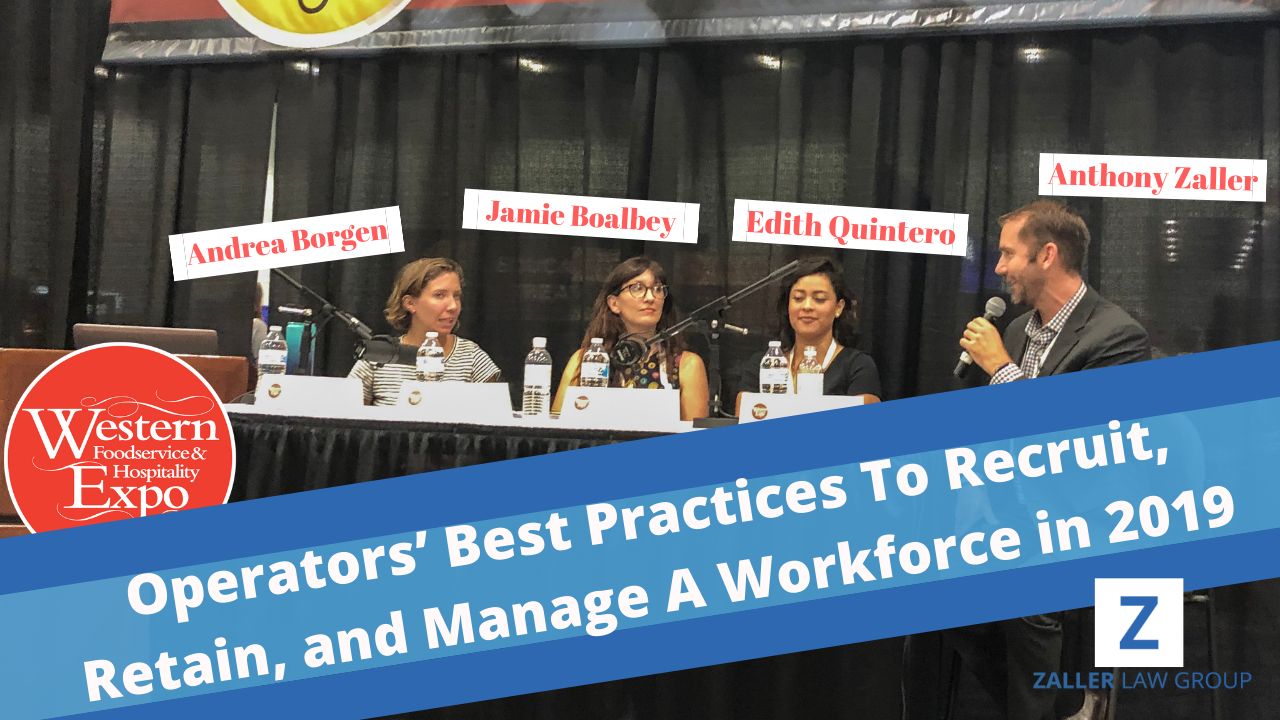
I was honored to moderate a panel discussion on best practices for employers to manage their workforces.  On the panel was Andrea Borgen, owner of Barcito, Edith Quintero, West Cost People & Development for Soho House & Co., and Jamie Boalbey, Director of Operations for Pitfire Pizza.  While the discussion had a focus on restaurant operations, the lessons are applicable to almost every type of business.  This Friday’s Five review the top five points I took away from our discussion:

1. Restaurant operators of all sizes face similar issues. Large or small, the key issues for a successful company are employees and company culture. 

2. Tipping policies are still a primary concern for restaurants.

3. Company culture is key:

  • To build culture, the company must do what it says it is going to do.
  • Utilize technology to communicate with employees. For example, Workplace on Facebook can be a cost-effective tool.

4. Hiring and recruiting are critical to a company’s success:

  • Connecting with applicants quickly and on a personal level helps recurring efforts. Two to three interviews during the interview process provides good interaction with the applicants.  Contacting references is critical.
  • Don’t let good applicants leave the interview without knowing what the next step is in the interview process.
  • Retention starts with the first interview. The interview process must ensure there is a match, not just from the company’s prospective, but does the applicant agree with the company’s culture?
  • But it does not stop there, and employees need continual training and engagement.

5. There are pros and cons to third party delivery platforms.

  • If your restaurant is not a fast-casual restaurant, the food may not travel well, but the service does open other markets for the restaurants.  This is incremental business that if a restaurant does not capture, it will go somewhere else.

In the coming weeks, we will have the full discussion available on our podcast (iTunes, Spotify, and Stitcher) and our YouTube channel.  Subscribe to avoid missing any content and updates.

California law generally holds that an employer may not pass the ordinary costs of doing business on to employees.  However, this general rule has a multitude of nuances once one examines all the different costs that arise in the employment context and the various Labor Code and Wage Order provisions that apply.  This article addresses five types of costs that arise in the employment context and the various regulations that apply to those scenarios:

1. Physical examinations

Employers are prohibited from requiring an applicant or employee to pay for a physical examination required by the employer.  Likewise, the employer cannot require an employee to pay for a medical or physical examination required by any federal, state or local law or regulation.  However, costs for pre-employment examinations that are required by law do not have to be reimbursed to the applicant.  See Labor Code section 222.5.

If an employer requires as a condition of employment a driver’s license, the employer is responsible to pay the costs for any physical examination that may be required for issuance of the license.  However, the employer is not responsible for costs for physical examinations taken prior to when the employee applied for employment.  See Labor Code section 231.

2. Cost of cashing checks and lost paychecks

California law prohibits employers from deducting the costs of cashing a paycheck from the employee’s wages.  The Division of Labor Standards Enforcement (DLSE) has issued an opinion letter stating that this prohibition also applies to the cost of reissuing a lost or misplaced paycheck. See Opinion Letter 1994.01.27.

3. Tools and equipment

Employers are responsible for paying for and providing the tools and equipment required to perform the job.  One exemption to this rule is for employees who earn at least two times the state minimum wage may be required to provide and maintain hand tools and equipment customarily required by the trade or craft.  See Wage Orders Nos. 1-2001 to 16-2001, section 8. Protective and safety equipment governed by the Occupational Safety and Health Standards Board requires that employers provide all equipment required under those regulations.

4. Mileage

Labor Code section 2802 requires an employer to reimburse employees for expenses they necessarily incur while discharging their duties.  If employees are required to drive their personal car for work, the employer must reimburse the employee for the costs attributed to the use of the employee’s car.  In Gattuso v. Harte-Hanks Shoppers, Inc., the California Supreme Court clarified the parameters of mileage reimbursement under California law, as well as the three different methods available for employers to reimburse employees for their mileage reimbursement. Click here for a detailed examination of the California Supreme Court’s ruling in Gattuso v. Harte-Hanks.

5. Uniforms

California law allows employers to require employees to wear particular types of clothing or uniforms to work. If an employer requires a non-exempt employee to wear a uniform, the employer must pay for and maintain it for the employee. What constitutes a “uniform” is not always clear.  Click here for more information regarding other considerations that arise with uniforms.

Here are five employment law and non-employment law issues that had my attention this week:

1. Will the future workforce be paid daily?

The Wall Street Journal’s article, “The Wait for Payday Doesn’t Have to Be So Long” raises some interesting issues about efforts to lower the time it takes for employees to receive paychecks.  The article noted that there are a variety of fronts that can speed up paycheck processing.  On one front, there is proposed legislation from Sen. Elizabeth Warren, among other representatives, to require a faster banking network for payments to consumers.  On another front, startup companies, such as DailyPay, Inc., work with companies to offer instant pay to their employees.  The article also notes that drivers for Uber can chose to be paid as often as five times a day.  The article raises interesting issues, and with the prevalence of technology making faster payments easier, is this something that employees and employers will move to?

2. California Supreme Court holds that plaintiffs cannot allege conversion claim for recovery of unpaid wages

In Voris v. Lampert, the California Supreme Court held that plaintiffs seeking recovery of unpaid wages cannot assert the tort claim of conversion to recover the unpaid wages.  The plaintiff in this case attempted to plead conversion to recover unpaid wages he was owed from a series of start-up companies he worked for.  The plaintiff attempted to plead a conversion claim against the defendants in order to hold the individual corporate officers personally liable, as the start-up company that plaintiff worked for had no assets.  In addition to the personal liability for corporate officers, a conversion claim would also allow the plaintiff to seek punitive damages.  The California Supreme Court’s refusal to permit the conversion claim provides some additional protection to corporate officers and prohibits punitive damages in standard wage claim cases.

3. NLRB issues first decision on mandatory arbitration case after Epic Systems

The National Labor Relations Board (NLRB) issued a decision on arbitration agreements in the workplace.  This decision was the first decision on arbitration agreements after the Supreme Court’s decision in Epic Systems v. Lewis.  The NLRB’s decision in Cordua Restaurants, Inc. 368 NLRB No. 43 (2019) held:

  • Employers are not prohibited under the National Labor Relations Act (NLRA) from informing employees that failing or refusing to sign a mandatory arbitration agreement will result in their discharge.
  • Employers are not prohibited under the NLRA from promulgating mandatory arbitration agreements in response to employees opting into a collective action under the Fair Labor Standards Act or state wage-and-hour laws.
  • Employers are prohibited from taking adverse action against employees for engaging in concerted activity by filing a class or collective action, consistent with the Board’s long-standing precedent.

4. California Court upholds arbitration of Unfair Competition Law claims

The California Court of Appeal held in Clifford v. Quest Software that claims against an employer brought under Business and Professions Code section 17200 (UCL) are subject to arbitration.  The Court held that UCL claims for private injunctive relief or restitution must be arbitrated, and a prior case, Cruz v. PacificCare Health Systems, Inc. (2003), to the extent it is still good law, only prohibits the arbitration on UCL claims for “public” injunctive relief.

5. The War of Art – a quote I’m pondering

After reading The War of Art by Steven Pressfield a few years ago, I still re-read it every so often.  It has nothing to do with employment law, but it is an excellent road-map to keep leaders, artists, entrepreneurs, writers or any other person trying to accomplish a great task on course and working in their profession.  Here is a quote I particularly like from the book:

Are you paralyzed with fear?  That’s a good sign.  Fear is good.  Like self-doubt, fear is an indicator.  Fear tells us what we have to do.  Remember our rule of thumb: The more scared we are of a work or calling, the more sure we can be that we have to do it.

Hope you are enjoying the summer so far.  As many employees take vacation during August, employers in California must be aware of unique rules that apply to vacation time. This Friday’s Five reviews five issues on vacation policies that can create traps for employers operating in California:

1. No use-it-or-lose-it policies permitted.
Under California law, vacation is treated the same as earned wages and vest as the employee performs work. Because vacation is earned proportionally as the employee works, any type of policy requiring employees to lose vacation that has already been earned is illegal under California law.

2. Reasonable caps are allowed.
While employers cannot implement “use-it-or-lose-it” policies, they can place a reasonable cap, or ceiling, on vacation accrual. The DLSE explains:

Unlike “use it or lose it” policies, a vacation policy that places a “cap” or “ceiling” on vacation pay accruals is permissible. Whereas a “use it or lose it” policy results in a forfeiture of accrued vacation pay, a “cap” simply places a limit on the amount of vacation that can accrue; that is, once a certain level or amount of accrued vacation is earned but not taken, no further vacation or vacation pay accrues until the balance falls below the cap. The time periods involved for taking vacation must, of course, be reasonable. If implementation of a “cap” is a subterfuge to deny employees vacation or vacation benefits, the policy will not be recognized by the Labor Commissioner.

3. Vacation is a form of earn wages that must be paid out on the employee’s last day of work.
An employee who is discharged must be paid all of his or her wages, including accrued vacation, immediately at the time of termination. See Labor Code Sections 201 and 227.3

4. Deductions are not permitted from employee’s final wages for use of vacation that was not accrued.
Vacation is treated as a form of wages under California law, and by permitting an employee to take vacation time before it is earned is similar to providing a loan to the employee.  Employers may not utilize self-help remedies to recover debts from the employee’s final pay check, including deducting wages owed to an employee to cover vacation that time was used but had not yet accrued.

5. “Cliff vesting” policies are problematic.
Employers may set probationary periods or waiting periods during which times employees do not accrue vacation time. However, the DLSE maintains that employers may not maintain a policy granting employees a lump sum of vacation upon reaching certain dates. The DLSE’s view on this type of “cliff vesting” is that the employer is really attempting to provide for accrued vacation, but at the same time is attempting to limit its liability of having to pay out a pro rata share of the accrued vacation if the employee does not work until the date in which the vacation is granted to the employee. It is safer for employers to avoid these lump sum grants of vacation, and simply set a time period (i.e., the employee’s first six months of employment) that the employee does not accrue vacation.

California law is vastly different than Federal law and other states. It can be a trap for employers, but with some understanding of the obligations created under the law it can easily be managed.

Hope you are enjoying the final weeks of the summer.