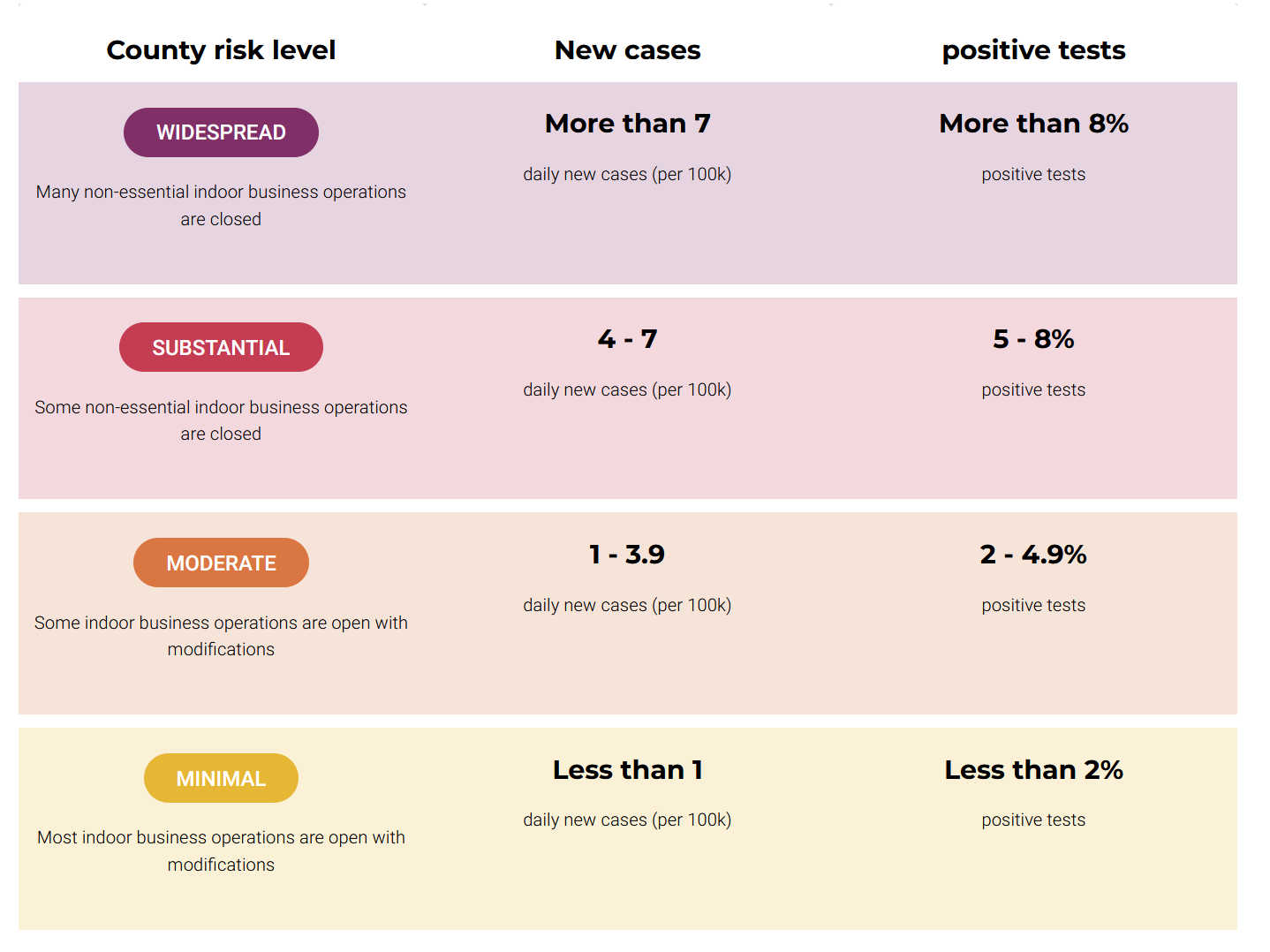
As employees are just beginning to return to work, or employers are making plans to reopen pursuant to California’s “Blueprint for a Safer Economy,” it is a good time to review the various paid sick leave laws that were implemented during the COVID-19 epidemic, as well as the paid sick leave laws that were already in place prior to COVID-19 under California and local laws.  Here is a review of five paid sick leave laws that could apply to employers in the Los Angeles and Southern California area:

1. Los Angeles City – COVID-19 Supplemental Paid Sick Leave

April 7, 2020, Mayor Garcetti signed the COVID-19 Supplemental Paid Sick Leave law.  The law is effective from April 7, 2020 and will remain in effect until two calendar weeks after the expiration of the COVID-19 local emergency period.

The final Order can be viewed here, and sets forth the following:

Covered employees:

An employee who has been employed with the same employer from February 3, 2020 through March 4, 2020, is entitled to supplemental paid sick leave.  The employee must perform any work within the geographic boundaries of the City for the employer.

Covered employers:

Applies to an employer that has either (i) 500 or more employees within the City of Los Angeles, or (ii) 2,000 or more employees within the United States.

Amount of Leave:

If an employee is unable to work or telework, they are entitled to leave as follows:

  1. An employee who works at least 40 hours per week or is classified as a full-time employee by the employer shall receive 80 hours of supplemental paid sick leave. Supplemental paid sick leave shall be calculated based on an employee’s average two week pay over the period of February 3, 2020 through March 4, 2020.
  2. An employee who works less than 40 hours per week and is not classified as a full-time employee by the employer shall receive supplemental paid sick leave in an amount no greater than the employee’s average two week pay over the period of February 3, 2020 through March 4, 2020.

Cap on payments:

The amount paid to an employee is limited to $511 per day and $5,110 in the aggregate.  Employees of joint employers are only entitled to the total aggregate amount of leave specified for employees of one employer.

Qualifying Reasons for Leave:

Supplemental paid sick leave upon the oral or written request of an Employee if:

  1. The employee takes time off due to COVID-19 infection or because a public health official or healthcare provider requires or recommends the employee isolate or self quarantine to prevent the spread of COVID-19;
  2. The Employee takes time off work because the employee is at least 65 years old or has a health condition such as heart disease, asthma, lung disease, diabetes, kidney disease, or weakened immune system;
  3. The employee takes time off work because the employee needs to care for a family member who is not sick but who public health officials or healthcare providers have required or recommended isolation or self-quarantine; or
  4. The employee takes time off work because the employee needs to provide care for a family member whose senior care provider or whose school or child care provider caring for a child under the age of 18 temporarily ceases operations in response to a public health or other public officials recommendation.  This provision is only applicable to an Employee who is unable to secure a reasonable alternative caregiver.

An Employer may not require a doctor’s note or other documentation for the use of Supplemental Paid Sick Leave.

Employer Offset:

This requirement will be reduced for every hour an employer provides paid leave to an employee (except for previously accrued hours) on or after March 4, 2020 for any reasons set forth above or in response to an employee’s inability to work due to COVID-19.

Businesses Exempt From the Supplemental Paid Sick Leave:

  1. Emergency and health services personnel.
  2. Critical parcel delivery employees.
  3. Employers who have a paid leave or paid time off policy that provides a minimum of 160 hours of paid leave annually.
  4. New businesses that started in the City or relocated to the City on or after September 4, 2019 through March 4, 2020.
  5. Government employees.
  6. Closed businesses and organizations – Any business or organization that was closed or not operating for a period of 14 or more days due to a city official’s emergency order because of the COVID-19 pandemic or provided at least 14 days of leave shall be exempt from the Order.
2. Los Angeles County COVID-19 Worker Protection Ordinance

On April 28, 2020, the Los Angeles County Board of Supervisors passed the Los Angeles County COVID-19 Worker Protection Ordinance.   Click here to view the Ordinance.

Effective Time Period:

March 31, 2020 to December 31, 2020 (unless it is extended by the Board of Supervisors)

Covered Employers:

Applies to employers operating in the unincorporated areas of the County of Los Angeles who have 500 or more employees nationally.

The ordinance applies to an individual who performed any work within the County for the employer.

Excluded Employees:

The Ordinance excludes food sector workers who are covered in California Governor’s Executive Order N-51-20 (see below).  Employers may also exclude emergency responders or health care providers (as defined by the Ordinance) from being eligible for paid sick leave.

Amount of Paid Sick Leave:

Employees who work at least forty hours per week or is classified as a full-time employee is entitled to 80 hours of supplemental paid sick leave.  The amount of pay is calculated on the employee’s highest average two week pay during the period of January 1, 2020 to April 28, 2020.

Employees who work less than 40 hours per week and is not classified as a full-time employee is entitled to paid sick leave calculated at the employee’s average two week pay over the period of January 1, 2020 to April 28, 2020.

The amount of paid sick leave is capped at $511 per day and $5,110 in the aggregate.  Paid sick leave under the Ordinance is in addition to any paid sick leave available to employees under Labor Code 246.  Employees of joint employers are only entitled to the total aggregate amount of leave specified for employees of one employer.

Covered Reasons For Leave:

Employers must provide paid sick leave to employees under the Ordinance at the written request (including, but not limited to, email and text) of an employee if the employee cannot work because:

  1. A public health official or healthcare provider requires or recommends the employee isolate or self-quarantine to prevent the spread of COVID-19;
  2. The employee is subject to a federal, State, or local quarantine or isolation order related to COVID-19 (e.g., is at least 65 years old or has a health condition such as heart disease, asthma, lung disease, diabetes, kidney disease, or weakened immune system);
  3. The employee needs to care for a family member who is subject to a federal, State, or local quarantine or isolation order related to COVID-19 or has been advised by a health care provider to self-quarantine related to COVID-19; or
  4. The employee takes time off work because the employee needs to provide care for a family member whose senior care provider or whose school or childcare provider ceases operations in response to a public health or other public official’s recommendation.

Employers may require a doctor’s note or other documentation confirming that the employee is entitled to sick leave under one of these qualifying reasons.

3. California Food Service Workers Supplemental Paid Sick Leave – Executive Order N-51-20

On April 16, 2020, Governor Gavin Newsom issued Executive Order N-51-20, which provides new paid sick leave to certain food service workers. Citing a need to fill a “gap” left by the federal Families First Coronavirus Response Act, which applies solely to employers with fewer than 500 employees, this  Executive Order provides up to 80 hours of “COVID-19 Supplemental Paid Sick Leave” to defined food sector workers.

Covered Employers:

Executive Order N-51-20 applies to employers with 500 or more employees in the United States, including full-time and part-time workers but not including independent contractors. Employees on leave of any kind are counted, but employees furloughed or laid off are not counted unless and until they are reemployed.

The Executive Order expressly applies to any “Delivery Network Company” (companies that use a website or mobile app to enable local delivery of products/food from third-party merchants; think Postmates or GrubHub) and any “Transportation Network Company” (companies that provide transportation services using online apps/platforms that connect passengers with drivers using a personal vehicle; think Uber or Lyft) that employs 500 or more employees.

As with the FFCRA and FMLA, common employees of joint or integrated employers must be counted together.

There is one exception: if, as of April 16, 2020, the employer already provides a “supplemental benefit” such as paid leave that provides the same or greater benefit provided by this Executive Order, then the employer does not have to provide the COVID-19 Supplemental Paid Sick Leave.

Employees Covered:

The Executive Order applies to “Food Sector Workers,” which it defines as any person who satisfies one of the following criteria:

  1. The person works in an industry or occupation covered by Wage Orders 3 (Canning, Freezing, and Preserving Industry), 8 (Industries Handling Products After Harvest), 13 (Industries Preparing Agricultural Products for Market, on the Farm), or 14 (Agricultural Occupations).
  2. The person works for a food facility,” which means an operation that stores, prepares, packages, serves, vends, or otherwise provides food for human consumption at the retail level, whether consumed on or off premises, as well as storage facilities for food-related utensils, equipment, and materials.
  3. The person delivers food from a food facility.

Food Service Workers only include those persons who are essential workers under the Governor’s stay-at-home order, or any other statewide stay-at-home order.  Employees who work from home do not qualify for the supplemental paid sick leave.

The Labor Commissioner’s Office, which enforces the Executive Order, has interpreted it to specifically encompass “grocery workers, restaurant or fast food workers, workers at warehouses where food is stored, and workers who pick-up or deliver any food items.”

Covered Reasons For Leave:

The worker must be unable to work due to one of three reasons:

  1. The Food Service Worker is subject to a Federal, State, or local quarantine or isolation order related to COVID-19;
  2. The Food Sector Worker is advised by a health care provider to self-quarantine or self-isolate due to concerns related to COVID-19; or
  3. The Food Sector Worker is prohibited from working by the employer due to health concerns related to the potential transmission of COVID-19.

Amount of Paid Sick Leave:

The worker is entitled to 80 hours of COVID-19 Supplemental Paid Sick Leave if either (1) the employer considers the worker to work “full-time”; or (2) the worker worked or was scheduled to work an average of at least 40 hours per week in the two weeks preceding the start of the leave.

If the worker does not meet either of the above “full-time” requirements, then the amount of leave depends on the worker’s schedule.  If the worker has a “normal weekly schedule,” the worker is entitled to leave equal to the total number of hours normally scheduled to work over two weeks.  If the worker has a “variable schedule,” the worker is entitled to fourteen times the average number of daily hours worked in the preceding six months.

The food service worker is paid at the regular rate of pay for the worker’s last pay period.  If the applicable state or local minimum wage is higher, then the worker gets that minimum wage.  Regardless, pay is capped at per worker at $511 per day and $5,110 in the aggregate.

The leave provided by the Executive Order is in addition to any paid sick leave available under Labor Code section 246 (see below for further details).

Effective Dates:

The Executive Order was signed on April 16, 2020.  The food service worker is entitled to leave upon oral or written request by the worker to the employer.  The worker, not the employer, may decide how many hours of leave to use, up to the total amount available.  The employer may not require the worker to use any other paid or unpaid leave, including vacation or other paid sick leave, prior to using the supplemental paid sick leave.

The Executive Order remains in effect during the pendency of any statewide stay-at-home order, but a worker taking leave at the time such an order expires is permitted to continue to take the full amount of leave.

Required Poster:

The Labor Commissioner published a poster that eligible employers must post related to this Executive Order.  For food service workers that do not frequent a workplace, the employer may email the poster to the worker.

Requirement To Wash Hands:

The Executive Order provides that food facilities must permit employees to wash their hands “every 30 minutes and additionally as needed.”

4. Families First Coronavirus Response Act

The Families First Coronavirus Response Act (FFCRA) was passed by the Senate and signed by President Trump on March 19, 2020.  The Act provides for two paid leaves that employers across the United States must provide to employees in response to the coronavirus epidemic.  The Act is effective in 15 days and applies to employers with 1 to 499 employees – yes, you read that right, large employers with 500 or more employees do not have to comply with this law.  It expires on December 31, 2020.  The Act provides for two sources of paid leave: Emergency Paid Sick Leave Act and the Emergency Family and Medical Leave Expansion Act.

Emergency Paid Sick Leave Act (EPSLA):

Covered Employees: All employees.

Covered Employers: Employers with fewer than 500 employees.

Amount of Leave:

  • Full time employees: 80 hours of paid leave
    • Calculated at their regular rate of pay (as calculated by the FLSA) or the minimum wage, whichever is greater.
  • Part-time employees: Average number of hours worked over a two-week period.
    • If employee works a variable schedule, it is the average number of hours they worked per day over the previous six months. If the employee has not worked this long, it is the reasonable expectation of the employee at the time of hire of the average number of hours per day the employee would normally be scheduled.

The Emergency Paid Sick Leave Act sets forth six covered reasons qualifying for paid sick leave, and a corresponding rates of pay for the employee and a cap on payments to the employees depending on the reason for leave:

Covered Reason For Leave Rate of Pay Cap on Payments
(1) The employee is subject to a Federal, State, or local quarantine or isolation order related to COVID–19 The employee’s regular rate of pay (as determined under section 7(e) of the Fair Labor Standards Act of 1938 (29 U.S.C. 207(e)). $511 per day and $5,110 in the aggregate
(2) The employee has been advised by a health care provider to self-quarantine due to concerns related to COVID–19 The employee’s regular rate of pay (as determined under section 7(e) of the Fair Labor Standards Act of 1938 (29 U.S.C. 207(e)). $511 per day and $5,110 in the aggregate
(3) The employee is experiencing symptoms of COVID–19 and seeking a medical diagnosis. The employee’s regular rate of pay (as determined under section 7(e) of the Fair Labor Standards Act of 1938 (29 U.S.C. 207(e)). $511 per day and $5,110 in the aggregate
(4) The employee is caring for an individual who is subject to an order as described in subparagraph (1) or has been advised as described in paragraph (2). Two-thirds of the employee’s regular rate of pay. $200 per day and $2,000 in the aggregate
(5) The employee is caring for a son or daughter of such employee if the school or place of care of the son or daughter has been closed, or the child care provider of such son or daughter is unavailable, due to COVID–19 precautions. Two-thirds of the employee’s regular rate of pay. $200 per day and $2,000 in the aggregate
(6) The employee is experiencing any other substantially similar condition specified by the Secretary of Health and Human Services in consultation with the Secretary of the Treasury and the Secretary of Labor. Two-thirds of the employee’s regular rate of pay. $200 per day and $2,000 in the aggregate

Employers cannot require employees to use any other leave prior to using the Emergency Paid Sick Leave.

Notice requirements: Employers must post a notice in conspicuous places on the premises of a notice to be prepared by the Secretary of Labor.  The Secretary of Labor has 7 days after the enactment of the Act to make the notice publicly available.

The Act cannot not diminish the rights or benefits of employees provided under any other Federal, State, or local law, collective bargaining agreement, or existing employer policy.

Employers are not required to pay out any unused Emergency Paid Sick Leave at the end of employment.

Emergency Family and Medical Leave Expansion Act:

Eligible employees: An employee who has been employed for at least 30 calendar days.

Covered employers: An employer with fewer than 500 employees.

Qualified reasons for paid FMLA leave: When the employee is unable to work (or telework) due to a need for leave to care for the son or daughter under 18 years of age of such employee if the school or place of care has been closed, or the child care provider of such son or daughter is unavailable, due to a public health emergency (with respect to a COVID-19 declared by a Federal, State, or local authority), the employee may take up to 12 weeks of leave.

Amount of paid leave:

  • First 10 days may be unpaid (but employee may use other paid leaves during this time)
  • Paid at no less than two-thirds of the employee’s regular rate of pay (as determined by the FLSA) and the number of hours the employee would normally be scheduled to work for up to 12 weeks.
  • Paid leave shall not exceed $200 per day and $10,000 in the aggregate.

Reinstatement rights:  Employees are entitled to reinstatement to the same position or an equivalent position, unless the employer employs fewer than 25 employees.  In that case, the employer must make reasonable efforts to provide the employee with a position or an equivalent position for 1 year after the “public health emergency concludes” or 12 weeks after commencement of the leave, whichever is earlier.

Exclusions: The Secretary of Labor has authority to issue regulations for good cause to exclude certain health care providers and emergency responders, and to exempt small businesses with few than 50 employees if requirements would “jeopardize the viability of the business as a going concern.”

The Act provides payroll tax credits granted to employers to offset the costs associated with these employer provided mandates.  This is a concern for many business owners, especially restaurant owners, who have been forced to close or substantially reduce their operations to take-out only, and now must find extra money for these payments and wait for a tax credit.

Required Poster:

The Department of Labor published the required posters employers will need to provide to employees under the Families First Coronavirus Response Act:

5. Other Paid Sick Leave Requirements Already In Place Prior to COVID-19

California employers still must comply with California’s Healthy Workplaces, Healthy Families Act of 2014 and any other local city or county paid sick leave laws that have been in place prior to COVID-19.  All California employer must comply with the California’s Healthy Workplaces, Healthy Families Act of 2014.

Some other examples of other local city or county paid sick leave laws in Southern California include:

  1. Los Angeles City’s paid sick leave requirements
  2. Los Angeles County’s paid sick leave requirements
  3. Santa Monica
  4. San Diego

More information on these local paid sick leave laws for Southern California can be read here.

The Golden State continues to be submerged in a rather bizarre reality. State and local government officials continue to juggle between safety and health concerns in one hand, and economic turmoil on the other. With no concise timeline as to when will business may go back to “normal” operations, employers must continue to comply with the labyrinth of federal, state and local rules regulations addressing COVID-19 issues. Unsurprisingly, administrative agencies have begun turning their resources towards enforcement of these rules and regulation. The latest agency to jump into this bandwagon is the California Department of Industrial Relations Division of Occupational Safety & Health (DOSH), or Cal/OSHA.

As an enforcement mechanism, Cal/OSHA may cite employers or businesses who fail to comply with health and safety requirements, particularly as they relate to COVID-19. Cal/OSHA has certainly deployed the “stick” method for employer compliance, as it issued citations to 11 different employers, equating to a total of roughly $116,775. These citations ranged from $2,025 to $51,190.

But why were these businesses cited? These particular businesses were cited for failing to protect workers from exposure to COVID-19, as they did not take steps to update their workplace safety plans to properly address hazards related to the virus. Among the reasons for the citations included: the businesses’ failure to ensure physical distancing, failing to install Plexiglas or other barriers between workers, failure to implement procedures to screen employees and visitors upon arrival to the facility, and failure to take appropriate measures for employees exhibiting COVID-19 symptoms at the business. The message is clear: employers should have already developed methods, strategies, and protocols to ensure compliance with these requirements.

Although these businesses are in the food processing, meatpacking, health care, agriculture and retail industries, this serves as a reminder to all businesses in any industry to comply with Cal/OSHA requirements. Indeed, Cal/OSHA Chief, Doug Parker, clearly stated that:

“These are industries where workers have been disproportionately affected, and these citations are the first of many to be issued in the coming weeks and months.”


Requirements Under Cal/OSHA

The overarching rule is that employers have a duty to provide work and workplaces that are safe and healthful. Further, Cal/OSHA’s regulations require protection for workers exposed to airborne infectious diseases such as COVID-19.

In particular, Cal/OSHA requires employers:

  • To implement an Injury and Illness Prevention Program (“IIPP”). The purpose of an IIPP is to protect employees from workplace hazards, including COVID-19. The IIPP should clearly establish relevant and applicable infection prevention measures, such as encouraging sick employees to stay home, encourage teleworking, and to practice social distancing. For a more detailed discussion of the requirements, see our previous post here.
  • Provide employee training. Employers must provide training to their employees with respect to COVID-19 generally, the ways in which COVID-19 may be spread by a person, proper use of cloth face coverings, the proper method for washing hands, and cleaning and sanitizing.
  • Provide personal protective equipment (PPE), if applicable. Employers must conduct a “hazard assessment” to determine if any PPE is needed to protect employees from hazards present – or likely to be present – in the workplace. Employers should review their local health department rules, requirements and regulations to ensure compliance. For example, restaurants doing businesses with Los Angeles County must provide employees with face masks and face shields.

Cal/OSHA has issued industry-specific guidance and guidelines on how to protect workers from COVID-19, and can be accessed here.

Employers should use this as an opportunity to review their protocols and ensure compliance not only with local regulations, but with safe and healthy requirements under Cal/OSHA.

As August comes to a close there are major developments for California employers.  Of primary note, the Governor set forth a new four-tiered system plan for businesses to reopen, which becomes effective on Monday, August 31, 2020.  There was additional DOL guidance issued this week regarding the FFCRA and paid leave once schools reopen, a disagreement between Governor Newsom and the CDC on testing (and what does this mean for employers), and what the future of Uber and Lyft may be in California:

1. Governor Newsom Announces New Plan for Reopening California

Today, August 28, 2020, Governor Newsom announced new plan to reopen California.  The plan set forth different restrictions for different industries base on a four-tiered structure (purple, red, orange, and yellow) based on new cases and positive tests.  Businesses can look up the requirements for their industry here based on which tier applies to the county they are operating in here.

As of August 31, 2020, counties in the Widespread (purple) tier may open some businesses and activities with modifications, including all retail, shopping centers at maximum 25% capacity, and hair salons and barbershops indoors.  Local counties can still limit any reopening plans if the county decides to do so.

The new plan sets forth the following reopening requirements for restaurants, wineries and bars based on the county’s designation (widespread, substantial, moderate, or minimal):

Widespread (purple):

    • Restaurants and wineries: Outdoor only with modifications
    • Bars, breweries, and distilleries: Closed

Substantial (red):

    • Restaurants:
      • Indoor with modifications
      • Capacity must be limited to 25% or 100 people, whichever is less
    • Wineries: Outdoor only with modifications
    • Bars, breweries, and distilleries: Closed

Moderate (orange):

    • Restaurants:
      • Indoor with modifications
      • Capacity must be limited to 50% or 200 people, whichever is less
    • Wineries:
      • Indoor with modifications
      • Capacity must be limited to 25% or 100 people, whichever is less
    • Bars, breweries, and distilleries: Outdoor only with modifications

Minimal (yellow):

    • Restaurants:
      • Indoor with modifications
      • Capacity must be limited to 50%
    • Wineries:
      • Indoor with modifications
      • Capacity must be limited to 50% or 200 people, whichever is less
    • Bars, breweries, and distilleries:
      • Indoor with modifications
      • Capacity must be limited to 50%

The plan sets forth that hotels and lodging (tourism and individual travel) may also open with modifications:

Widespread (purple): Open with modifications

Substantial (red): Open with modifications

Moderate (orange):

    • Open with modifications
    • Fitness centers can open to 25% capacity
    • Indoor pools can open

Minimal (yellow):

    • Open with modifications
    • Fitness centers can open to 50% capacity
    • Indoor pools can open
    • Spa facilities can open

The requirements for each industry are set forth on California’s website here.

2. Department of Labor Updates FAQ on Families First Coronavirus Response Act

On August 27, 2020, the Department of Labor (DOL) issued three additional FAQs for the FFCRA.  The three new FAQs address FFCRA paid leave issues for employees with children returning to school:

FAQ #98My child’s school is operating on an alternate day (or other hybrid-attendance) basis. The school is open each day, but students alternate between days attending school in person and days participating in remote learning. They are permitted to attend school only on their allotted in-person attendance days. May I take paid leave under the FFCRA in these circumstances? 

FAQ #99 – My child’s school is giving me a choice between having my child attend in person or participate in a remote learning program for the fall. I signed up for the remote learning alternative because, for example, I worry that my child might contract COVID-19 and bring it home to the family. Since my child will be at home, may I take paid leave under the FFCRA in these circumstances?

FAQ #100 – My child’s school is beginning the school year under a remote learning program out of concern for COVID-19, but has announced it will continue to evaluate local circumstances and make a decision about reopening for in-person attendance later in the school year. May I take paid leave under the FFCRA in these circumstances?

3. California’s Department of Fair Employment and Housing (DFEH) Employment Law FAQ

Employers are reminded to review their current obligations under California law.  The DFEH updated its FAQs for California employers on July 24, 2020.  The FAQs address:

  • COVID-19 Inquiries and Protective Equipment
  • Employees with COVID-19 Symptoms or Infection
  • Job-protected Leave
  • Reasonable Accommodations For Employees With a Disability/Vulnerable Populations

The DFEH’s updated FAQs can be viewed here.

4. Governor’s refusal to follow CDC COVID-19 testing guidelines – how does this impact employees and employers?

On August 24, 2020, the CDC updated guidance regarding when individuals should be tested. The updated guidance stated that individuals who have had close contact (within 6 feet) of a person with COVID-19 for at least 15 minutes, and who do not have symptoms, “do not necessarily need a test unless you are a vulnerable individual or your health care provider or State or local public health officials recommend you take one.”

Governor Newsom came out against the revised guidance and stated California will not comply with the CDC’s new guidance.  Newsom said that he does not agree with the CDC guidance and said it is not the policy in the state of California.

But what does this mean for individuals and employers in California?  There is not much of an impact for employees and employers.  There is no law that requires individuals or employees to be tested for COVID-19 – individuals may refuse to be tested and employers are not legally required to administer tests to employees.  Both the CDC guidance and the state of California guidance is simply that – guidance.

5. Uber’s and Lyft’s future in California

There has been a lot of media attention on the possibility that Uber and Lyft may shut down operations in California by August 20, 2020.  However, the shutdown was avoided when a California appeals court granted the companies’ request to continue to operate with independent contractors while they appeal a lower court’s order requiring them to reclassify their drivers as employees.  The litigation involves California’s AB 5 that took effect in 2020, making it more difficult for employers to classify workers as independent contractors.  While this legal fight makes it way through the courts, California will vote on Proposition 22 on November 2, 2020, which would grant app-based transportation workers and delivery companies from AB5 and provide other benefits to the workers.


As the end of summer is nearing, and there is no clear date for businesses and activities to fully reopen across the United States and California, more and more attention has been given to what protections businesses have from COVID-19 related lawsuits.  Many businesses find it a necessity to reopen during this time of uncertainty in order to simply avoid going out of business – they must do something to pay their rent, insurance, and other financial obligations.  With the press of reopening, businesses are rightfully concerned that they will be named a defendant by an employee or a customer who contracts COVID-19 and claims that the virus was contracted while working at or visiting the business establishment.  Here are five issues California businesses must understand regarding the legislative environment of COVID-19 liability, and the potential to have employees or customers waive liability related to contracting COVID-19.

1. Legal liability shield on the Federal level

As part of the ongoing negotiations for additional economic relief between Congress and the White House, Republicans have been arguing for a liability shield that would protect businesses from COVID-19 related lawsuits from employees as long as the employer uses “reasonable efforts” to comply with regulations and protect employees.  However, as of August 2020, there has been no agreement between Republicans and Democrats on this issue, and it remains a contentious issue in the ongoing negotiations for further relief bills.

2. California legislation creating presumption that employee contracted COVID-19 at work

In direct opposition to proposals on the federal level to protect employers, California has implemented and is looking to continue presumptions that an employee contracted COVID-19 at work if they are infected.  On May 6, 2020, Governor Newsom issued Executive Order N-62-20, creating a rebuttable presumption that an employee’s COVID-19-related illness arose out of the course of employment for workers’ compensation purposes if the employee tests positive or is diagnosed “within 14 days after a day that the employee performed labor or services at the employee’s place of employment at the employer’s direction.” The presumption does not apply if the employee worked from home.  We previously wrote about this Executive Order here.

That presumption expired in July, but the California legislature is currently drafting legislation that would implement a similar presumption that was set forth in the Governor’s Executive Order.

3. Liability waivers

In response to lack of a federal liability shield and California’s potential extension of a presumption that an employee contracted COVID-19 at work, many employers are seeking some type of potential protection and have asked if a liability waiver by employees is a viable option.  Private parties may enter into agreements to limit liability for either party’s negligence, and these agreements are generally enforceable.  These liability release agreements can include provisions whereby a party covenants not to sue, acknowledges an assumption of risk, and provides for indemnification against the company should litigation ensue.  While these liability waivers are enforceable in the commercial setting (such as customers coming into a restaurant or retail location), in the employment context their enforceability may be more limited.

For example, the California Labor Code section 2800 requires employers to indemnify employees for losses caused by the employers’ “want of due care,” and prohibits any waiver of this right.

4. Limits of liability waivers in California

California law places many limits on claims employees can prospectively release, and therefore employers considering such waivers of liability with employees should use caution and seek legal advice before doing so.  For example, California law is clear that workers compensation claims cannot be released as a matter of law.

In addition, failure to comply with mandatory safety requirements and safety guidelines could also impact the enforceability of liability waivers.  If a company does not follow the guidelines, it could be argued that the actions were grossly negligent actions, which cannot be subject to be released or waived.  Also, California Civil Code section 1668 states that it is against public policy for a party to attempt to contract around their obligations to comply with the law.

Generally, California law does not favor waivers and will be strictly construed against the party drafting them.

5. Liability waivers for customers

As mentioned above, a contract waiving liability for injuries caused by ordinary negligence is enforceable under California law if it does not violate public policy.  Outside of the employment context, liability waivers are likely to be more enforceable, but companies must remember that California law does not favor waivers and a court will scrutinize any contract that seeks to waive liability, and no case law has yet addressed whether some unique aspect of COVID-19 would remove it from the general category of risks for which liability can be waived.  In addition, companies must review the public perception of having customers and clients entering into liability waivers.  However, the longer the virus is present and absent any federal law granting businesses a liability shield, liability waivers may become more common.

On April 1, 2020, the Department of Labor issued its Final Rule implementing the Families First Coronavirus Response Act (FFCRA), pursuant to the authority it was granted under the law to issue regulations the implement the statute.  The State of New York filed a lawsuit (State of New York v. United States Department of Labor, et al.) challenging four aspects of the DOL’s regulations set forth in the Final Rule: (1) the “work-availability” requirement, (2) the DOL’s definition of “health care provider,” (3) the DOL’s provisions related to intermittent leave, and (4) the DOL’s documentation requirements.  The Southern District of New York Court’s ruling issued on August 3, 2020, could have a huge impact on how employer implement aspects of the FFCRA, and creates even more confusion regarding employers’ obligation under the new law.

This litigation involves two major provisions of that law: the Emergency Family and Medical Leave Expansion Act (“EFMLEA ”) and the Emergency Paid Sick Leave Act (“EPSLA”).

The EPSLA requires covered employers to provide paid sick leave to employees with one of six qualifying COVID-19-related conditions: (1) the employee “is subject to a Federal, State, or local quarantine or isolation order related to COVID-19”; (2)  the employee “has been advised by a health care provider to self-quarantine due to concerns related to COVID-19”; (3) the employee “is experiencing symptoms of COVID-19 and seeking a medical diagnosis”; (4) the employee “is caring for an individual subject” to a quarantine or isolation order by the government or a healthcare provider; (5) the employee is caring for a child whose school or place of care is closed, or whose childcare provider is unavailable, because of COVID-19; or (6) the employee “is experiencing any other substantially similar condition specified by the Secretary of Health and Human Services in consultation with the Secretary of the Treasury and the Secretary of Labor.”

The EFMLEA grants paid leave to employees who are unable to work because they must care for a dependent child due to COVID-19.  See FFCRA §§ 3102(a)(2); 3102(b).  The employer is entitled to a tax credit to off set the costs of the qualifying paid EFMLEA leave.  The EFMLEA permits employers to exclude “an employee who is a health care provider or emergency responder” from the benefits provided by the EFMLEA.

1. Exclusion of employees for benefits under the FFCRA if employer lacks works for employees

The EPSLA grants paid leave to employees who are “unable to work (or telework) due to a need for leave because” of any of six COVID-19-related criteria.  The EFMLEA similarly applies to employees “unable to work (or telework) due to a need for leave to care for . . . [a child] due to a public health emergency.”  The Final Rule implementing each of these provisions excludes from these benefits employees whose employers “do[] not have work” for them.

The Court rejected the DOL’s Final Rule regulations in holding that the regulations were not “reasoned decision-making” and invalidated the DOL’s regulation.  This holding has a large potential impact on employers.  If the Court’s decision stands, employers who have had to close their businesses during COVID-19 would still be obligated to provide employees with paid sick leave under the FFCRA.

2. Definition of “Health Care Provider”

New York also challenged the definition of “health care provider” issued under the DOL’s Final Rule.  The FFCRA permits employers to exclude “health care providers” from leave benefits, the definition has importance to many employers.  The DOL’s definition included “anyone employed” at a doctor’s office, hospital, health care center, or other facilities “where medical services are provided.”  The Court held that this definition was too broad “in that it includes employees whose roles bear no nexus whatsoever to the provision of healthcare services.”

3. Intermittent leave

New York next challenged the DOL’s regulation that permitted intermittent leave by the employee “only if the Employer and Employee agree.”  The Court found that the requirement of “employer consent for intermittent leave…is entirely unreasoned” and therefore invalid.

The Court did however, agree with the DOL’s regulations that prohibit employees from taking intermittent leave “based on qualifying conditions that implicate an employee’s risk of viral transmission.”  For example, intermittent leave by an employee is not permitted when the employee has been advised by a health care provider to self-quarantine due to concerns related to COVID-19, or is experiencing symptoms of COVID-19 and are taking leave to obtain a medical diagnosis.

4. Documentation requirements

The DOL’s Final Rule requires that employees submit documentation to their employer prior to taking leave.  The Rule sets forth that employees must document the reason for leave, the duration of the requested leave, and, when relevant, the authority for the isolation or quarantine order qualifying them for leave. See Final Rule at 19,355 (§ 826.100).  The Court held that the documentation requirements set forth by the DOL “to the extent they are a precondition to leave, cannot stand.”  The FFCRA permits that “[a]n Employer may require an Employee to follow reasonable notice procedures after the first workday (or portion thereof) for which an Employee takes Paid Sick Leave for any reason other than that described in § 826.20(a)(1)(v).”  Therefore, the Court held that the documentation requirements only prohibit documentation requests as a precondition to leave.

5. What does this mean for employers?

This New York decision creates more questions for employers already struggling to comply with the new requirements under the FFCRA (and comply with many other state and local requirements here in California).  Here are a few thoughts on how this may impact employers:

  • Since the decision was issued by a court in the Southern District of New York, the applicability of the decision is likely limited to New York employers (maybe arguably employers in the 2nd Circuit). In addition, if the DOL appeals the decision, the ruling could be stayed pending the appeal.
  • The FFCRA expires at the end of 2020. If the DOL appeals the decision, there may not be any clear guidance on what standards employers should use in implementing FFCRA policies and standards.
  • Employers outside of New York and the 2nd Circuit could expect to see challenges to the DOL’s Final Rule in their jurisdictions. However, as mentioned above, the FFCRA expires at the end of 2020, so any decision would likely be after the expiration of the law.  This puts employers in a difficult position of not having clear guidance on what their obligations are under the law until after the law expires.  Employers subject to the FFCRA should approach this issue with caution, continue to monitor any developments, and seek legal advice regarding their obligations.

Hope you have been able to enjoy the summer, even during the pandemic.  As many employees take (or consider taking) vacation during August, employers in California must be aware of unique rules that apply to vacation time. This Friday’s Five reviews five issues on vacation policies that can create traps for employers operating in California:

1. No use-it-or-lose-it policies permitted.
Under California law, vacation is treated the same as earned wages and vest as the employee performs work. Because vacation is earned proportionally as the employee works, any type of policy requiring employees to lose vacation that has already been earned is illegal under California law.

2. Reasonable caps are allowed.
While employers cannot implement “use-it-or-lose-it” policies, they can place a reasonable cap, or ceiling, on vacation accrual. The DLSE explains:

Unlike “use it or lose it” policies, a vacation policy that places a “cap” or “ceiling” on vacation pay accruals is permissible. Whereas a “use it or lose it” policy results in a forfeiture of accrued vacation pay, a “cap” simply places a limit on the amount of vacation that can accrue; that is, once a certain level or amount of accrued vacation is earned but not taken, no further vacation or vacation pay accrues until the balance falls below the cap. The time periods involved for taking vacation must, of course, be reasonable. If implementation of a “cap” is a subterfuge to deny employees vacation or vacation benefits, the policy will not be recognized by the Labor Commissioner.

3. Vacation is a form of earn wages that must be paid out on the employee’s last day of work.
An employee who is discharged must be paid all of his or her wages, including accrued vacation, immediately at the time of termination. See Labor Code Sections 201 and 227.3

4. Deductions are not permitted from employee’s final wages for use of vacation that was not accrued.
Vacation is treated as a form of wages under California law, and by permitting an employee to take vacation time before it is earned is similar to providing a loan to the employee.  Employers may not utilize self-help remedies to recover debts from the employee’s final pay check, including deducting wages owed to an employee to cover vacation that time was used but had not yet been accrued by the employee.

5. “Cliff vesting” policies are problematic.
Employers may set probationary periods or waiting periods during which times employees do not accrue vacation time, but at a certain date of employment the employee will receive a lump sum of vacation (for example, such a policy would grant the employee 5 days of vacation at the employee’s one year anniversary of work, but not permit the employee to take any vacation prior to the anniversary). However, the DLSE maintains that employers may not maintain a policy that grants employees a lump sum of vacation upon reaching certain dates. The DLSE’s view on this type of “cliff vesting” is that the employer is really attempting to provide for accrued vacation, but at the same time is attempting to limit its liability of having to pay out a pro rata share of the accrued vacation if the employee does not work until the date the vacation is granted to the employee.  Many employers avoid these lump sum grants of vacation, and simply set a time period (i.e., the employee’s first six months of employment) that the employee does not accrue vacation.

California law is vastly different than Federal law and other states. It can be a trap for employers, but with some understanding of the obligations created under the law it can easily be managed.

Hope you are enjoying the final weeks of the summer.

08/13/2020 UPDATE:

On the date of the initial publication of this article, the Labor Commissioner’s lawsuits against ride-sharing behemoths Uber and Lyft, were in the early stages.  But, the Labor Commissioner’s office is not the only entity seeking relief from the court against Uber and Lyft.  Back on May 5, 2020, the California Attorney General brought action against these companies to enjoin them from continuing to classify their drivers as independent contractors. 

Fast forward in time.  On August 10, San Francisco Superior Judge, Ethan P. Schulman, issued an order granting the State’s preliminary injunction.  What does this mean?  In effect, the court is restraining both Uber and Lyft from continuing to classify their drivers as independent contractors.  Judge Schulman’s order defines “drivers” as all individuals who drive for Uber and Lyft as ride-hailing drivers in the state of California during the pendency of this lawsuit. 

In reaching this determination, the court determined that the State will likely prevail on their claim that Uber and Lyft have misclassified their drivers.  In applying the ABC Test, Judge Schulman stated that “[i]t’s simple: [Uber and Lyft] drivers do not perform work that is ‘outside the usual course’ of their business,” thereby failing Prong B of the test. 

Although a major win for employees, the fight is far from over.  Both Uber and Lyft have appealed the Superior Court’s order; Uber’s constitutional challenge to A.B. 5 is pending in the U.S. Court of Appeals for the 9th Circuit; and, Proposition 22 – an initiative sponsored by Uber and Lyft that would exempt them from complying with A.B. 5 – remains on calendar to be voted on by the people of California. 

As State agencies and workers continue to focus their efforts on enforcing the requirements of A.B. 5, employers must review their classification practices to avoid any potential liability.  We will continue to monitor this issue and keep employers updated of any new developments.

**************************************************************************

On Wednesday, August 5, the California Labor Commissioner filed two complaints against ridesharing giants Uber and Lyft with the Alameda County Superior Court.  The complaints allege various wage and hour causes of action, including misclassification of employees as independent contractors, failure to pay minimum wage, failure to pay overtime, failure to pay wages for meal and rest periods, failure to indemnify employees for incurring business expenses, among others.  However, the crux of Labor Commissioner’s complaints is simple: Lyft and Uber have made business decisions to unlawfully classify its drivers as independent contractors rather than as employees.

The complaints allege that Uber and Lyft cannot overcome the presumption that all of its drivers are employees, as both companies fail to satisfy the requirements under AB-5, as codified in Labor Code section 2750.3 (see discussion below).  Specifically, the complaints allege that Uber and Lyft exert substantial control and direction over the drivers, including setting restrictions on the types of vehicles drivers may drive, setting the fares customers must pay, setting the compensation of their drivers, tracking the drivers through their respective apps., etc.  Additionally, since Lyft’s and Uber’s drivers transport customer passengers, they are not engaged in an independently established trade or business of the same nature as the work they perform for Lyft or Uber.

Ultimately, the Labor Commissioner’s position is that Uber and Lyft cannot meet the elements of the ABC Test.  Thus, both companies have willfully and unlawfully “misclassified [their] drivers as independent contractors . . . thereby denying [them] the protections available to employees under the Labor Code . . .”

The Labor Commissioner’s complaints seek injunctive relief (a court order prohibiting a party from doing or engaging in a specific action or conduct – in this case misclassifying their drivers as independent contractors), as well as, statutory and civil penalties for wage and hour violations.  For that reason, Uber and Lyft could face substantial liability for the alleged violations.

The ABC Test: The Legal Basics

These lawsuits stem from Uber and Lyft violating AB-5.  AB-5, which went into effect on January 1, 2020, codified the California Supreme Court’s ABC Test for independent contractors as set forth in Dynamex Operations West, Inc. v. Super. Ct. decided in 2018. 

In short, AB-5 presumes that a worker is an employee, unless the hiring entity establishes that the worker:

A.     Is free from the control and direction of the hiring entity in connection with the performance of the work – both under the contract for the performance of the work and in fact;

B.     Performs work that is outside the usual course of the hiring entity’s business; and,

C.     Is customarily engaged in an independently established trade, occupation, or business of the same nature as that involved in the work performed.

Lab. Code § 2750.3(a)(1)(A)–(C) (emphasis added).

Although it may seem simple on its face, the ABC Test makes classifying a worker as an independent contractor much harder for employers.  Specifically, businesses will face an uphill battle in overcoming prong “B” of the test.

Of course, and as with almost any law, AB-5 carves out certain (and very narrow) exemptions, such as for those engaged in “professional services” and “bona fide business-to-business contracting relationships” (if certain conditions are met).  In these circumstances, the determination of employee or independent contractor status is governed by the Borello test. 

The Independent Contractor/Employee Dichotomy: Corresponding Legal Implications and Requirements

Why is it so important to properly classify a worker as an independent contractor vis-à-vis an employee?

Federal and state laws impose numerous requirements on employers with respect to their employees.  That is not the case when workers are classified as independent contractors.  For that reason, many businesses classify workers as independent contractors because it relieves them from having to comply with such laws or providing certain benefits.  For example, independent contractors need not be covered by workers’ compensation, are not covered by wage and hour laws, and are excluded from coverage under the National Labor Relations Act. 

On the other hand, classifying a worker as an employee may feel as opening Pandora’s box; it triggers numerous requirements under the law.  These include: complying with all wage and hour laws (such as payment for overtime, providing meal and rest breaks, paid sick leave, reimbursement of business expenses), record keeping, deducting employment taxes from their earnings, etc. 

Employers must remember, however, that both independent contractors and employees are protected under state anti-harassment laws.

Takeaways

The lawsuits against Uber and Lyft serve as an important reminder for all employers to audit and take a closer look at their classification practices, and ensure proper compliance with the law.  Simply deeming and “classifying” a worker as an independent contractor on paper may be insufficient.  Employers must carefully apply the ABC Test to make a proper determinations and classifications.  Moreover, even if a business believes that they may be exempted from the ABC Test, it is recommended that they consult with legal counsel, as the exemptions are rather complex. 

The consequences of misclassification can include liability for unpaid wages and hefty statutory and civil penalties.  More importantly, misclassifying workers may expose companies to lawsuits under the Private Attorneys General Act (PAGA), which allows employees to sue the employer on a representative capacity on behalf of the state and other aggrieved employees.  PAGA claims can lead to substantial civil penalties and can become an employer’s biggest headache rather quickly. 

Employers need to prepare and plan on how to defend claims brought before the California Labor Commissioner.  With some planning, the process is a lot less daunting.  Here are five issues employers must understand in defending Labor Commissioner claims:

1. Understanding the claims made by the employee.

Employers usually become aware of a complaint to the Labor Commissioner when they receive a Notice of Claim and Conference from the Labor Commissioner’s office.  Employers are not required to file any paperwork in response to the notice of conference, but the employer or an employer’s representative, is required to appear at the conference at the date and time indicated on the notice.  The conference is not the actual hearing on the matter.  Rather the conference is structured as a non-binding settlement conference during which the Labor Commissioner discusses the various allegations, the employer’s response, and will attempt to mediate a resolution between the parties.

2. Ensure the claims alleged by the employee can be heard by the Labor Commissioner.

The Labor Commissioner can only hear disputes for “any action to recover wages, penalties, and other demands for compensation.”  Labor Code section 98(a).  Therefore, the Labor Commissioner cannot adjudicate any other types of employment claims, such as harassment or discrimination.  If the employer has a counter claim against the employee, it cannot be heard by the Labor Commissioner, but must be filed in court.  Likewise, if the employee has entered into an arbitration agreement with the employer, the employer can compel arbitration of the claim and remove jurisdiction from the Labor Commissioner.

3. Decide if legal representation is required during the Labor Commissioner complaint process.

Neither the employee or the employer are required to have an attorney during any stage of the Labor Commissioner process.  Whether or not an employer decides to have legal representation during the process depends on how comfortable the employer is with handling these issues and how well they understand the law to assert the various defenses available.  Also, many employers attend the settlement conference without legal representation if they are comfortable with the issues, and if the case does not settle and is set for a hearing, then the employer has an attorney assist with the hearing.

4. Understanding strengths and weaknesses of case going in to settlement hearing.

Although it is not mandatory, most Labor Commissioner offices will often set the matter for a settlement conference.  Employers often misunderstand the purpose of the initial settlement conference.  The settlement conference is not the hearing on the matter in which the Labor Commissioner takes sworn testimony and makes a decision.  While this step is not the actual hearing that will determine who should prevail, employers should prepare evidence that will be persuasive during the settlement conference to establish defenses to the employee’s claims.  It is also good to listen to the employee’s facts and learn what they are claiming, what evidence they may have, and who may be a witness.  It is important to learn this information in the event that the case does not settle and is set for a formal hearing.

It is important for employers to review the paperwork provided from the Labor Commissioner’s office to ensure that they gather and bring the required paperwork to the settlement conference.

Usually the Labor Commissioner requires the following background information from the employer:

  1. Completion of the DLSE’s Report of Workers’ Compensation Insurance
  2. City business license
  3. Articles of information filed with the Secretary of State
  4. Any documentation that may be applicable to the employee’s claims: payroll records, time sheets, handbook and applicable policies, correspondence with the employee, etc.…

The employer should also review the employee’s allegations in the notice of claim and prepare an outline of defenses and facts that support their position.

Employers need to understand the arguments in support of their defenses so that those can be articulated to the employee and Labor Commissioner.  The more persuasive the employer’s case is, the more likely that the case can be resolved for a nominal amount during the settlement conference.

Employers should be prepared to negotiate during the settlement conference and be prepared with a range of how much they would be willing to settle the case. An experienced employment law attorney can help address the strengths and weaknesses of the claims and can help advise on the appropriate settlement offer, if any, that could be made.

5. Preparing for hearing.

If the case does not settle at the settlement conference, or if there was never a settlement conference set, the Labor Commissioner will set the matter for a hearing pursuant to Labor Code section 98(a).  The hearings are often referred to as “Berman” hearings after the name of the legislator who sponsored the bill creating this procedure.  The basic idea behind Berman hearings is to provide a relatively fast way to resolve wage disputes.  However, with the state budget constraints, the hearings are usually set for about one year from the date that the settlement conference takes place.

The hearing takes place in the Labor Commissioner’s office, usually in a conference room.  The Labor Commissioner will tape record the hearing, and all witnesses’ testimony is provided under oath, just as if they are testifying in court.  The Labor Commissioner can issue subpoenas compelling the attendance of parties at the hearing, as well as compelling parties to produce documents at the hearing.

Generally, employers need to be prepared but flexible for how the hearing will proceed.  The Labor Commissioner conducting the hearing has a lot of flexibility on how the parties are to present witnesses and conduct cross-examinations.  The rules of evidence are not controlling in the proceeding, but the Labor Commissioner generally has discretion to control the evidence presented during the hearing.  The Labor Commissioner can, and usually will, ask questions of their own to get a better understanding of certain issues.

After the hearing, the Labor Commissioner will issue a written order that must be served on all parties.  Unless this order is appealed, it is a binding judgment against the parties, and a certified copy of the order is filed with the superior court and judgment is entered.

Arbitration agreements are an increasingly popular way for employers to manage employment disputes effectively and efficiently. A common provision in arbitration agreements is a class action waiver, wherein the parties agree to resolve any dispute on an individual basis. Any employer who has faced a wage and hour class action understands how complex and expensive such cases can be to defend, regardless of merit.

A recent published decision from the California Court of Appeal reminds us that arbitration agreements are subject to many of the pitfalls of contract. Specifically, regardless of what you want it to accomplish, a contract is only as good as what it actually says.

In Garner v. Inter-State Oil Company, an employee filed a class action alleging Inter-State Oil “engaged in various illegal employment practices related to wages, breaks, and reimbursement of business expenses.”  The employer sought to compel arbitration of the employee’s claims on an individual basis–i.e., that the class claims would be dismissed and the individual employee’s claims would proceed in arbitration.

The Court of Appeal read the arbitration agreement slightly differently: it ruled that everything, both the individual claims and the class claims, would be going to arbitration.

Yes, there is such a thing as class arbitration. To be clear, this is not what Inter-State Oil wanted. It wanted a ruling that the employee could not maintain a class action and had to proceed in arbitration on an individual basis.

So how did the appellate court decide class arbitration was required? It did so by interpreting two relevant sentences from the arbitration agreement:

"To resolve employment disputes in an efficient and cost-effective manner, you and Inter-State Oil Co. agree that any and all claims arising out of or related to your employment that could be filed in a court of law, including but not limited to, claims of unlawful harassment or discrimination, wrongful demotion, defamation, wrongful discharge, breach of contract, invasion of privacy, or class action shall be submitted to final and binding arbitration, and not to any other forum.”
...

"This Arbitration Agreement Is A Waiver Of All Rights To A Civil Jury Trial Or Participation In A Civil Class Action Lawsuit For Claims Arising Out Of Your Employment."

Inter-State Oil focused on the second sentence, arguing that the employee waived the right to “participate in a civil class action lawsuit.”  But the court found this reading incomplete, noting that “lawsuit” generally refers to a court action.  Thus, just because the employee waived the right to bring a class action lawsuit in court didn’t mean the employee waived the right to participate in any class action.

The Court of Appeal also noted a curious (for Inter-State Oil’s position) inclusion in the first sentence.  The first sentence lists a series of claims that the parties agreed to arbitrate.  The last entry in that series was “class action.” Read in isolation, this meant the parties “agree that any and all claims arising out of or related to your employment that could be filed in a  court of law, including but not limited to . . . class action shall be submitted to final and binding arbitration, and not to any other forum.”

Most likely, whoever drafted this arbitration agreement intended it to mean that the employee waived the right to bring a class action, and that any dispute had to be resolved on an individual basis in arbitration. But this is not the first time a contract was meant to accomplish one thing but written another way. As the Court of Appeal noted, this agreement “is not a model of clarity.”

Take this opportunity to review your arbitration agreement to make sure it says what you mean it to say. Just in case, have legal counsel give it a second look. And if your arbitration agreement is old enough to wear a mask, check to see if it needs updating to meet your needs and the ever-changing legal landscape.

This week’s Friday’s Five is reexamining the Families First Coronavirus Response Act (FFCRA) and four new issues addressed by the DOL on July 20, 2020.  Plus, (because I needed an additional point to make this five points), I reexamine the DOL’s definition of “individual” as used in qualifying reason number three for EPSLA.  Many employers are dealing with these questions as they are fighting to reopen their businesses across the country, and it is a good time to re-familiarize oneself with the guidance issued by the DOL.

Questions 94 to 97 are summaries of the DOL’s questions and answers issued on July 20, 2020, and the final question is the reexamination of the prior guidance, but is a question we have been dealing a lot with recently.

Question #94: Issue regarding employer’s concerns of employee who has taken paid sick leave under the FFCRA and is returning to work.  The employee has been taking care of a sick family member.  Can the employer require the employee to telework or take leave until they test negative for COVID-19?

DOL states that it depends.  The DOL sets forth the following guidance:

  • The employer may reinstate employee to an equivalent position that requires less interaction with co-workers or require him to telework.
  • May require the employee to telework or take leave until he has tested negative for COVID-19, regardless of whether the employee has taken any time of leave. The DOL cautions employer that they cannot require employees to take be tested for COVID-19 simply because the employee took FFCRA leave.

Question #95: Issue of where an employee has used all 80 hours of paid sick leave under the FFCRA before being furloughed, and now the employer is recalling the employee.  Does the employee have additional paid sick leave to use once they return to work?

No.  The DOL explains that employees are limited to a total of 80 hours of paid sick leave under the FFCRA.

Question #96: Issue of an employee who has taken four weeks of expanded family and medical leave before being furloughed, and is now being recalled by her employer.  If the employee still needs to care for her child because the child care provider is unavailable for COVID-related reasons, how much expanded family and medical leave does the employee have to use?

The DOL explains that employees are entitled to 12 weeks of expanded family and medical leave.  If the employee has used four weeks before being furloughed, when she returns to work she will have eight additional weeks available.

The DOL also notes the following regarding re-certification by the employee for the reason of the leave:

Because the reason your employee needs leave may have changed during the furlough, you should treat a post-furlough request for expanded family and medical leave as a new leave request and have her give you the appropriate documentation related to the reason she currently needs leave. For example, before the furlough, she may have needed leave because her child’s school was closed, but she might need it now because her child’s summer camp is closed due to COVID-19-related reasons.

Question #97: Issue of an employer who furloughed all employees, and now the quarantine order has been lifted and employees are returning to work.  Can the employer extend one employee’s furlough because he would need to take additional FFCRA leave to care for his child?

No.  The DOL explains that employers cannot discriminate or retaliate against employees (or prospective employee) for “exercising or attempting to exercise their right to take leave under the FFCRA.”  The employer cannot assume the employee will make a request, and use this as a factor in deciding whether to recall the employee from furlough.

Question #63: What type of relationship does an employee must have with an “individual” to qualify for paid leave under reason #4 of the Emergency Paid Sick Leave Act?

This guidance has been issued well before the July 20 guidance set forth above, but there have been a few issues arising with this and wanted to address.  The DOL explains that employees can qualify for EPSLA if they care for an individual who, as a result of being subject to a quarantine or isolation order, is unable to care for themselves and depends on the employee for care.  By providing the care, the employee is then prevented from working or teleworking.  The DOL sets forth that an “individual” “includes an immediate family member or someone who regularly resides in your home. You may also take paid sick leave to care for someone if your relationship creates an expectation that you would care for the person in a quarantine or self-quarantine situation, and that individual depends on you for care during the quarantine or self-quarantine.”  Paid sick leave would not apply for caring for someone where there is no relationship, or if the person does not expect or depend on the employee’s care.

For the full list of the DOL’s questions and answers (and the full text of the Q&A), visit the DOL’s website here: https://www.dol.gov/agencies/whd/pandemic/ffcra-questions