Governor Newsom signed AB 257, termed the Fast Food Accountability and Standards Recovery Act or FAST Recovery Act, on Monday, September 5, 2022.  The new law establishes a Fast Food Sector Council to regulate California’s fast food restaurants.  The council will be composed of 10 members who are not elected, but are appointed by the Governor, Speaker of the Assembly, and the State Rules Committee.  The council has the power to set standards for minimum wages, working hours, “and other working conditions related to the health, safety, and welfare of” fast food establishments.  California employers in the fast food industry must review the new legislation closely to see if their establishments are covered by the FAST Act.  Here are some key components of the new law:

AB 257 regulates “fast food chains”

The new law defines “fast food chain” as “a set of restaurants consisting of 100 or more establishments nationally that share a common brand, or that are characterized by standardized options for decor, marketing, packaging, products, and services.”

AB 257 applies to “fast food restaurants”

The law also only applies to fast food restaurants, which is defined as:

“Fast food restaurant” means any establishment in the state that is part of a fast food chain and that, in its regular business operations, primarily provides food or beverages in the following manner:

(1) For immediate consumption either on or off the premises.

(2) To customers who order or select items and pay before eating.

(3) With items prepared in advance, including items that may be prepared in bulk and kept hot, or with items prepared or heated quickly.

(4) With limited or no table service. Table service does not include orders placed by a customer on an electronic device.

Permits the council to increase the minimum wage for fast food workers to $22 per hour by January 1, 2023

The law permits the council to set standards for minimum wages, maximum hours of work, and other working conditions for fast food restaurant employees.

The law permits the council’s ability to increase minimum wage for restaurant workers, and requires that any minimum wage set by the council can be as high as $22 per hour between January 1, 2023 to December 31, 2023.  Thereafter, the minimum wage can increase at the less of 3.5% or the rate of change set by the U.S. Bureau of Labor Statistics.

If on January 1, 2029, the council is no longer operative, the minimum wage set for fast food restaurant employees in effect on December 31 shall be increased by the lesser of 3.5% or the rate of change set by the U.S. Bureau of Labor Statistics.

The law requires the council to meet at lease once every 6 months.

“Working conditions” is defined by the law to “include, but are not limited to, wages, conditions affecting fast food restaurant employees’ health and safety, security in the workplace, the right to take time off work for protected purposes, and the right to be free from discrimination and harassment in the workplace.”

The law permits “Local Fast Food Councils”

A county, or a city with a population of greater than 200,000, may establish a Local Fast Food Council.  These local councils have the ability to provide recommendations to the council.

Protects employees who disclose information to “watchdog or community based organizations”

The new law also prevents a fast food restaurant operator discharging or retaliating against any employee if the employee made a complaint or disclosed information to the media, or to a “watchdog or community based organization” regarding employee or public health or safety.

Also, employers may not take adverse actions against employees if “[t]he employee refused to perform work in a fast food restaurant because the employee had reasonable cause to believe that the practices or premises of that fast food restaurant would violate worker or public health and safety laws.”

The law deleted the aspect of the law that made franchisors jointly liable for franchisees’ violations

The final version of the law deleted language from the bill that would hold franchisors jointly liable for franchisees’ violations.

August 31, 2022 marked the deadline for the state Legislature to pass any new bills for this legislature year.  There are many employment-related bills that are now awaiting the Governor’s approval, and he has until September 30 to approve or veto the bills.  This Friday’s Five highlights five key bills that California employers need to monitor:

1. AB 257 – Fast Recovery Act fast food council (update: Governor Newsom signed AB 257 into law on 9/5/22 – read our update here)

AB 257, termed the Fast Food Accountability and Standards Recovery Act or FAST Recovery Act, proposes to establish a Fast Food Sector Council to regulate California’s fast food restaurants.  The council would be composed of 10 members who are not elected, but are appointed by the Governor, Speaker of the Assembly, and the State Rules Committee.  The council would have the power to set standards for minimum wages, working hours, “and other working conditions related to the health, safety, and welfare of” fast food establishments.  Our prior analysis of the Fast Recovery Act is here.

2. AB 152 – Supplemental paid sick leave extended until December 31, 2022

AB 152 proposes to amend Labor Code section 248.6 to extend the requirement for employers to provide supplemental paid sick leave until December 31, 2022.  Currently, California’s supplemental paid sick leave is set to expire on September 30, 2022, as we explained here.

If passed, AB 152 would extend the supplemental paid sick leave requirement until the end of 2022.  It would not change the existing reasons for paid leave, and it does not give employees who have already used supplemental paid sick leave additional time off.  The bill does provide that employers may require employees to submit to a second test within 24 hours after a positive test and provide documentation of the results.

3. AB 2188 – Prohibition on California employers to discriminate against employees for off-duty use of cannabis

AB 2188 proposes to amend Government Code section 12945 to make it illegal for employers to discriminate against employees who use cannabis off the job and away from the workplace.  The bill states that it does not create the right for the employee to be impaired while at work, does not apply to the building and construction trades, and does not preempt state or federal laws requiring employees to be tested.  If passed, this would change the status of California law, and would become effective on January 1, 2024.

In 2016, California passed Proposition 64 legalizing marijuana.  Proposition 64 expressly provides that employers may prohibit marijuana in the workplace, and will not be required to accommodate an employee’s use of marijuana.  This is also consistent with the California Supreme Court’s holding in Ross v. Ragingwire Telecommunications, Inc.  In that case the court examined the conflict between California’s Compassionate Use Act, (which gives a person who uses marijuana for medical purposes on a physician’s recommendation a defense to certain state criminal charges and permission to possess the drug) and Federal law (which prohibits the drug’s possession, even by medical users).  The court held that the Compassionate Use Act did not intend to address the rights and obligation of employers and employees, and further noted that the possession and use of marijuana could not be a protected activity because it is still illegal under federal law.

4. SB 1162 – Pay data reporting and disclosures

SB 1162 would require additional information be reported to the state of California on the employer’s pay data report.  For example, the bill would require employers to report the median and mean hourly rates for employees.  It would also require employers who hire an employee through labor contractors to submit a separate report for those employees.

The bill would also require employers to provide a pay scale to any current employee for their position currently working upon request.  Existing law requires employers to provide a pay scale to an applicant upon request.  In addition, the bill would require employers with 15 or more employees to include the pay scale for a position in any job posting.

5. AB 1949 – Bereavement leave

AB 1949 would grant employees up to five days of bereavement leave under the California Family Rights Act (CFRA).  The bill would permit employees to take the leave if they have been employed for at least 30 days prior to the leave, and the leave is for the death of a spouse or a child, parent, sibling, grandparent, grandchild, domestic partner, or parent-in-law.  The leave is unpaid, but the employee must be permitted to use vacation, personal leave, accrued and available sick leave, or compensatory time off that is otherwise available.  Employers may request documentation from the employee within 30 days which could consist of a death certificate, a published obituary, or written verification of death, burial, or memorial services from a mortuary, funeral home, burial society, crematorium, religious institution, or governmental agency.

We will continue to closely monitor these and other employment-related bills, make sure to subscribe to the blog for updates going into 2023.

AB 257, termed the Fast Food Accountability and Standards Recovery Act or FAST Recovery Act, proposes to establish a Fast Food Sector Council to regulate California’s fast food restaurants.  The council would be composed of 10 members who are not elected, but are appointed by the Governor, Speaker of the Assembly, and the State Rules Committee.  The council would have the power to set standards for minimum wages, working hours, “and other working conditions related to the health, safety, and welfare of” fast food establishments.  The bill is being voted on next week by the California Senate.  Here are five key aspects of the proposed bill to regulate California restaurants:

1. AB 257 regulates “fast food chains.”

As drafted, the bill permits the council to regulate fast food chains.  The bill defines “fast food chain” as “a set of restaurants consisting of 100 or more establishments nationally that share a common brand, or that are characterized by standardized options for decor, marketing, packaging, products, and services.”  The bill would add another layer of complexity for these restaurants in addition to the existing Labor Code.

2. Permits the Council to increase the minimum wage for fast food workers to $22 per hour by January 1, 2023.

The bill permits the council to set standards for minimum wages, maximum hours of work, and other working conditions for fast food restaurant employees.

The bill permits the council’s ability to increase minimum wage for restaurant workers, and requires that any minimum wage set by the council can be as high as $22 per hour between January 1, 2023 to December 31, 2023.  Thereafter, the minimum wage can increase at the less of 3.5% or the rate of change set by the U.S. Bureau of Labor Statistics.

If on January 1, 2029, the council is no longer operative, the minimum wage set for fast food restaurant employees in effect on December 31 shall be increased by the lesser of 3.5% or the rate of change set by the U.S. Bureau of Labor Statistics.

The bill requires the council to meet at lease once every 6 months.

“Working conditions” is defined by the bill to “include, but are not limited to, wages, conditions affecting fast food restaurant employees’ health and safety, security in the workplace, the right to take time off work for protected purposes, and the right to be free from discrimination and harassment in the workplace.”

3. Permits “Local Fast Food Councils”

A county, or a city with a population of greater than 200,000, may establish a Local Fast Food Council.  These local councils have the ability to provide recommendations to the council.

4. Protects employees who disclose information to “watchdog or community based organizations.”

The bill also prevents a fast food restaurant operator discharging or retaliating against any employee if the employee made a complaint or disclosed information to the media, or to a “watchdog or community based organization” regarding employee or public health or safety.

Also, under the bill, employers may not take adverse actions against employees if “[t]he employee refused to perform work in a fast food restaurant because the employee had reasonable cause to believe that the practices or premises of that fast food restaurant would violate worker or public health and safety laws.”

5. As currently drafted, the bill deleted the aspect of the law that made franchisors jointly liable for franchisees’ violations.

The current version of the bill published as of Friday, August 26, 2022, removes the language from the bill that would hold franchisors jointly liable for franchisees’ violations.
Recently we have been litigating and answering basic issues about employers’ obligations to provide meal and rest breaks.  It has been a few years since the California Supreme Court issued its groundbreaking ruling in Brinker Restaurant Group v. Superior Court, and there is no indication that wage and hour litigation for California employers will lighten up, so employers should constantly monitor and audit their meal and rest break policies and practices. Here are five reminders for employers:

1. Timing of breaks.

Meal Breaks
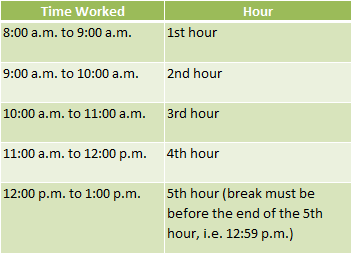
The California Supreme Court made clear in Brinker Restaurant Group v. Superior Court that employers need to give an employee their first meal break “no later than the end of an employee’s fifth hour of work, and a second meal period no later than the end of an employee’s 10th hour of work.” Here is a chart to illustrate the Court’s holding:


Rest Breaks
As for rest breaks, the Court set forth that, “[e]mployees are entitled to 10 minutes’ rest for shifts from three and one-half to six hours in length, 20 minutes for shifts of more than six hours up to 10 hours, 30 minutes for shifts of more than 10 hours up to 14 hours, and so on.” This rule is set forth in this chart:

In regard to when rest breaks should be taken during the shift, the Court held that “the only constraint of timing is that rest breaks must fall in the middle of work periods ‘insofar as practicable.’” The Court stopped short of explaining what qualifies as “insofar as practicable” and employers should closely analyze whether they may deviate from this general principle.

2. Rule regarding waiver of breaks.

Meal Breaks
Generally meal breaks can only be waived if the employee works less than six hours in a shift. However, as long as employers effectively allow an employee to take a full 30-minute meal break, the employee can voluntarily choose not to take the break and this would not result in a violation. The Supreme Court explained in Brinker (quoting the DLSE’s brief on the subject):

The employer that refuses to relinquish control over employees during an owed meal period violates the duty to provide the meal period and owes compensation [and premium pay] for hours worked. The employer that relinquishes control but nonetheless knows or has reason to know that the employee is performing work during the meal period, has not violated its meal period obligations [and owes no premium pay], but nonetheless owes regular compensation to its employees for time worked.

Rest Breaks
Rest breaks may also be waived by employees, as long as the employer properly authorizes and permits employees to take the full 10-minute rest break at the appropriate times.

3. Timekeeping requirements of meal breaks.

Meal breaks taken by the employees must be recorded by the employer. However, there is no requirement for employers to record 10-mintute rest breaks.

4. Implementing a procedure for employees to notify the company when they could not take a break.

If employers have the proper policy and practices for meal and rest breaks, the primary issue then becomes whether the employer knew or should have known that the employee was not taking the meal or rest breaks. Therefore, allegations that the employer was not providing the required breaks can be defended on the basis that the employer had an effective complaint procedure in place to inform the employer of any potential violation, but the plaintiff failed to inform the employer of these violations.

5. Time rounding for meal breaks is not permitted under California law.

In Donohue v. AMN Services LLC, the California Supreme Court held that employers may not use time rounding policies in context of meal periods, and time records for meal periods that are incomplete or inaccurate raise a rebuttable presumption of meal period violations.  The Court explained that rounding polices when used for meal breaks, an employee’s 30-minute meal break could lose 9 minutes due to rounding, which amounts to nearly a third of the meal break.  If an employee is not provided a full 30-minute meal break because of rounding, there is no mechanism that makes up for the premium pay owed to the employee that would average out over time.  The Supreme Court held, “The precision of the time requirements set out in Labor Code section 512 and Wage Order No. 4 — “not less than 30 minutes” and ‘five hours per day’ or ‘ten hours per day’ — is at odds with the imprecise calculations that rounding involves.  The regulatory scheme that encompasses the meal period provisions is concerned with small amounts of time.”

As employers and employees adapt to the new realities of working from home on a permanent or modified basis, employers need to be aware of the employment law issues that arise with such arrangements.  This Friday’s Five covers five items employers should review for employees working from home:

1. Confidentiality and security.

Employers are able to monitor company owned equipment and internet services at the office.  However, with employees working remotely, employers lose this control, and employees likely do not have the same sophistication when setting up security for technology.  Employers should review the need to provide training to employees about the use of public Wi-Fi, updating passwords, the use of password security management software, and other best practices.  It is also recommended to remind employees to be aware of their surroundings when discussing confidential company information – such as on phone calls in public areas.

2. Employee privacy.

Employers can generally monitor employees’ use of company provided internet at the office, employers have less rights to monitor employees while they are working from home.  The employer’s ability to monitor employees away from the office can create some issues (especially when there is no clear distinction of when the employee is on or off duty – as discussed below).  Employers should review their policies to ensure that any monitoring does not violate employee’s privacy rights and sets for a clear policy of what the employer is monitoring.  A critical aspect of the review is the company’s policies about what is being monitored, ensuring that there is a need for the monitoring, and ensuring that the monitoring does not capture data or information that the employee has a reasonable expectation of privacy.

3. Clear designation of working hours.

The Wage Orders require that California employers keep “[t]ime records showing when the employee begins and ends each work period.  Meal periods, split shift intervals and total daily hours worked shall also be recorded.”  IWC Wage Order 5-2001(7)(a)(3).

Additionally, Labor Code section 1174 requires employers to keep time records showing the hours worked daily and the wages paid, number of piece-rate units earned by, and the applicable piece rate paid.

Employers need to ensure employees have a clear method for tracking their time worked at home to meet these obligations.  In addition, employers should consider setting designated work hours, so that employees are clear on when they are expected to be responsive to work-related requests and to minimize the need for overtime work.

4. Expense reimbursement.

As explained on this blog before, California Labor Code section 2802 requires employers to pay for necessary business expenses incurred by employees, and this would include expenses for working at home, such as for computers, printers, internet usage, and other items, such as paper for printing if required by the employer.  However, as the LA Times reported, some plaintiffs are alleging that not only should employers have to pay for their printers and computers, but also for missed revenue the employee could have received for renting out their home office.  I’m a bit skeptical about whether missed rental revenue is recoverable under the Labor Code, as missed rent would be difficult to prove.

5. Minimum wage, paid sick leave, and other local requirements based on where the employee’s home is located.

Employers need to be careful about varying minimum wage and paid sick leave requirements for employees who are working from home.  The employee’s home may be located in a different jurisdiction than the employer’s workplace, and it could require the employer to pay the employee at a different minimum wage rate or provide additional paid sick leave.

Many of the local and county ordinances set forth when the city or county law will cover an employee who works within its jurisdiction.  For example:

  • Santa Monica:  Law applies to any employee working a minimum of two hours within Santa Monica in a given week (even if employer is located outside of Santa Monica).
  • City of Los Angeles: “An employee is an individual who performs at least two hours of work in a particular week within the City of Los Angeles….”
  • County of Los Angeles: “Anyone who works at least two hours in a one-week period within the unincorporated areas of Los Angeles County is entitled to the County minimum wage for the hours worked in the unincorporated area of the County.”
  • Pasadena: Applies to employees who perform at least two hours of work in Pasadena.

Employers need to review the various jurisdictions in which the employees are located when working from home to ensure the employees are provided the required minimum wage and paid sick leave that may be triggered based on where the employee is performing their work.

On February 9, 2022, Governor Newsom signed a new law requiring employers to provide supplemental COVID-19 paid sick leave during 2022 through September 30, 2022.  The law, SB 114, unlike the supplemental paid sick leave law passed in 2021, provides for no offsetting tax credits for employers to assist with the added costs this paid sick leave places on businesses across the state.  Here are five reminders for California employers about the law and its related deadlines as we approach its September 30th expiration:

1. The COVID-19 supplemental paid sick leave law took effect on February 19, 2022 and expires on September 30, 2022.

The Governor signed the law on February 9, 2022, and the paid sick leave requirement took effect 10 days after the enactment of the law – February 19, 2022.  The law applied retroactive obligation for employers to pay for qualifying paid sick leave starting January 1, 2022.  The paid sick leave requirement expires on September 30, 2022 (but employees currently using the sick leave can continue its use past the September 30th deadline).

2. Which employers are covered by the law?

The law applies to employers with more than 25 employees.

3. Which employees are entitled to paid sick leave?

Employers are required to provide employees COVID-19 supplemental paid sick leave if the employee is unable to work or telework due to the following reasons:

  1. The employee is subject to a quarantine or isolation period related to COVID-19 as defined by an order or guidance of the State Department of Public Health, the federal Centers for Disease Control and Prevention, or a local public health officer who has jurisdiction over the workplace.
  2. The employee has been advised by a health care provider to isolate or quarantine due to COVID-19.
  3. The employee is attending an appointment for themselves or a family member to receive a vaccine or a vaccine booster for protection against COVID-19, subject to certain limitations.
  4. The employee is experiencing symptoms, or caring for a family member experiencing symptoms, related to a COVID-19 vaccine or vaccine booster that prevents the employee from being able to work or telework.
  5. The employee is experiencing symptoms of COVID-19 and seeking a medical diagnosis.
  6. The employee is caring for a family member who is subject to an order or guidance or who has been advised to isolate or quarantine.
  7. The employee is caring for a child whose school or place of case is closed or otherwise unavailable for reasons related to COVID-19 on the premises.
  8. If the employee, or a family member for whom the employee is providing care, tests positive for COVID-19. (Note: employer may condition payment of supplemental paid sick leave for this reason upon the employee providing a positive test for themselves or the family member they are caring for.)

4. How much paid leave is required?

The employee is eligible for potentially up to 80 hours of leave available under two different banks:

  • Bank #1: Employees are entitled up to 40 hours of COVID-19 supplemental paid sick leave for full time employees based on reasons 1 through 7 above.
  • Bank #2: Employees are entitled up to 40 hours of paid leave for reason number 8 listed above (if they or a family member test positive).

Employers should therefore implement internal tracking measures to track the reason for the leave and how much of the leave the employee has taken under each of the two banks of leave available.  More information can be found on the Labor Commissioner’s FAQ page.

Calculating Amount of Leave Available

The law sets forth how employers are to calculate the amount of leave for part-time, variable scheduled employees, and full-time employees.  Employers need to review the requirements in order to make the appropriate calculations for these different classes of employees.

Calculating Rate of Pay

The law sets forth how employers are to calculate the rate of pay for nonexempt employees, and exempt employees.  Employers need to carefully review these calculations to ensure the proper rate of pay is being used when an employee takes qualifying paid leave.

Caps on Payments

However, the total paid sick leave is capped at 80 hours for the period between January 1, 2022 to September 30, 2022.  In addition, employers are not required to pay more than $511 per day and $5,110 in the aggregate to an employee (unless federal legislation changes these amounts set forth in the FFCRA).

Interaction with California’s Healthy Workplaces, Healthy Families Act and Cal/OSHA ETS Exclusion Pay, and Local Ordinances

The supplemental paid sick leave is in addition to the paid sick leave employees are entitled to under California’s Healthy Workplaces, Healthy Families Act set forth in Labor Code 246.  Moreover, employers cannot require employees to first exhaust the supplemental paid sick leave before paying exclusion leave required under the Cal/OSHA Emergency Temporary Standards (ETS).  The California supplemental paid sick leave leaves in place any employer obligation to comply with local paid sick leave requirements, such as those in Los Angeles City and County, Long Beach, and Oakland.

5. Notice and pay stub requirements.

The law requires employers to provide a notice to employees the amount of COVID-19 supplemental paid sick leave that the employee has used through the pay period that it was due to be paid.  This can be provided on the employee’s pay stub or on another writing provided to the employee on the designated pay day.  The employer shall list “zero hours used” if a worker has not used any COVID-19 supplemental paid sick leave.  This requirement took effect the next full pay period following February 19, 2022.

Employers are also required to post or distribute a notice to employees that was developed by the Labor Commissioner and can be found here.

Other provisions of the law also address firefighters and providers of in-home supportive services employees.

On July 27, 2022, California’s Department of Finance confirmed that due to the raising inflation, the minimum wage for all employers will increase by 3.5% to $15.50 per hour on January 1, 2023.

California’s minimum wage not only impacts minimum wage workers, but it also effects the salary required for employees to qualify as an exempt employee.  Here are five reminders about the California minimum wage increase and its impact upon exempt employees:

1.  As of January 1, 2023, the minimum wage in California will increase to $15.50 for all employers – large and small.

The minimum wage increase on January 1, 2023 will set the same minimum wage for large and small employers, unlike recent minimum wage increases which provided for a lower amount required for smaller employers with 25 or fewer employees.  The increase on January 1, 2023 will be especially hard for small employers given the $1.50 increase in minimum wage (increase from the current $14.00 per hour) for these companies.

2.  With the increase in the state minimum wage, there is a corresponding raise in the minimum salary required to qualify as exempt under the “white-collar” exemptions. 

To be exempt from the requirement of having to pay overtime to the employee, the employee must perform specified duties in a particular manner and be paid “a monthly salary equivalent to no less than two times the state minimum wage for full-time employment.” (Lab. Code, § 515, subd. (a).)  Therefore, on January 1, 2023, to qualify for a white-collar exemption, the employee must receive an annual salary of at least $64,480 annually ($1,240 weekly) for all employers.

3.  The salary for exempt employees must be a guaranteed, fixed amount.

The employee’s salary cannot be reduced for quality or quantity of work.

4.  To qualify as an exempt employee, the employee must perform more than 50% of their time performing exempt duties.

More information about the types of duties that qualify for the white-collar exemptions can be read here.

5.  Employers bear the burden of proof when establishing that an employee qualifies as an exempt employee.

Employers have the burden of proof when an employee challenges an exempt classification.  California courts have made clear that the employer bears the burden of proof when asserting that an employee is an exempt employee:  “[T]he assertion of an exemption from the overtime laws is considered to be an affirmative defense, and therefore the employer bears the burden of proving the employee’s exemption.”  Ramirez v. Yosemite Water Co. (1999).

Employers have the burden to record and maintain accurate time records under California law. If the employer knows employees are not properly recording their time, the employer needs to enforce a policy to have employees accurately record their time, even if it requires disciplinary action. In addition, employers need to review their time records to ensure employees are following proper procedures.  Here are five reminders of best practices for time records for California:

1. Ensure the time records are accurate.

It goes without saying that the time records need to be accurate in the time that is being recorded for the employees.  For the employer, this means reviewing the use of electronic time keeping systems.  However, if an employer is relying upon the employee to record their time manually, or in a spreadsheet, these records must be audited to ensure that the employee is being accurate in the time they are recording.  For example, the employer needs to prevent an employee manually recording their start and stop time and the same time every day without any variations.  More information about electronic time records and storage requirements is available here.

2. Storing time records for the required amount of time.

The statute of limitations can reach back four years in wage and hour class actions under California law, and time records will be the primary evidence in most of these cases.  California law requires employers to track start and stop times for hourly, non-exempt employees, and record meal breaks as discussed below.  Employers need to ensure they are keeping these critical records for the amounts of time required under the law, and also long enough to defend against wage and hour claims.

3. Must record all required information.

Employers need to ensure their timekeeping system is recording the required information.  For example, while employers are not required to record 10-minute rest breaks, employers are required to record employee’s meal periods under the IWC Wage Orders (requirement is found section 7 – Records).

4. Maintaining time records in a usable format.

Maintaining records in a form that makes reviewing the records almost impossible is almost equivalent to not maintaining them in the first place. Some thought should be put into how an employer is storing time records and understanding how that data could efficiently be reviewed in the future if needed.  Electronic time records are easiest to analyze given that the data is digital.  However, employers should consider where the records are stored (electronic or paper), and how easy is it to pull information for individual employees, and for all employees, if needed.

5. Tracking employees’ signed waivers, acknowledgments, and time card adjustments.

Just like time records, employers need to consider a system for storing, indexing, and retrieving records related to the employee’s time records, such as any time adjustments, employee signed waivers (more information about meal break waivers is available here), and signed acknowledgments.  Documentation is critical but being able to track and retrieve documents for specific employees or for the workforce over a period of time is just as important.  Employers need to put just as much thought into this aspect as they do in training managers and supervisors to document issues in the first place.

Hope you are having a great summer.  As many employees take (or consider taking) vacation during this summer, employers in California must be aware of unique rules that apply to vacation time. This Friday afternoon, I thought it was an appropriate time to review five potential vacation policy traps for California employers:

1. No use-it-or-lose-it policies permitted.
Under California law, vacation is treated the same as earned wages and vest as the employee performs work. Because vacation is earned proportionally as the employee works, policies requiring employees to lose vacation already earned is illegal under California law.

2. Reasonable caps are allowed.
While employers cannot implement “use-it-or-lose-it” policies, they can place a reasonable cap, or ceiling, on vacation accrual. The DLSE explains:

Unlike “use it or lose it” policies, a vacation policy that places a “cap” or “ceiling” on vacation pay accruals is permissible. Whereas a “use it or lose it” policy results in a forfeiture of accrued vacation pay, a “cap” simply places a limit on the amount of vacation that can accrue; that is, once a certain level or amount of accrued vacation is earned but not taken, no further vacation or vacation pay accrues until the balance falls below the cap. The time periods involved for taking vacation must, of course, be reasonable. If implementation of a “cap” is a subterfuge to deny employees vacation or vacation benefits, the policy will not be recognized by the Labor Commissioner.

3. Vacation is a form of earned wages that must be paid out on the employee’s last day of work.
An employee who is discharged must be paid all of his or her wages, including accrued vacation, immediately at the time of termination. See Labor Code Sections 201 and 227.3.  More information about the timing and payment of final wages can be read here.

4. Deductions are not permitted from employee’s final wages for use of vacation that was not accrued.
Vacation is treated as a form of wages under California law, and by permitting an employee to take vacation time before it is earned is similar to providing a loan to the employee.  However, employers may not utilize self-help remedies to recover debts from the employee’s final pay check, including deducting wages owed to an employee to cover vacation that time was used but had not yet been accrued by the employee.

5. “Cliff vesting” policies are problematic.
Employers may set probationary periods or waiting periods during which employees do not accrue vacation time. However, the DLSE maintains that employers may not have a policy that grants employees a lump sum of vacation upon reaching certain dates (for example, a policy granting the employee five days of vacation at the employee’s one year anniversary of work, but not permit the employee to take any vacation prior to the anniversary date).

The DLSE’s view on this type of “cliff vesting” is that the employer is attempting to provide for accrued vacation, but at the same time is attempting to limit its liability of having to pay out a pro rata share of the accrued vacation if the employee does not work until the date the vacation is granted to the employee.  Many employers avoid these potentially problematic lump sum grants of vacation by setting a time period (i.e., the employee’s first six months of employment) that the employee does not accrue vacation.

California law on vacations is vastly different than Federal law and other states. It can be a trap for employers, but with some understanding of the obligations created under the law it can easily be managed.

Hope you are enjoying your summer.

Instead of relying on the old job offer letter you had a lawyer review in the 1990’s for your next new hire, it is recommended to review the offer letter to ensure it is up to date with current law. Here are the five terms employers should consider to include in job offer letters:

1. At-will designation

An offer letter should clearly set forth that the employee is being hired as an at-will employee, and that employment may be terminated by either party with or without notice at any time. Under California law, it is presumed that all employment is terminable at-will. California Labor Code section 2922 provides: “An employment, having no specified term, may be terminated at the will of either party on notice to the other.” The at-will doctrine means that the employment relationship can be terminated by either party at any time, with or without cause, and with or without advanced notice. Even though the law presumes all employment is at-will, it should be clearly set out in the offer letter as well.

2. Description of the job

It is a good practice to have job descriptions for all positions in a company. If the company does not have a job description, be as detailed as possible about the duties of the position the applicant is being hired for in the offer letter. This will help avoid potential disputes about whether certain duties are essential functions of the position for reasonable accommodation purposes, and could also be evidence in defending claims that the employee was misclassified as exempt. The job offer could also set forth whether the position is non-exempt or exempt, and have the duties reflect the designation.

3.  Integration Clause

Place language into the offer letter that the terms set forth in the letter supersede any other offers or promises. This type of term is referred to as an integration clause. Including an integration clause into the offer letter will assist in countering any claim later on that other promises were made to the employee at the time of hire and the employer failed to comply with those promises.

4.  Set forth commission terms if employee is eligible for commissions

Since January 1, 2013, all commission agreements must be in writing and must be signed by the employer and employee. Employers should review the offer letter to see if the offer letter meets these requirements. If it does not, or the commission structure is too complex to include in the offer letter, commission agreements still must be set out in a separate writing and signed by the employer and the employee. Employers should approach the issue of commissions carefully to ensure that the agreement defines key terms. In addition, in the case of non-exempt hourly employees, employers must be careful on how the commissions could affect the calculation of the regular rate of pay for overtime purposes.

5.  Confidentiality provisions

Set forth if your company will require the employee to enter into a confidentiality agreement. If possible, attach the confidentiality agreement and have the applicant sign the agreement at the same time the job offer is accepted. The offer letter should also contain language to the effect that the applicant does not have any agreements with prior employers that would interfere with their duties and that the applicant will not use any confidential information learned at prior positions.