This week’s Friday’s Five: a curated collection of must-watch videos on our YouTube channel for all California employers. Stay informed and discover the valuable insights you need to navigate the intricacies of the state’s employment landscape:

1. Exempt or non-exempt?

2. Meal and rest break basics

3. Culture fit happens in hiring

4. Arbitration agreements 101

5. Steps for avoiding wrongful termination claims as a California employer

By Pooja Patel and Anthony Zaller

An issue that constantly plagues the service industry is what to do about tips and the challenges that come with mandated tip pooling and mandatory service charges. This week’s post is an update and a general discussion about tipping and mandatory service charges. This simple concept is surprisingly complex for employers.  Here are five issues employers should understand about tips in California.

1) Who owns a tip?

California law is clear that voluntary tips left for an employee for goods sold or services performed belong to the employee, not the employer. Labor Code section 351 provides, “No Employer or agent shall collect, take or receive any gratuity or a part thereof that is paid, given to, or left for an employee by a patron…. Every gratuity is hereby declared to be the sole property of the employee or employees to whom it was paid, given, or left for.”

2) Is employer-mandated tip pooling legal?

Yes, generally tip pooling is legal in California as long as it is fair and reasonable. In Leighton v. Old Heidelberg, Ltd., the court held that an employer’s practice of tip pooling among employees was not prohibited by section 351 because the employer did not “collect, take, or receive” any part of a gratuity left by a patron, and did not credit tips or deduct tip income from employee wages. The court relied upon the “industry practice” that 15% of the gratuity is tipped out to the busboy and 5% to the bartender, which was “a house rule and is with nearly all Restaurants.”

There must be a reasonable relationship between tip pooling arrangements.  The following examples of mandatory tip pooling percentages have been approved by a court, the DLSE or DOL:

  • A policy in which 80 percent of tips were allocated to waiters, 15 percent to busboys and five percent to bartenders
  • A policy in which cocktail service must give one percent of tips to bartender
  • The Department of Labor responsible for enforcing Federal law has stated that a policy that requires servers to share 15 percent of their tips with other employees is presumptively reasonable
  • A policy in which a server contributes 15 percent to a tip pool, and other employees in the chain of service receive a portion of these tips based on the amount of hours they worked

The following examples were tip pooling policies disapproved by courts or the DLSE and therefore employers cannot legally establish them:

  • A policy providing 90 percent of tips to hostesses who spend only a small amount of time seating customers
  • A policy requiring food server to share 10 percent of tips with floor managers

3) Who can share in the tip pool?

Employees in the chain of service:

Generally, employees who are in the “chain of service” may partake in a mandatory tip pool. In Etheridge v. Reins International California, Inc., the servers challenged the inclusion of employees, such as kitchen staff, bartenders, and dishwashers, who do not provide direct table service in the mandatory tip pool. The California Court of Appeals confirmed that employees who do not provide direct table service but are in the “chain of service,” such as kitchen staff, bartenders, and dishwashers, are allowed to participate in mandatory tip pools. The Court reasoned that this would encourage all staff in the chain of service to give their best service, regardless of whether the customers personally see them performing the work.

Managers, owners, or supervisors:

Labor Code section 351 prohibits agents from keeping a share or any portion of gratuities left or given to one or more employees by a customer. However, the California Court of Appeal in Chau v. Starbucks Corp. found that a service employee who is also an agent, such as the shift supervisor, can participate in tip pools for tips left in a collective tip box for all service employees. While Chau permitted employers to include supervisors in tip pools, that case addressed a very specific set of facts, and employers must approach the issue of including supervisors in tip pools with caution.

4) Do tips change an employee’s minimum wage or regular rate of pay for overtime calculations?

No. Because tips are voluntarily left by customers to employees, tips do not increase an employee’s regular rate of pay used to calculate overtime rates.

Additionally, California law does not allow employees to “credit” an employee’s tips towards the minimum wage. Therefore, employers should still ensure to pay employees the state (or local) minimum wage.

5) Are mandatory service charges the same as a tip?

No. A tip is voluntarily left by the patron, while a mandatory service charge is mandatorily charged to the patron by the employer.

While a tip is considered the employee’s property, a mandatory service charge is considered the employer’s property. Thus, unlike with tips, an employer may distribute all or part of the service at their discretion. However, this freedom comes with strings: the amounts paid to employees as a mandatory service charge must be considered when calculating the employee’s regular rate to calculate overtime rates. As a reminder, to calculate an employee’s regular rate of pay, the employer must divide all compensation for the week by the total number of hours worked by the employee.

Reminder: there may be additional requirements under local ordinances regulating service charges. For example, Santa Monica’s minimum wage ordinance requires employers to “distribute all Service Charges in their entirety to the Employee(s) who performed services for the customers from whom the Service Charges are collected . . . no part of these amounts may be paid to Employees whose primary role is supervisory or managerial”  Santa Monica Municipal Code § 4.62.040.  “Service Charge” is defined as “any separately-designated amount charged and collected by an Employer from customers, that is for service by Employees, or is described in such a way that customers might reasonably believe that the amount is for those services or is otherwise to be paid or payable directly to Employees…under the term ‘service charge,’ ‘table charge,’ porterage charge,’ ‘automatic gratuity charge,’ ‘healthcare surcharge,’ ‘benefits surcharge,’ or similar language.”  Santa Monica Municipal Code § 4.62.010(g).

Employers considering implementing noncompetition and nonsolicitation agreements for their California workforce must understand the differences in these agreements, and California’s public policy against restraints against an employee’s ability to work in their profession or trade.  This Friday’s Five covers the top five issues employers must know about noncompetition and nonsolicitation agreements in California.

1. Noncompetition and nonsolicitation agreements cannot violate Business & Professions Code section 16600

In California, noncompetition agreements are governed by Business & Professions Code section 16600, which states: “Except as provided in this chapter, every contract by which anyone is restrained from engaging in a lawful profession, trade, or business of any kind is to that extent void.” The statute permits non-competition agreements in the context of sale or dissolution of corporations (§ 16601), partnerships (§ 16602), and limited liability corporations (§ 16602.5).  But other than these narrow exceptions connected with the sale or dissolution of a company, California has a strong public policy against non-competition agreements.

Under the common law, as still recognized by many states today, contractual restraints on the practice of a profession, business, or trade, were considered valid, as long as they were reasonably imposed.

2. California Supreme Court ruling in Edwards v. Arthur Andersen regarding non-competition agreements

In 2008, the California Supreme Court ruled on the enforceability of non-competition agreements under California law in Edwards v. Arthur Andersen LLP. Arthur Andersen argued that California courts have held that section 16600 embraced the rule of reasonableness in evaluating competitive restraints.

The Court disagreed with Arthur Andersen and held that the non-competition agreement at issue was invalid under California law because the agreement prohibited the employee from performing professional services for any client he worked with at Arthur Andersen for a 18-month period.  It also prohibited the employee from soliciting any client of Arthur Andersen’s Los Angeles office.  The Court held that these prohibitions restricted the employee’s ability to practice his accounting profession, and therefore was unenforceable under California law.

3. California Supreme Court refused to recognize the “narrow-restraint” exception in non-competition agreements

Arthur Andersen argued that section 16600 has a “narrow-restraint” exception and that its agreement with Edwards survives under this exception because the restraints against the employee were narrow and reasonable.  Arthur Andersen maintained that the federal court in International Business Machines Corp. v. Bajorek (9th Cir. 1999) upheld an agreement mandating that an employee forfeits stock options if employed by a competitor within six months of leaving employment.  It also noted that a Ninth Circuit federal court in General Commercial Packaging v. TPS Package (9th Cir. 1997) held that a contractual provision barring one party from courting a specific customer was not an illegal restraint of trade prohibited by section 16600, because it did not “entirely preclude[]” the party from pursuing its trade or business.

In rejecting Arthur Andersen’s argument, the California Supreme Court refused to recognize the “narrow-restraint” exception for noncompetition agreements in California:

Contrary to Andersen’s belief, however, California courts have not embraced the Ninth Circuit’s narrow-restraint exception. Indeed, no reported California state court decision has endorsed the Ninth Circuit’s reasoning, and we are of the view that California courts “have been clear in their expression that section 16600 represents a strong public policy of the state which should not be diluted by judicial fiat.” [citation] Section 16600 is unambiguous, and if the Legislature intended the statute to apply only to restraints that were unreasonable or overbroad, it could have included language to that effect. We reject Andersen’s contention that we should adopt a narrow-restraint exception to section 16600 and leave it to the Legislature, if it chooses, either to relax the statutory restrictions or adopt additional exceptions to the prohibition-against-restraint rule under section 16600.

4. Customer nonsolicitation agreements

There are two types of non-solicitation agreements: one that restricts the employee’s ability to solicit customers and another that restricts the employee’s ability to solicit employees (see item #5 below).

Regarding customer non-solicitation agreements, as set forth above, the California Supreme Court in Edwards v. Arthur Andersen ruled that a prohibition on a former employee’s solicitation of clients was an invalid restraint on the employee’s ability to pursue his trade or business.  Similarly, in 2009, a California appellate court in Dowell v. Biosense Webster, Inc. held that a broadly worded non-solicitation clause that prohibited an employee for a period of 18 months postemployment from soliciting any business from, selling to, or rendering any service directly or indirectly to any of the accounts, customers or clients with whom they had contact during their last 12 months of employment was void under section 16600.  In Dowell, the court rejected the employer’s argument that the agreement was enforceable under the trade secret exception because it found the non-solicitation provision was “not narrowly tailored or carefully limited to the protection of trade secrets, but are so broadly worded as to restrain competition.”

5. Employee nonsolicitation agreements

Employee non-solicitation clauses can also be found to violate section 16600 if drafted too broadly and it in effect becomes an invalid restraint on the employee’s ability to work in their profession or trade.  The court in Loral Corp. v. Moyes (1985), ruled that the agreement at issue was more of a “noninterference agreement” between the employer and former employee and upheld the employer’s non-solicitation provision.  The ruling upheld an agreement that prevented the former employee from soliciting employees from the employer, and, even though the agreement did not have a time limitation, the court interpreted the agreement to apply a one-year limit.

However, in AMN Healthcare, Inc. v. Aya Healthcare Services, Inc. (2018), a California court of appeal held that employee non-solicitation to be an invalid restrain on trade.  The court explained:

Indeed, the broadly worded provision prevents individual defendants, for a period of at least one year after termination of employment with AMN, from either “directly or indirectly” soliciting or recruiting, or causing others to solicit or induce, any employee of AMN. This provision clearly restrained individual defendants from practicing with Aya their chosen profession— recruiting travel nurses on 13-week assignments with AMN.

The ruling in AMN Healthcare arguably overturned decades of decisions, such as Loral, upholding employee non-solicitation agreements.  However, some have argued that AMN Healthcare is a unique case with a limited holding – since the issue delt with employees who were professional recruiters, and therefore baring them from recruiting employees would be more impactful on their ability to continue to work in their chosen profession.  Nevertheless, AMN Healthcare raises doubt about whether employee non-solicitation provisions can be enforced in California.

California employers are cautioned to carefully review all agreements that restrict former employees’ ability to compete and solicit customers and employees to ensure the restrictions do not violate California’s strong public policy in allowing employees to perform their chosen profession or trade.

Recently we have been litigating and answering basic issues about employers’ obligations to provide meal and rest breaks.  It has been a few years since the California Supreme Court issued its groundbreaking ruling in Brinker Restaurant Group v. Superior Court, and there is no indication that wage and hour litigation for California employers will lighten up, so employers should constantly monitor and audit their meal and rest break policies and practices. Here are five reminders for employers:

1. Timing of breaks.

Meal Breaks
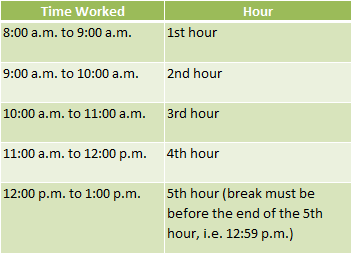
The California Supreme Court made clear in Brinker Restaurant Group v. Superior Court that employers need to give an employee their first meal break “no later than the end of an employee’s fifth hour of work, and a second meal period no later than the end of an employee’s 10th hour of work.” Here is a chart to illustrate the Court’s holding:

Rest Breaks
As for rest breaks, the Court set forth that, “[e]mployees are entitled to 10 minutes’ rest for shifts from three and one-half to six hours in length, 20 minutes for shifts of more than six hours up to 10 hours, 30 minutes for shifts of more than 10 hours up to 14 hours, and so on.” This rule is set forth in this chart:

In regard to when rest breaks should be taken during the shift, the Court held that “the only constraint of timing is that rest breaks must fall in the middle of work periods ‘insofar as practicable.’” The Court stopped short of explaining what qualifies as “insofar as practicable” and employers should closely analyze whether they may deviate from this general principle.

2. Rule regarding waiver of breaks.

Meal Breaks
Generally meal breaks can only be waived if the employee works less than six hours in a shift. However, as long as employers effectively allow an employee to take a full 30-minute meal break, the employee can voluntarily choose not to take the break and this would not result in a violation. The Supreme Court explained in Brinker (quoting the DLSE’s brief on the subject):

The employer that refuses to relinquish control over employees during an owed meal period violates the duty to provide the meal period and owes compensation [and premium pay] for hours worked. The employer that relinquishes control but nonetheless knows or has reason to know that the employee is performing work during the meal period, has not violated its meal period obligations [and owes no premium pay], but nonetheless owes regular compensation to its employees for time worked.

Rest Breaks
Rest breaks may also be waived by employees, as long as the employer properly authorizes and permits employees to take the full 10-minute rest break at the appropriate times.

3. Timekeeping requirements of meal breaks.

Meal breaks taken by the employees must be recorded by the employer. However, there is no requirement for employers to record 10-mintute rest breaks.

4. Implementing a procedure for employees to notify the company when they could not take a break.

If employers have the proper policy and practices for meal and rest breaks, the primary issue then becomes whether the employer knew or should have known that the employee was not taking the meal or rest breaks. Therefore, allegations that the employer was not providing the required breaks can be defended on the basis that the employer had an effective complaint procedure in place to inform the employer of any potential violation, but the plaintiff failed to inform the employer of these violations.

5. Time rounding for meal breaks is not permitted under California law.

In Donohue v. AMN Services LLC, the California Supreme Court held that employers may not use time rounding policies in context of meal periods, and time records for meal periods that are incomplete or inaccurate raise a rebuttable presumption of meal period violations.  The Court explained that rounding polices when used for meal breaks, an employee’s 30-minute meal break could lose 9 minutes due to rounding, which amounts to nearly a third of the meal break.  If an employee is not provided a full 30-minute meal break because of rounding, there is no mechanism that makes up for the premium pay owed to the employee that would average out over time.  The Supreme Court held, “The precision of the time requirements set out in Labor Code section 512 and Wage Order No. 4 — “not less than 30 minutes” and ‘five hours per day’ or ‘ten hours per day’ — is at odds with the imprecise calculations that rounding involves.  The regulatory scheme that encompasses the meal period provisions is concerned with small amounts of time.”

Employers of 100 or more employees to report to the California Civil Rights Department pay and hours-worked data by establishment, pay band, job category, sex, race, and ethnicity.  For 2023, the pay data reports are due by May 10.  This requirement applies to employers even if they are based outside of California, but have one employee (or even one employee hired through a labor contractor such as an staffing agency) working in California or assigned to an establishment in California.   

In Senate Bill 973, passed in 2020, the California Legislature found that “[d]espite significant progress made in California in recent years to strengthen California’s equal pay laws, the gender pay gap persists, resulting in billions of dollars in lost wages for women each year in California. …Although there are legitimate and lawful reasons for paying some employees more than others, pay discrimination continues to exist, is often ‘hidden from sight,’ and can be the result of unconscious biases or historic inequities.”

By requiring large employers to report pay data annually the Legislature sought to encourage these employers to self-assess pay disparities along gendered, racial, and ethnic lines in their workforce and to promote voluntary compliance with equal pay and anti-discrimination laws.

In addition, Senate Bill 973 authorized CRD to enforce the Equal Pay Act (Labor Code section 1197.5), which prohibits unjustified pay disparities. Moreover, the Fair Employment and Housing Act (Gov. Code § 12940 et seq.), already enforced by CRD, prohibits pay discrimination. The CRD states that the Employers’ pay data reports allow CRD to identify wage patterns and allow for effective enforcement of equal pay or anti-discrimination laws, when appropriate.

In 2022, the Legislature passed Senate Bill 1162 to enhance the California pay data reporting law in many aspects.  For example, for the first time in 2023, private employers with 100 or more workers hired through labor contractors in the prior calendar year to report pay data for these workers and requiring more information about the employer’s workforce, such as median and mean wage information. 

1. SB 1162, passed in 2022 changed a few aspects of the prior pay data reporting requirements.

New deadline of the second Wednesday of May each year (May 10, 2023) (previously deadline was March 31).

Requires additional information: median and mean hourly rate for each combination of race, ethnicity, and sex within each job category.

Requires employers with 100 or more employees hired through contractors to submit a separate report for these employees.

Requires employers with multiple establishments to submit a report for each establishment.

2. Employers who must report.

Under Government Code section 12999(a)(1), a private employer that has 100 or more employees (anywhere as long as it has one employee in California) are required to submit a pay data report to the Civil Rights Division (CRD).  An employee is “an individual on an employer’s payroll, including a part-time individual, and for whom the employer is required to withhold federal social security taxes from that individual’s wages.” Gov. Code § 12999(k)(1).

3. Determining if an employer has 100 or more employees.

An employer has the requisite number of employees if the employer either employed 100 or more employees in the Snapshot Period or regularly employed 100 or more employees during the Reporting Year. “Regularly employed 100 or more employees during the Reporting Year” means employed 100 or more individuals on a regular basis during the Reporting Year. “Regular basis” refers to the nature of a business that is recurring, rather than constant. See Cal. Code Regs., tit. 2, §§ 11008(d)(1) & 11008(d)(1)(A).

The Snapshot Period is a single pay period between October 1 and December 31 of the Reporting Year.  For the 2023, the Reporting Year is 2022.  Employers may choose the single pay period between October 1 and December 31. The Snapshot period is used to identify the employees to be reported on in the pay data report. The employee does not have to be paid during the Snapshot period – it only matters whether the employee was employed during the Snapshot Period.

Employees located inside and outside of California are counted when determining whether an employer has 100 or more employees. See Cal. Code Regs., tit. 2, § 11008(d)(1)(C).

An employer with no employees in California during the Reporting Year is not required to file a pay data report.

Part-time employees, including those who work partial days and fewer than each day of the work week, are counted the same as full-time employees. 

Employees on paid for unpaid leave, including the California Family Rights Act (CFRA) leave, pregnancy leave, disciplinary suspension, or any other employer-approved leave of absence, must be counted.

Employers must include all employees assigned to California establishments and/or working within California.

4. Must include remote workers outside of California, but “assigned” to an establishment in California.

The CRD sets forth that remote workers outside of California “assigned” to an establishment in California must be included in the employee pay data report.  The CDR provides the following example: If an employer has a single establishment in Riverside, California with 500 employees working from that location, the employer would submit a report covering all 500 employees. If 25 of these employees were working remotely (in California or beyond), the employer’s report would still cover all 500 employees.

5. When a Labor Contractor Employee Report must be filed.

Companies are required to file a separate Labor Contractor Employee Report if it had 100 or more workers hired through labor contractors in the prior calendar year anywhere with at least one worker based in California. 

“Labor contractor” – is defined as “an individual or entity that supplies, either with or without a contract, a client employer with workers to perform labor within the client employer’s usual course of business.” 

The CRD set forth the following example: In 2022, GHI Company had 200 payroll employees and 100 workers hired through labor contractors, all in California. GHI Company is required to submit a Payroll Employee Report covering its 200 payroll employees and, separately, a Labor Contractor Employee Report covering the 100 labor contractor employees.

The Civil Rights Department California Pay Data Reporting website is here.

The CRD’s FAQs about the Pay Data Report is here.

With summer right around the corner, many businesses are looking to hire from local high schools. Whether you are hiring minors as seasonal or full-time employees, there are key laws that employers should be familiar with. The Fair Labor Standards Act (FLSA), California Labor Code, California Wage Orders, and California Education Code regulate child labor.  

Who is a minor?  

Anyone under the age of 18 who is required to attend school and anyone under the age of six is considered a minor. 

What is a work permit and who needs one?  

All minors who have not graduated high school or been awarded a certificate of proficiency, must have a valid work permit. This is true even if it is summer or the minor is only hired seasonally. The first thing an employer should do when they hire a minor is ensure that they have a valid work permit. The minor obtains a work permit through their school and provides it to their employer. It is important to remember that work permits expire five days into the opening of the following school year and a permit still needs to be obtained even if it is summer. The permit should be maintained in the minors personnel file and needs to be obtained before the minor does any work for the employer.  

Key documents: 

Statement Of Intent To Employ A Minor And Request For A Work Permit–Certificate Of Age CDW Form B1-1: https://www.dir.ca.gov/dlse/dlseformB1-1.pdf  

Permit To Employ And Work CDE Form B1-4: https://www.dir.ca.gov/dlse/dlseformB1-4.pdf  

What hours can a minor work? 

The number of hours and time a minor can work depends on whether school is in session and the minors age. Generally, minors must have completed 7th grade to work while school is in session. Minors who are enrolled in remote or hybrid schools are still subject to the requirements below.  

Ages 16 and 17: 

Exception: if the minor is enrolled in work experience or cooperative vocational program approved by the California Department of Education, they can work until 12:30am any day and can work up to 8 hours on a school day  

If school in session, they can work up to 4 hours on school days and 8 hours on a non-school day and on days before non-school days. If school is not in session, they can work up to 8 hours a total. They can work up to 48 hours per week and can work between the hours of 5am and 10pm. On evenings before non-school days, they may work until 12:30am.  

 Ages 14 and 15:  

Exception: if the minor is enrolled in work experience or cooperative vocational program approved by the California Department of Education, they can work during school hours and up to 23 hours per week.  

If school is in session, they can work up to 3 hours on school days and 8 hours on a non-school day. They can work up to 18 hours per week and can work between the hours of 7am and 7pm. Between June 1 and Labor Day, they can work until 9pm.  

Ages 12 and 13:  

They can only work during school holidays and weekends – never on school days. They can work up to 8 hours per day, and up to 40 hours per week. Like 14- and 15-year-olds, they can work between the hours of 7am and 7pm, and between June 1 and Labor Day, they can work until 9pm. 

What duties can minors perform?  

Job restrictions vary by industry and age of the minor. Generally, minors cannot work in any occupation that is considered hazardous.  

Some examples include: 

  • 14- and 15-year-olds may only perform cooking duties in plain sight of customers and when it is not their sole duty  
  • Minors under 16 may not work in the baking industry  
  • Minors cannot use power-driven meat processing machines and certain baking machines  
  • Minors cannot work at a business whose main purpose is to sell alcoholic beverages for use on the premises (this includes all jobs, not just serving alcohol) 
  • Minors may bus tables in a bona fide public eating establishment where alcohol is served  
  • Minors may only sell alcoholic beverages for off-site compensation or lottery tickets if they are constantly supervised by a someone 21 years old or older 

What wage and hour obligations do I have to minors? 

Employers must pay minors at least the applicable minimum wage. In addition, minors that are non-exempt workers must be provided with legally compliant meal and rest breaks, overtime wages, and workers compensation protection. If the minor is a high school graduate, they must be paid equal to adults.  

Penalties for violating child labor laws  

Violation of child labor laws carry both civil and criminal penalties. Civil penalties range from $500 to $10,000 per minor employed per violation. Criminal violations are misdemeanors and are punishable by imprisonment for up to 6 months and/or fines up to $10,000.  

The Labor Commissioner has published a booklet containing detailed information about child labor laws and requirements: https://www.dir.ca.gov/dlse/ChildLaborLawPamphlet.pdf  

In Ready, Fire, Aim, an excellent book for entrepreneurs, Michael Masterson sets out a compelling reason why nearly everyone in the workplace needs a mentor (and why everyone should also be a mentor).  Masterson explains, “The big problem everyone has when beginning a new business is ignorance.  New entrepreneurs don’t know how the business should work – where to go for customers, how much to charge for the product, how many customers are needed for the business to become profitable, and so on.”  The solution, Masterson explains, is learning.  This can be done through two ways: (1) attending seminars, taking programs, and reading books, and (2) by speaking with people who have dealt with the issues and getting firsthand advice from them.  

Masterson’s book is written for entrepreneurs and business owners, but the advice easily carries over to employees and supervisors.  Here are five tips Masterson provides for how to effectively be mentored and the benefits for companies in establishing a mentoring system:

1. Do no be afraid to ask questions, even obvious questions.

People need to overcome the fear that asking questions shows weakness.  As Masterson explains, even bosses have a vested interest in (or should have) sharing knowledge and answering questions for those working for them.  Now, I would add that those seeking advice need to do their work and think through problems first, and then approach a mentor for the advice.  Do not use the mentor as a crutch for avoiding doing the hard work and learning through dealing with difficult problems. 

2. Have multiple mentors and maintain the relationship by being appreciative.

It is critical to have advice from people who have different experiences and different perspectives.  The more diverse your input from mentors, the more data points you have to rely upon for a well educated decision.  Don’t forget to show appreciation to your mentors as well – send a bottle of wine or a gift card for a nice dinner with a personal note. 

3. Ask people of all ages and skill levels.

Masterson describes this as asking “up, down, and sideways.”  For business owners, great advice and input should be sought from employees and anyone else who might have something to add.  Generally, it is most helpful to have advice from people who have been through the experience already, but keep the inputs open and seek advice from multiple people. 

4. Make your own decisions and take responsibility for them.

If the decision works, give your mentors credit for the well-founded advice they provided to you to help make it successful.  If the decision does not work, accept the loss as yours. 

5. Everyone should be a mentor (and organizations need to encourage mentoring).

There are multiple positive benefits for mentoring others as well, such as: helping others less fortunate, helping the next generation, developing meaningful relationships with others beyond a superficial transactional basis.  Masterson cites a study by psychology professor Lillian Eby which found that 74 percent of mentors believed that mentoring others had a positive impact on their jobs.  The study also found that the organization that implemented the mentor program reported increased productivity, lowered stress levels, and increased job performance. 

On April 1, 2023, the City of Los Angeles’ Fair Work Week Ordinance (“FWWO”) becomes effective and regulates retail businesses with employees working in the City.  The FWWO states that there are over 140,000 workers in the retail sector in the “Los Angeles economy.”  The ordinance sets out that “unpredictability of work schedules endemic in the retail industry creates many socioeconomic burdens on worker of large retail establishments.”  The ordinance is effective on April 1, 2023, there is a 180-day grace period for employers to comply, then on September 28, 2023, the City will fully enforce the ordinance and its fines. On the state level, there have been similar proposed bills for all employers (not just the retail industry), but of them have passed.  This article reviews the five key issues retail employers must understand about the newly enacted City of Los Angeles ordinance:

1. Employers and employees covered under the ordinance

The ordinance applies to all employers who:

  1. Have 300 or more employees globally;
  2. Are identified as a retail business or establishment in the North American Industry Classification System (NAISCS) within the retail trade categories and subcategories 44 through 45; and
  3. Directly, indirectly or through an agent (including through a temporary or staffing agency) exercise control over the wages, hours, or working conditions of any employee. 

The ordinance applies to any employee who performs at least two hours of work within the City of Los Angeles and who qualifies as an employee under Labor Code section 1197 and the wage orders. 

2. Good faith estimate of schedule before hiring

Employers covered under the FWWO are required to provide new employees a “written good faith estimate of the Employee’s Work Schedule” before hiring the employee.  Employers must notify new employees of their rights under the ordinance, or alternatively, provide the new employee with a copy of the poster required by Section 185.10 of the ordinance (as of March 24, 2023, the City has yet to publish this poster).  Employers are also required to provide a written good faith estimate of the employee’s work schedule within 10 days of an employee’s request. 

The good faith estimate is not a contractual offer, but the employer “must have a documented, legitimate business reason, unknown at the time the good faith Work Schedule estimate was provided to the Employee, to substantiate the deviation.” 

A work schedule is defined as “the hours, days, and times, including On-Call Shifts, when the Employer requires an Employee to work or to be on-call to work.” 

3. Predictable pay

Under the ordinance, retail sector employers are required to provide employees with written notice of the work schedule at least 14 calendar days before the start of the work period.  If the employer changes the schedule within the 14 calendar days, the employee has a right to decline any hours that were not included in the initial work schedule.

If the employee voluntarily consents to work the changed hours, the consent must be in writing.  In addition, the employer must pay the employee “predictability pay” as set forth in this chart:

Employer-initiated ChangePredictability Pay
Increase in hours that exceeds 15 minutesOne (1) hour at the Employee’s regular rate of pay
Change to the date, time, or location (but no change in hours)One (1) hour at the Employee’s regular rate of pay for each change
Reduction of hours by at least 15 minutesHours not worked at one-half the Employee’s regular rate of pay
On-call shift, when the employer does not call the employee to perform workHours not worked at one-half the Employee’s regular rate of pay

This “predictability pay” is not required under the following exceptions:

  • the employee makes the schedule change request;
  • if an employee accepts a schedule change initiated by the employer due to an absence of another employee or unanticipated customer need (but the employer must communicate that acceptance of the hours is voluntary and the employee has a right to decline);
  • if the employee accepted the hours posted by the employer before hiring another employee to perform the work;
  • if the employee’s hours are reduced as a result of the employee’s violation of law or the employer’s lawful policies and procedures;
  • if the employer’s operations are compromised pursuant to law or force majeure; or
  • if the extra hours worked require the payment of overtime premium.

4. Other requirements under the FWWO

In addition to predicable schedules, the FWWO requires many other items, such as:

  • Employees have the right to request preference for certain hours, times, or locations of work.
  • Additional work hours must be offered to current employees before hiring new employees.
  • Employers may not require employees to find coverage for their shift if unable to work for reasons protected by law.
  • Employers may not schedule an employee to work a shift that starts less than 10 hours from the employee’s last shift without the employee’s written consent. Employers must pay a premium of time and a half for each shift that is not separated by at least 10 hours.
  • Employers must maintain records for at least three years of the work schedules, written offers and responses for additional work hours, written correspondence about work schedule changes, good faith estimates of work schedules, and “any other records that may be required to comply with the FWWO.
  • Notice and posting of employee rights under the ordinance.

5. Penalties and ability to cure violations

The City of Los Angeles can recover penalties up to $500 per violation per employee.  Employees and their representatives can also obtain certain relief under the ordinance under a private right of action that permits employees to file claims for violation of the ordinance.  However, employers are provided a cure period of 15 days from receipt of a written notice to cure, to take action to correct violations prior to an employee or their representative filing a complaint with the City or a civil action. 

Do employers need to have a computerized timekeeping system to comply with their requirements under California law?  Surprisingly (or maybe not so – depending on your views on how slow the law is in adapting to technological advances), the Labor Code does not address this issue right on point.  Yet, there are some governing principles employers can review in making the decision on what practices are best for their business. This Friday’s Five covers five key obligations employers should consider when setting up time keeping systems:

1. Are employers required to use a particular type of timekeeping system?

California law does not require the use of any electronic type of timekeeping system or time clocks.  Employers may elect to use paper and pen in recording an employee’s time.  As explained below, the records should be “indelible,” meaning that the time entries cannot be erased, removed, or changed.  However, even with just a handful of employees, many employers find it more efficient to use an electronic timekeeping system.  Moving towards an electronic time keeping system can reduce mistakes in the recording and calculation of time worked, make it easier to track changes, and could make a review of the time entries easier should there ever be a challenge by the employee about their pay.  Most timekeeping software today will also help monitor meal break compliance and will automatically flag any violations for a manager’s review.

2.  Can time records be kept electronically?

California Wage Orders require that employers maintain the employees time records “in the English language and in ink or other indelible form.”

The Division of Labor Standards Enforcement (“DLSE”) issued an Opinion Letter on July 20, 1995 stating that “storage of records by electronic means meets the requirements of California law if the records are (1) retrievable in the State of California, and (2) may be printed in an indelible format upon request of either the employee or the Division.”

The DLSE issued another Opinion Letter on November 10, 1998 advising employers that the electronic time record data could be maintained outside of the State of California “as long as a hard copy of the records was maintained at a central location within California.”  While the DLSE’s opinion letters are not binding legal precedent, they are given pervasive authority in court.  Thus, employers need to be careful about relying too heavily on these opinions.  In addition, these two Opinion Letters contradict each other.  As set forth below, the Wage Orders require time records “shall be kept on file by the employer for at least three years at the place of employment or at a central location within the State of California.”  Therefore, employers should consider maintaining a copy of employee time records, either electronically or on paper, within the State of California.

Similar language is also found in Labor Code section 226 pertaining to the information required to be provided to employees on pay stubs:

The deductions made from payments of wages shall be recorded in ink or other indelible form, properly dated, showing the month, day, and year, and a copy of the statement or a record of the deductions shall be kept on file by the employer for at least three years at the place of employment or at a central location within the State of California.

On July 6, 2006, the DLSE issued an Opinion Letter permitting employers to issue electronic pay stubs to employees if certain requirements were met.  The DLSE stated:

The Division in recent years has sought to harmonize the “detachable part of the check” provision and the “accurate itemized statement in writing” provision of Labor Code section 226(a) by allowing for electronic wage statements so long as each employee retains the right to elect to receive a written paper stub or record and that those who are provided with electronic wage statements retain the ability to easily access the information and convert the electronic statements into hard copies at no expense to the employee.

The DLSE approves electronic wage statements if the employer incorporates the following features:

  1. An employee may elect to receive paper wage statements at any time;
  2. The wage statements will contain all information required under Labor Code section 226(a) and will be available on a secure website no later than pay day;
  3. Access to the website will be controlled by unique employee identification numbers and confidential personal identification numbers (PINs).  The website will be protected by a firewall and is expected to be available at all times, with the exception of downtime caused by system errors or maintenance requirements;
  4. Employees will be able to access their records through their own personal computers or by company-provided computers.  Computer terminals will be available to all employees for accessing these records at work.
  5. Employees will be able to print copies of their electronic wage statements at work on printers that are in close proximity to the computer or computer terminal.  There will be no charge to the employee for accessing their records or printing them out.  Employees may also access their records over the Internet and save it electronically and/or print it on their own printer.
  6. Wage statements will be maintained electronically for at least three years and will continue to be available to active employees for that entire time.  Former employees will be provided paper copies at no charge upon request.

This same analysis would likely apply to the time records employers are required to maintain under California law.  However, employers need to approach this issue with advice from counsel, as there are no clear court decisions that have approved of the DLSE’s position.

3.  Length of time electronic records should be kept

The records must be kept for at least three years.  Labor Code section 1174(d). However, employers should also note that the statute of limitations for many wage and hour class actions in California can extend back to four years under Business and Professions Code section 17200. Therefore, employers should consider keeping wage statements and other documentation required to defend against claims going back the previous four years.

4. Time records must record more than just start and stop times for the day

The Wage Orders require that California employers keep “[t]ime records showing when the employee begins and ends each work period. Meal periods, split shift intervals and total daily hours worked shall also be recorded. Meal periods during which operations cease and authorized rest periods need not be recorded.”  IWC Wage Order 5-2001(7)(a)(3).

Additionally, Labor Code section 1174 requires employers to keep time records showing the hours worked daily and the wages paid, number of piece-rate units earned by, and the applicable piece rate paid.

5. Records must be maintained in California

These records must be maintained in the state or at the “plants or establishments at which employees are employed.”  Labor Code section 1174(d).

The Wage Orders likewise require that employers keep records “at the place of employment or at a central location within the State of California.” As mentioned above, if employers have electronic records, a copy of the electronic data should be maintained within the state just as a precaution.

Employers need to ensure that the data being saved is the actual time records of the employees and can be reproduced in format that is accurate and easy to read, should the records ever be requested or needed to defend litigation.

Effective January 1, 2023, employers with 15 or more employees are required to include the pay scale for the position in any job posting.  SB 1162 amends Labor Code section 432.3 to add this obligation, among other items.  As a reminder, Labor Code section 432.3, effective since January 1, 2018, prohibits California employers from asking applicants about prior salary history.  Section 432.3 already required employers to provide applicants a pay scale upon reasonable request.  We are receiving a lot of questions about the new requirements effective in 2023.  This Friday’s Five (sorry I could not fit the requirements into five issues today) highlights some of the law’s key provisions that apply to all employers, and additional provisions that apply to employers with 15 or more employees:

All Employers:

  • Starting on January 1, 2018, Labor Code section 432.3 prohibits California employers from relying on salary history information of an applicant in determining whether to make an offer to the applicant, and in determining the pay to offer.  As discussed below, Labor Code section 432.3 has been amended each year and employers need to comply with the most current version which is effective January 1, 2023. 
  • However, employers are permitted to ask an applicant about their salary expectations for the position (as long as they do not ask what the applicant has earned in the past).  Employees may voluntarily disclose how much they were paid at previous positions, but employers are prohibited from relying on prior salary information to justify a pay difference between employees of the opposite sex or different races or ethnicities, who are performing substantially similar work. 
  • Rather, Labor Code section 432.3 requires that employers provide a pay scale for a position upon “reasonable request” to an applicant applying for employment.  “Pay scale” is defined to mean a salary or hourly wage range. A more specific definition of “pay scale” is provided below. The prior version of this Labor Code section defined “reasonable request” as a request made after an applicant has completed an initial interview with the employer. However, this was removed effective January 1, 2023, and therefore employers must provide this information to any job applicants regardless of whether they have interviewed or not. 
  • Labor Code section 432.3 requires all employers to provide an employee with the pay scale for their current position upon request. 
  • An employer shall maintain records of a job title and wage rate history for each employee for the duration of the employment plus for three years after the end of the employment in order for the Labor Commissioner to determine if there is a pattern of wage discrepancy. These records shall be open to inspection by the Labor Commissioner.  Failure to maintain these records creates a rebuttable presumption in favor of the employee’s claim. 
  • The Labor Commissioner has jurisdiction to enforce Labor Code section 432.3 with penalties ranging from $100 to $10,000 per violation.  However, for a first offense, no penalty shall be issued if the employer updates all job postings for open positions to comply with the law.
  • Remember, employers cannot prohibit employees from discussing or disclosing their wages, or for refusing to agree not to disclose their wages under Labor Code sections 232(a) and (b). In addition, employers cannot require that an employee refrain from disclosing information about the employer’s working conditions, or require an employee to sign an agreement that restricts the employee from discussing their working conditions under Labor Code section 232.5.

Employers with 15 or more employees:

  • An employer with 15 or more employees shall include the pay scale for a position in any job posting.
  • The Labor Commissioner FAQs explains that Labor Code section 432.3 “defines ‘pay scale’ to mean the salary or hourly wage range the employer reasonably expects to pay for a position. An employer who intends to pay a set hourly amount or a set piece rate amount, and not a pay range, may provide that set hourly rate or set piece rate.”  The FAQs provide that “[a] legally compliant job posting only requires the ‘salary or hourly wage range that the employer reasonably expects to pay for the position.’” The FAQs also explain that other compensation “or tangible benefits provided in addition to a salary or hourly wage are not required to be posted.”  However, if the hourly or salary wage includes piece rate or commission, then the posting must include this range as well. 
  • The law does not define “job posting.”  This has left many questions for employers on whether a help wanted sign, or a banner indicating the establishment is hiring, must also include the pay scale. 
  • An employer with 15 or more employees that engages a third party to announce, post, publish, or otherwise make known a job posting shall provide the pay scale to the third party. The third party shall include the pay scale in the job posting.
  • The Labor Commissioner interprets the law to require that “the pay scale must be included within the job posting if the position may ever be filled in California, either in-person or remotely.”