2024 brought a host of challenges for California employers, with significant legal changes and new compliance requirements reshaping the workplace. Employers faced hurdles such as adapting to updated employment laws, implementing workplace violence prevention plans by July 1, 2024, and managing the $20 per hour minimum wage for fast food workers effective April 1, 2024. While the PAGA reform enacted in June 2024 provided much-needed relief from the deluge of PAGA litigation, proactive measures are still required for employers to fully benefit from these changes.

This week’s Friday’s Five showcases the dedicated efforts of our team at Zaller Law Group (ZLG) throughout 2024 to equip California employers with the knowledge and resources they need to navigate these complexities successfully.

1. 58 Blog Posts

The California Employment Law Report continued to be a cornerstone resource for providing timely updates on California employment law. Our blog consistently addresses critical legal developments, ensuring employers have the insights they need to navigate this complex landscape. If you haven’t yet subscribed, stay ahead of legal updates by subscribing here: California Employment Law Report Subscription.

2. Over 15 Webinars Conducted

In 2024, we hosted a variety of webinars, both independently and in collaboration with partner organizations. These sessions provided invaluable education on California’s ever-evolving employment law landscape. Looking ahead to 2025, we’re preparing an expanded lineup of webinars and in-person seminars to support California employers. If you’d like to receive updates on upcoming events, feel free to reach out via email.

3. 63 YouTube Videos

Our video content on YouTube saw over 130,000 views this year, with our subscriber count climbing to more than 2,883. In 2025, we’re excited to announce a major rebranding of our channel to The Legal Lineup. This evolution reflects our broader focus on both employment law and business legal topics, offering actionable insights for California employers and business leaders. Subscribe now to stay informed: The Legal Lineup YouTube Channel.

4. Most Viewed LinkedIn Post

Our most engaging LinkedIn post in 2024 addressed a critical issue:
“Employees who quit without 72 hours’ notice must receive all wages, including accrued vacation, within 72 hours of leaving.”

Under California law, delays in final wage payments can result in steep “waiting time penalties” under Labor Code section 203. Employers must act swiftly to avoid these costly penalties. Connect with me on LinkedIn for more timely updates: Anthony Zaller on LinkedIn.

5. Over 10 Employees at Zaller Law Group

The achievements listed above reflect the dedication of our talented attorneys and staff at Zaller Law Group. Balancing these accomplishments alongside our litigation work, we remain committed to defending and advising employers throughout California.

As we step into 2025, we remain steadfast in our mission to empower California employers with the tools and knowledge needed to thrive in an increasingly complex legal environment. Wishing you all a successful and prosperous New Year!

This Friday’s Five is a break from the normal legal update – I’m asking you a few questions.  I started this post in 2022, and wanted to continue with the questions. Hopefully the questions will help you reflect on 2024, what you are most grateful for, and what you are looking forward to in 2025.  I cannot claim credit for many of these questions, as many of them have been asked during various meetings I attended leading up to the holidays.

What is the thing you are most grateful for in 2024?

I’m grateful to work with the team of lawyers and support staff at Zaller Law Group. I’m proud to be able to work with these lawyers, and am humbled that these skilled and some of the best employment attorneys in California. The support staff at the Firm is also amazing, and they are the ones that enable this small group of attorneys to perform at such a high level. I’m also grateful to be a partner in the Prosper Forum, and to be able to work with this great team. 2024 marked the second Prosper Forum, and we are excited to launch another conference in 2025 – the Prosper Accelerate.

What is your favorite thing to do over the holidays? 

I enjoy going somewhere with snow with my family.  We spend some time skiing and have a lot of down time to hang out.  Usually we get snowed in, and it is nice to spend the time with family with no outside obligations.  However, again this year, there is not much snow, but it is nice being in an area without distractions so that I can spend time with my family without having everyone preoccupied with gifts and other obligations.

If you were to have a famous singer visit your house for a concert during the holidays, who would you like? 

This was a question asked during a board meeting – the responses were awesome.  For me, my favorite singer is still Walker Hayes.  I really enjoyed seeing him in concert, and think Walker would be a great musician to have over for a holiday party.  My favorite song of his?  Probably “Country Stuff.”

What is your favorite food during the holidays?

I’ve had some great tamales given to me from a restaurant client, and I look forward to them every year.  However, my best friend/roommate from college and his mom make a cookie plate with a variety of cookies, and these are by far my favorite (if I can fend off my family members from eating them before I can have a couple).

What is the coldest place you’ve ever traveled to during the holidays?

In 2022 while I was in Montana for the holidays, it reached -22 degrees Fahrenheit. This was the coldest weather I’ve ever been in.

I hope these questions help you review what is important to you and reflect, even if it is only for a minute.  I hope you are staying warm and wishing you the best over the holidays and have a Merry Christmas.

As 2024 comes to a close, California employers are reminded of their obligations under SB 476, which took effect on January 1, 2024. This law requires employers to shoulder the costs of obtaining food handler cards and compensate employees for their time spent on training and testing. Now, nearly a year into its implementation, it’s crucial for employers to ensure ongoing compliance with these requirements.

Here are five key aspects of SB 476 that California employers should keep in mind:

1. Employers Must Pay for Food Handler Card Costs and Training Time

Under SB 476, employers must:

  • Cover the cost of the training course and examination required to obtain a food handler card.
  • Compensate employees for the time spent in training and testing.
  • Ensure employees are relieved of other work duties while participating in these activities.

This obligation has been in effect for nearly a year, and employers should review their payroll and reimbursement processes to ensure compliance.

2. Employment Cannot Be Conditioned on Possessing a Food Handler Card

SB 476 prohibits employers from requiring job applicants or employees to already have a food handler card as a condition of employment. Employers must avoid:

  • Making possession of a food handler card a prerequisite in job postings.
  • Refusing to hire or retain employees solely because they have not yet obtained the card.

Employers should ensure that hiring practices, job descriptions, and onboarding materials reflect this requirement. Train managers involved in hiring to avoid inadvertent violations.

3. Timing Requirements for Food Handler Cards Are Unchanged

While SB 476 introduced new employer obligations, it did not alter the timeline for employees to obtain and maintain food handler cards:

  • Employees must acquire a food handler card within 30 days of hire.
  • Cards remain valid for three years from issuance and transfer with the employee to new employers during this period.

Employers should monitor compliance to ensure employees meet these deadlines, avoiding potential penalties.

4. Training and Examination Standards Remain Consistent

The law maintains existing standards for food handler training and testing, which include:

  • Specific course content as outlined in Section 113947.2.
  • A minimum of 40 questions on the exam, requiring a passing score of 70% or higher.
  • Training options via in-person or online courses with security measures to prevent fraud.

Employers should verify that the courses they sponsor meet these requirements to ensure compliance.

5. Recordkeeping Obligations Are Unchanged

SB 476 did not modify employers’ documentation requirements. Employers must maintain records proving that each food handler employed has a valid card and provide these records to local enforcement officers upon request.

Exemptions from Food Handler Card Requirements

It’s also important to remember the exemptions to the food handler card requirement, which include employees at:

  • Public and private school cafeterias.
  • Certified farmer’s markets and grocery stores.
  • Healthcare facilities and elderly nutrition programs.
  • Facilities with collective bargaining agreements or in-house food safety training programs that meet specific criteria.

Review the full list of exemptions to determine whether your employees are covered by this requirement.

Steps Employers Should Take to Ensure Compliance

With nearly a year of SB 476 in effect, employers should take the following steps to stay compliant:

  1. Audit reimbursement and payroll practices to confirm training costs and wages for training time are covered.
  2. Update hiring materials and train managers to avoid conditioning employment on food handler card possession.
  3. Monitor employee compliance with the timeline for obtaining and maintaining valid cards.
  4. Confirm that training providers meet regulatory standards.
  5. Maintain accurate records to provide to enforcement officers if requested.

By reviewing policies and procedures now, employers can ensure they remain compliant and avoid potential penalties.

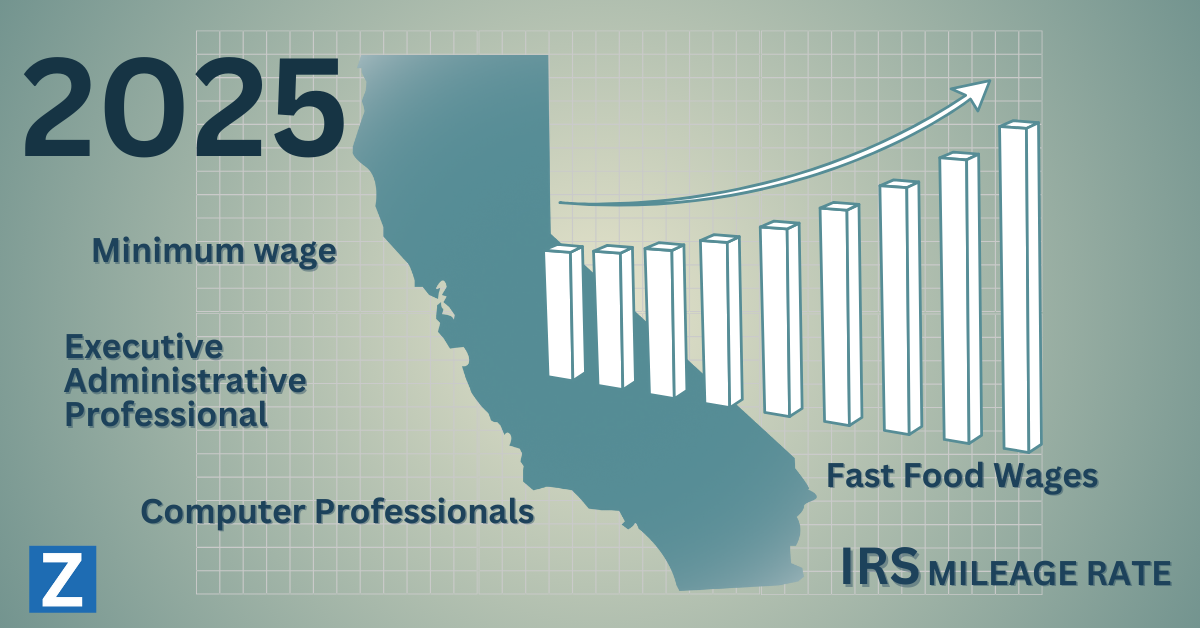
As we approach 2025, California employers must gear up for a series of significant legal and financial adjustments. These changes range from minimum wage hikes to increased salary thresholds for exempt employees, and they impact various industries across the state. Staying ahead of these updates is crucial to ensure compliance and maintain smooth operations. Here are the top five increases California employers must prepare for in 2025.

1. California’s Minimum Wage Increases

Effective January 1, 2025, California’s minimum wage will increase to $16.50 per hour. While Proposition 32, which proposed raising the minimum wage to $18 per hour, was rejected by voters, employers must still comply with higher rates set by local ordinances. Cities like San Francisco and counties such as Los Angeles often have their own minimum wage requirements, and businesses must adhere to the highest applicable rate.

For more context, read the Los Angeles Times’ analysis on Proposition 32.

2. Increased Minimum Pay for Exempt Employees

California law requires exempt employees to meet both a salary basis test and a duties test. With the state’s minimum wage increasing in 2025, the minimum salary threshold for exempt employees will also rise. Starting January 1, 2025, the annual minimum salary to qualify for the white-collar exemption (executive, administrative, and professional) will increase to $68,640 (or $5,720 per month), up from $66,560 in 2024.

Employers must ensure compliance with these thresholds to avoid misclassification issues. For additional details on exempt employee classifications, see our previous article.

3. Fast Food Worker Minimum Wage Updates

Fast food workers in California saw a significant wage increase to $20 per hour starting April 1, 2024, under AB 1228. This law applies to national fast-food chains with more than 60 establishments nationwide. Beginning January 1, 2025, the Fast Food Council may further increase this rate based on economic indicators such as the U.S. Consumer Price Index.

Employers covered by AB 1228 should stay alert for announcements regarding the 2025 rate and be prepared to implement any necessary changes by January 1.

4. Adjusted Salary Thresholds for Computer Professionals

Certain computer software employees are exempt from overtime requirements under Labor Code section 515.5, provided they meet specific salary thresholds. For 2025, the Department of Industrial Relations has adjusted these thresholds as follows:

  • Minimum hourly rate: $56.97 (up from $55.58 in 2024)
  • Minimum monthly salary: $9,888.13 (up from $9,646.96 in 2024)
  • Minimum annual salary: $118,657.43 (up from $115,763.35 in 2024)

Employers in the tech sector must review compensation plans to ensure compliance with these updated rates.

5. Updated IRS Mileage Rates

The IRS annually adjusts its standard mileage rates, which impact how employers reimburse employees for business-related travel. For 2024, the rates were:

  • 67 cents per mile for business use
  • 21 cents per mile for medical or moving purposes (for qualified active-duty Armed Forces members)
  • 14 cents per mile for charitable purposes (unchanged)

The IRS is expected to announce the 2025 mileage rates in mid-December 2024. Employers should monitor these updates to ensure accurate reimbursement practices. For further details on mileage reimbursement obligations, see our previous article.

As the holiday season approaches, it’s a great time for employers to revisit their responsibilities when it comes to accommodating holiday leave requests and ensuring proper pay practices. Last week, we discussed important vacation considerations for employers during the holiday season. This week, we are sharing five key reminders about holiday-related policies for California employers:

1. Time Off for Holidays Is Not Mandated in California

California employers are not required to grant employees time off for holidays, except when it involves religious accommodations (discussed below). The California Division of Labor Standards Enforcement (DLSE) clarifies:

“Hours worked on holidays, Saturdays, and Sundays are treated like hours worked on any other day of the week. California law does not require employers to provide paid holidays, close their business on holidays, or give employees time off for specific holidays.”

2. No Obligation for Paid Holidays or Extra Pay for Holiday Work

California employers are not obligated to pay employees for holidays they do not work or to provide additional wages for working on a holiday. While employers can voluntarily implement a “holiday pay” policy, it’s important to clearly outline such terms in the company’s handbook or policies.

Although California lawmakers have proposed bills like the “Double Pay on the Holiday Act of 2016,” which sought to require double pay for certain holiday work (e.g., Thanksgiving), no such legislation has been enacted. Employers should remain informed about potential legislative changes.

3. Religious Accommodations for Holiday Observances Are Required

Employers must provide reasonable accommodations for employees unable to work on specific holidays due to religious observances. Accommodations are evaluated on a case-by-case basis, taking into account the nature of the business and the employee’s request.

For businesses that require employees to work during recognized holidays, such as restaurants, it’s important to communicate these expectations in the employee handbook or other policies.

4. Holiday Pay Benefits Do Not Accrue

If an employer offers paid holidays, they are not required to allow employees to accrue this benefit. For example, if an employee leaves the company before a holiday occurs, the employer does not have to pay for the unused holiday. To avoid misunderstandings, policies should clearly state that holiday pay is contingent on being employed during the holiday. Employers often add conditions, such as requiring employees to work the days immediately before and after a holiday to qualify for holiday pay.

5. Payroll Processing Can Be Delayed for Certain Holidays

If a holiday falls on a scheduled payday and the employer’s office is closed, wages may be processed on the next business day. The DLSE outlines these requirements, and employers should familiarize themselves with the holidays listed in the California Government Code Section 6700, including:

  • New Year’s Day (January 1)
  • Martin Luther King Jr. Day (Third Monday in January)
  • Memorial Day (Last Monday in May)
  • Independence Day (July 4)
  • Veterans Day (November 11)
  • Christmas Day (December 25)

Other holidays, such as Admission Day (September 9) and Native American Day (Fourth Friday in September), are also recognized. Employers should ensure their payroll policies align with these requirements.

Wishing you a happy and successful holiday season! By staying proactive and informed, employers can ensure smooth operations and maintain compliance during this festive time of year.

As employees begin planning for winter vacations and time off to celebrate, it’s a good opportunity for California employers to review the state’s unique rules regarding vacation policies. To help navigate these complexities, this Friday’s Five highlights five critical vacation policy issues that can create challenges for California employers during the holidays:

1. “Use-it-or-lose-it” policies are prohibited.

Under California law, vacation time is treated as earned wages and accrues as employees work. This means employees cannot lose accrued vacation once it’s earned. Policies requiring employees to forfeit unused vacation time at the end of the year or before the holidays are not permitted. Employers must ensure their policies reflect this rule to avoid liability.

2. Reasonable caps on vacation accrual are allowed.

Although “use-it-or-lose-it” policies are illegal, employers may set reasonable caps on vacation accrual. A cap limits how much vacation time an employee can accrue.

The DLSE explains that once the cap is reached, additional vacation does not accrue until the employee uses some of their accrued time. However, the cap must be reasonable and not designed to deny employees their earned benefits. For example, a cap equivalent to 1.75 times an annual accrual has been considered reasonable by the DLSE in the past, but employers must consult counsel when setting a vacation cap. 

3. Accrued vacation must be paid out when employment ends.

With many employers and employees reevaluating roles during the new year, it’s important to remember that any unused, accrued vacation must be paid out as part of an employee’s final paycheck. California law treats vacation as earned wages, and it must be included in final pay under Labor Code Sections 201 and 227.3. Employers should ensure final paychecks are accurate and issued on time to avoid penalties.

4. Final wages cannot include deductions for unaccrued vacation.

Some employees may take vacation time during the holidays before fully earning it. While this is often treated like an advance, California law prohibits employers from deducting any “negative balance” from an employee’s final paycheck. Self-help remedies, such as recovering these unaccrued amounts directly from wages, are not allowed.

5. “Cliff vesting” vacation policies are problematic.

Employers may establish probationary or waiting periods during which employees do not accrue vacation time. However, policies granting a lump sum of vacation only after reaching a specific milestone—like a one-year anniversary—can create legal risks.

The DLSE views such “cliff vesting” as an attempt to avoid paying pro rata vacation if an employee separates before the milestone date. Instead, employers are encouraged to set a waiting period during which no vacation is accrued (e.g., the first six months) rather than using lump-sum grants tied to specific dates.

California law governing vacation policies is stricter than federal laws and those of other states. Employers who understand these rules can better manage holiday schedules, support employees during the winter break, and avoid potential legal pitfalls. By planning ahead, the holiday season can be a stress-free time for both employers and their teams.

When interviewing potential employees, California employers must navigate a complex landscape to ensure their practices are compliant and effective. Here are five essential practices to consider:

1. Understand Prohibited Questions to Avoid Discrimination

California law restricts employers from asking certain questions during interviews that could be seen as discriminatory. Employers must refrain from asking about an applicant’s marital status, children, plans for having children, religion, age, national origin, other protected characteristics, as well as pay history. Even seemingly harmless questions that could be interpreted as discriminatory should be avoided, as they may lead to potential claims. To prevent any missteps, employers should thoughtfully plan and review all interview questions in advance.

2. Prepare Effective Questions to Evaluate Candidates’ Thinking

Crafting questions that encourage applicants to think critically can reveal their problem-solving abilities and how they approach challenges. Some effective questions include:

  • “Tell me something that’s true that almost nobody agrees with you on.” (Peter Thiel)
  • “On a scale of one to 10, how weird are you?” (Tony Hsieh)

These types of questions not only test creativity but also provide insights into the applicant’s personality and how they handle unexpected queries.

3. Implement “Try Outs” Instead of Traditional Interviews

In a concept championed by Seth Godin, traditional interviews can be replaced with practical, hands-on “try out” sessions. This approach involves putting the candidate into real-life scenarios where they collaborate with potential team members or demonstrate their skills in action. For example, if hiring for a copywriting role, have the candidate create content and go through an editing process to see how they respond to feedback.

However, California employers must take caution to ensure these “try out” periods comply with wage and hour laws. The Division of Labor Standards Enforcement (DLSE) states that these sessions should be:

  • Focused on skill testing, not training.
  • Non-productive for the employer (i.e., the work isn’t sold or used for profit).
  • Limited in duration based on the complexity of the task.

The goal is to gain insight into the candidate’s abilities and compatibility without crossing into unpaid labor that may violate compensation laws.

4. Conduct Thorough Reference Checks

Following up with an applicant’s provided references can be a useful tool in the hiring process. This step helps verify the candidate’s work history and performance. However, I’ve changed my opinion on reference checks recently, as any applicant will not list anyone who may not provide a positive reverence for them. Therefore, employers should also considering searching publicly available information online, and this could provide a broader view of the applicant’s background. It is essential, however, to approach online searches carefully and ensure compliance with privacy laws and non-discrimination practices.

5. Exercise Caution with Background Checks

Background checks are a common part of the hiring process, but employers must proceed with caution due to strict regulations. Under both federal and California laws, including the Fair Credit Reporting Act (FCRA), the Investigative Consumer Reporting Agencies Act (ICRAA), and the Consumer Credit Reporting Agencies Act (CCRA) , employers have detailed obligations they must follow. Failure to comply with these rules can lead to significant legal exposure, as demonstrated in previous lawsuits involving improper background reporting.

Employers should familiarize themselves with these complex regulations or seek legal counsel to ensure they comply when conducting background checks. For more in-depth guidance, you can refer to the comprehensive article on navigating employment background checks in California here.

By following these practices, California employers can navigate the interview process effectively while maintaining legal compliance and fostering a positive candidate experience.

Under California law, non-exempt employees are entitled to one unpaid 30-minute meal period and two paid 10-minute rest breaks during a typical 8-hour shift. However, California’s meal and rest break rules (“MRB rules”) do not apply to interstate truck drivers.

If you’re asking yourself why truck drivers do not get the benefits of California’s more generous meal and rest break rules, the answer is federal preemption.

Background

The Motor Carrier Safety Act of 1984 empowers the Secretary of Transportation to “prescribe regulations on commercial motor vehicle safety,” including regulations ensuring “the responsibilities imposed on operators of commercial motor vehicles do not impair their ability to operate the vehicles safely.” (49 U.S.C. § 31136(a).) The Secretary delegated its rulemaking and preemption authority to the Administrator of the Federal Motor Carrier Safety Administration (FMCSA).

In 2011, the FMCSA revised the federal hours-of-service (HOS) regulations and adopted the rules on breaks for truck drivers including one 30-minute rest break for every eight hours worked. This break requirement supplemented longstanding federal regulations prohibiting a driver from operating a commercial motor vehicle if too fatigued or unable to safely drive.

Preemption (Federal Law v. California Law)

The HOS regulations on breaks and California’s MRB rules are very different. On the one hand, California’s Wage Order 9-2001, which applies to “all persons employed in the transportation industry,” guarantees employees two 10-minute rest breaks and one 30-minute lunch break during a typical 8-hour shift. California employers who fail to provide a such breaks must pay the employee one additional hour of premium pay, at the employee’s regular rate of compensation, for each day the meal or rest break is not provided. On the other hand, that same employee would only be entitled to one 30-minute break for that same 8-hour shift under the FMCSA’s HOS regulations.

This conflict between federal and state law created chaos for trucking companies and made compliance unreasonably burdensome. In response, the American Trucking Associates (ATA) petitioned the FMCSA to preempt California’s MRB rules.

In December 2018, the FMCSA examined the issue and determined that California’s MRB rules were preempted under 49 U.S.C. 31141(c) because they “caused an unreasonable burden on interstate commerce.”

In 2021, the Ninth Circuit upheld the FMCSA determination and confirmed that California’s more rigorous MRB rules for interstate truck drivers were preempted by the federal HOS regulations. (International Brotherhood of Teamsters, Local 2785 v. Federal Motor Carrier Safety Administration, 986 F. 3d 841 (9th Cir. 2021)). This decision affected truck drivers everywhere since, as the Ninth Circuit noted, 50% of the nation’s total container-cargo volume enters this country through California’s three major ports.

The FMCSA determination and Ninth Circuit decision in Int’l Brotherhood of Teamsters, Local 2785 was clear that the preemption applied to long-haul drivers (drivers that generally complete trips outside of a 150-mile radius from their work location).

In 2022, the California Court of Appeal in Espinoza v. Hepta Run, Inc. addressed the open question of whether the FMCSA preemption order also covers short-haul drivers. (Espinoza v. Hepta Run, Inc., 74 Cal. App. 5th 44 (2022))  Plaintiff Espinoza worked as a short-haul truck driver. He filed a lawsuit alleging, among other things, that he was not provided meal periods and rest breaks in compliance with California law.  His employer, Hepta Run, Inc., filed a motion for summary adjudication asserting that Espinoza’s meal and rest period claims were preempted by FMCSA’s preemption order.  The trial court denied the employer’s motion and Espinoza prevailed at trial. On appeal, the Second District Court of Appeal held that short-haul drivers are also covered by the FMCSA preemption order and, therefore, not governed by California’s MRB rules.

Possible Change: California Seeks Preemption Waiver

In November 2023, the California Attorney General and Labor Commissioner filed a petition requesting waiver of the FMCSA’s order preempting California’s MRB rules as applied to drivers of commercial motor vehicles subject to the HOS regulations (Docket ID FMCSA-2019-0048). Petitioners contend that California’s MRB rules “provide substantial health and safety benefits to drivers and the public and there is no tangible evidence that their enforcement has weakened the national supply chain.”

In response to the petition, the FMCSA requested comments by February 26, 2024, and that commentators address the following four issues:

  1. Whether and to what extent enforcement of a State’s meal and rest break laws with respect to intrastate property-carrying and passenger-carrying CMV drivers has impacted the health and safety of drivers;
  2. Whether enforcement of State meal and rest break laws as applied to interstate property-carrying or passenger-carrying CMV drivers will exacerbate the existing truck parking shortages and result in more trucks parking on the side of the road and whether any such effect will burden interstate commerce or create additional dangers to drivers and the public;
  3. Whether enforcement of a State’s meal and rest break laws as applied to interstate property-carrying or passenger-carrying CMV drivers will dissuade carriers from operating in that State; and
  4. Whether enforcement of a State’s meal and rest break laws as applied to interstate property-carrying or passenger-carrying CMV drivers will weaken or otherwise impact the resiliency of the national supply chain.

The FMCSA has received 52 comments, but its disposition remains pending as of October 28, 2024. The FMCSA has not issued its determination of California’s petition for waiver of the preemption order and there is no indication as to when a decision will be made.

Take Away

At present, the FMCSA’s preemption of California’s meal and rest break rules applies broadly to the trucking industry. California’s meal and rest break rules do not apply to truck drivers subject to federal HOS regulations, regardless of whether they are long-haul or short-haul drivers. However, that may change depending on the FMCSA’s decision on California’s pending waiver petition.

Trucking companies and companies that have logistical functions should review their meal period and rest break policies and consult with legal counsel if they have specific questions about the applicability of the FMCSA preemption order to their drivers.

With the return of Donald Trump to the presidency, California employers should evaluate how key workplace issues could be influenced under a Trump administration. Here’s an analysis of how these critical areas may be affected:

1. Immigration and Enforcement

Under a Trump administration, there could be an intensified focus on immigration enforcement. This might include stricter oversight and increased workplace audits, which could significantly impact sectors that rely on immigrant labor. Employers would need to be prepared for heightened compliance measures and potential disruptions to their workforce. For California businesses, this could mean ramping up internal audits and ensuring that their employment practices are in line with federal immigration laws to avoid penalties.

2. EEOC Pay Data Reporting: EEO-1 Component 2

The Trump administration’s track record has shown a general reluctance to implement stringent regulatory measures, and it is likely that under a renewed presidency, the EEOC would deprioritize federal pay data reporting requirements, such as EEO-1 Component 2. This could mean fewer obligations for employers at the federal level regarding wage reporting. However, California’s state pay data requirements, which are due on May 14, 2024, are more rigorous and California employers still must comply with these requirements.  

3. Diversity, Equity, and Inclusion (DEI) Initiatives

The Trump administration has historically taken a critical stance on DEI initiatives, aiming to restrict or even ban training and policies perceived as “divisive.” Employers in California could see a pushback on federally driven DEI requirements, aligning more with the recent efforts by 13 Republican attorneys general who issued warnings to Fortune 100 companies about DEI policies. Shortly after this letter was published, 21 Democratic attorneys general sent a letter to the Fortune 100 companies encouraging diversity programs.  However, under the Trump administration’s critical view on these programs could have companies reevaluate and potentially limit DEI initiatives based on potential federal repercussions. Nonetheless, differing state views on this issue will lead to a complex environment for employers navigating state versus federal priorities.

4. Labor Relations and Unionization Efforts

The Trump administration could continue efforts to limit the influence of unions, supporting legislative measures or policies that favor employers over organized labor. California employers, who already face strong union presence in certain sectors, would need to monitor federal developments that might embolden management rights or make union organizing more challenging.  However, employers should watch JD Vance’s involvement in this area, as he and Marco Rubio did propose a bill, Teamwork for Employees and Managers Act of 2024, promoting employee involvement organizations, and the blue-collar workers strongly supported Trump helping him get reelected

5. Minimum Salary Requirement Under the FLSA and California Law

The Trump administration has typically supported policies that prioritize flexibility for employers, and changes to the Fair Labor Standards Act (FLSA) under Trump could delay or reduce the increases in the federal minimum salary threshold for exempt employees. While the Department of Labor’s set increase in the minimum salary levels for exempt employees to $58,565 by January 1, 2025, would still be expected to proceed, there might be efforts to stall or revise these figures. However, these changes would not impact California employers directly, where the exempt salary threshold is already higher. California’s exempt salary will increase to $68,640 per year by January 1, 2025 (contingent on the outcome of Prop 32, which appears to have failed), state laws will remain the governing force for California employers in this regard. 

6. No Tax On Tips

The Trump administration has shown interest in supporting policies that reduce tax burdens, including the idea of eliminating taxes on tips. This aligns with both Harris’s and Trump’s previous platforms advocating for the removal of tip taxes. While California employers would likely see nominal impact due to existing state wage laws, potential federal legislation, such as the No Tax on Tips Act, could create nationwide standards eliminating tip taxes while maintaining the tip credit in certain states. This could be beneficial for certain employers, but the overall effect would be limited by California’s own stringent labor policies which does not recognize a tip credit.  However, a no tax on tips would still place market burdens on California employers in certain industries that customarily include tips, and there could be advantages in certain tip pooling policies that permit employees to receive additional compensation through tips.    

The Trump administration could introduce changes that lean toward deregulation and policies favoring business flexibility. While this may relieve certain federal compliance burdens, California employers will still need to navigate state-specific requirements that often go beyond federal standards. By keeping a close watch on potential federal shifts, especially in areas like immigration enforcement, labor relations, DEI policies, and wage regulations, California employers can better anticipate and adapt to a potentially evolving legal and regulatory environment.

As the November 5, 2024 election approaches, political discussions in the workplace may become a hot topic, and California employers are considering how best to regulate this sensitive issue. The goal is often to maintain a professional environment without violating employees’ rights. Recently, Elon Musk has taken a public stance by backing two high-profile cases where employees claim they were wrongfully terminated for expressing political views, bringing even more attention to this issue. Here are five essential points California employers should keep in mind when managing political discourse in the workplace:

1. Employers Have the Right to Regulate the Workplace, But Clarity Is Key

California employers can establish workplace guidelines that limit political discourse at the workplace and during working hours. Some companies implement an outright ban on political discussions to avoid distractions or conflicts. However, a complete ban may lead to confusion, as employees may be unclear about which conversations are permitted. For example, informal discussions about the election outcome are common and may not seem problematic to many.

A more effective approach is to articulate specific concerns about political discussions in the workplace, such as emphasizing professionalism and inclusivity. Employers should focus on maintaining a respectful environment where political talk does not disrupt workflow or alienate coworkers with differing views.

2. Contentious Issues Are Inevitable, So an Unbiased Approach Is Crucial

Allowing political discussions in the workplace can spark intense debates, especially in a highly polarized environment. Employers who choose to permit such discussions need to ensure they are conducted respectfully and that all perspectives are fairly represented. Taking a one-sided approach or censoring specific views can expose employers to legal risks, as seen in two cases currently supported by Elon Musk.

In one case, Gina Carano, formerly of “The Mandalorian,” was let go by Lucasfilm in 2021 after posting her positions on political issues on social media. Musk’s company, X Corp, is financially backing Carano’s lawsuit, arguing her termination infringed on rights protected under the California Labor Code. This support highlights Musk’s commitment to protecting employees from workplace repercussions for their political expressions, especially when those political views diverge from those of the employer.

Similarly, X Corp is supporting Major Dustin Whidden, who claims wrongful termination by Form Energy after expressing political views on X and participating in military training. Form Energy allegedly censored Whidden’s social media, an action Musk views as an overreach that infringes upon Whidden’s rights to free speech and his military service obligations. Both Carano and Whidden are basing their lawsuits on protections provided by the California Labor Code, which safeguards employees’ right to engage in political activities outside of work on their own time.

Musk has taken a strong public stance on employees’ rights to political expression, reinforcing his position in a recent post on X:

3. Understand the Boundaries Set by California Labor Codes

California law protects employees’ rights to political expression, particularly in personal or off-duty contexts. For example, Labor Code Section 96(k) prohibits employers from interfering with employees’ lawful conduct outside of work. Labor Code sections 1101 and 1102 further restrict employers from controlling or directing employees’ political activities, or from attempting to influence political choices through threats or coercion. For example, Section 1101 explicitly prohibits employers from “controlling or directing, or tending to control or direct the political activities or affiliations of employees.”

Employers should recognize that employees have the legal right to political expression outside the workplace, free from employer intervention. These laws underscore the importance of allowing employees freedom in personal political matters while setting reasonable boundaries within the workplace.

4. Employees Don’t Have First Amendment Protections in Private Workplaces

While employees may feel they have a constitutional right to free speech, the First Amendment’s protections do not apply to private employers. Courts have consistently upheld that private businesses have the right to regulate or restrict certain types of speech within their walls. For example, the Eisenberg v. Alameda Newspapers, Inc. (1999) case established that a private corporation could discharge an at-will employee due to dissatisfaction with the employee’s expressed views or writings.

Understanding this distinction can help employers clarify that while employees have rights to personal expression, private employers still retain control over workplace discussions.

5. Be Prepared for New Regulations Starting in 2025: The California Worker Freedom from Employer Intimidation Act

As of January 1, 2025, SB 399—the California Worker Freedom from Employer Intimidation Act—will introduce additional protections for employees. Under this new law, employers cannot compel employees to participate in meetings or communications where the employer expresses opinions on religious or political matters. Employees who choose not to attend these meetings must still be paid for the time, and employers who retaliate against employees for their decision could face a $500 civil penalty.

SB 399 highlights the state’s commitment to ensuring employees are free from pressure regarding political or religious issues in the workplace. Employers should prepare for this change by reviewing and, if necessary, adjusting policies and training to ensure compliance with the new requirements.

With the election season underway, California employers face the complex task of regulating political discourse in a way that respects employee rights while preserving a professional environment. By setting clear, unbiased guidelines, respecting legal protections for employees’ off-duty political activities, and staying informed on upcoming changes in state law, employers can manage this delicate balance effectively.