
In sales, it is usually the case when the sale is made, but the customer has a set period of time to return the product. This presents an issue for an employer who pays the sales representative a commission. The employer does not want to pay a commission on an item sold that may be returned. On the other hand, the sales representative would like use of the money while waiting to the period of time the customer has to cancel the purchase. Add to the mix California’s very stringent requirements prohibiting chargebacks and protection of employee wages, and the issue becomes very complex. The decision in Deleon v. Verizon Wireless clarified the issue about whether employers may chargeback commissions that have not yet been earned by the sales representative.

The plaintiff, Deleon, worked as a sales representative for Verizon Wireless. He sued Verizon on the basis that its commission plan violated Labor Code section 223 by “secretly pay[ing] a lower wage while purporting to pay the wage designated by statue or by contract.” Verizon contended its chargeback policy did not violate section 223 because: (1) Deleon’s commission payments were advances, not wages; (2) the chargeback policy was set forth in the compensation plans and was not a “secret” underpayment of a lower than agreed-upon wage; and (3) the chargeback provision did not result in a payment of a lower wage than the wage designated in the compensation plans.

In agreeing with Verizon, the court held that while sales commissions are wages, the right to commissions is determined by the “terms of the contract for compensation.” Here, the agreement Verizon had with plaintiff clearly set forth the conditions necessary before a commission was earned. The plan was clear that commissions were only earned if the customer did not discontinue the cell phone service during the applicable chargeback period. The court held that until this chargeback period expired, plaintiff had not made a commission and the amounts provided to plaintiff were only advances. Because Verizon provided plaintiff an advance on the commissions, and if the customer cancelled the service before the chargeback period expired, it was permissible for Verizon to reduce the representative’s next advance as an offset of the cancelled sale.

The take away for employers: commission plans and agreements must be clearly drafted and set forth the conditions that must be met before the commission is earned. It must also set forth that any payments to the sales representative are only advances, not wages, until the sale is final. If the plan is clear, a chargeback against the advances are permissible should the sale not become final with the customer.
 

I don’t have any personal knowledge of how Steve Jobs was as a manager, but every account I read of him was that he was demanding and in your face. While this can be an effective management style of some, it does come with some associated costs.

Increased litigation costs
Unless your start-up has a huge backer and litigation budgets are not a concern, being a demanding manager that only says what is exactly on your mind when it comes into your mind may get good results, but it will also invite litigation. Don’t get me wrong, there is nothing illegal about being a demanding manager at work, but a lot of people probably don’t understand that. Also, over 20 states have proposed legislation to make bullying in the workplace illegal, but none of these attempts have become law – yet. Plus, even if the employee understands it is not illegal behavior, it creates an environment where the employee wants to get even with a manager or founder for how they were treated. This leads them to talk to a lawyer, which may lead to a lawsuit based on some other ground. Even if a lawsuit filed against a company is frivolous, it will take time and money away from what the company is supposed to be doing. This can cause a huge stress on a start-up company.

Good employees have options
If you treat your superstars badly, they know they will find another comparable job in this economic climate. Jobs and Apple created an environment where only the best work from everyone was tolerated. Jobs said that this helped the company maintain its “A” players because they did not have to be around B or C players. While I can see this rational, unless the company is Apple with an existing reputation, a lot of employees will not put up with an over demanding, unfriendly workplace. And many talented employees left Apple because they did not like Jobs’ style. The loss of good employees (who probably go to work for a competitor) asserts a huge cost on a start-up.

It still comes down to management style choices. But the choice to be like Jobs will have a cost associated with it. And if the company is a start-up, these costs may not be worth the perceived benefits.

 A split shift is defined in the California IWC Wage Orders as:

…a work schedule, which is interrupted by non-paid non-working periods established by the employer, other than bona fide rest or meal periods.

See Cal. Code Regs., tit. 8, § 11040, subd. 2(Q). If the employee works two shifts separated by more than a rest or meal period, they are entitled to receive one hour’s of pay at the minimum wage rate in addition to the minimum wage for that work day. See Cal. Code Regs., tit. 8, §11040, subd. 4(C). Any additional amounts over minimum wage paid to the employee can be used to offset the split shift pay due to an employee. For example, say an employee earns $10 per hour. She works 10:00 a.m. to 1:00 p.m., and then again from 3:00 p.m. to 8:00 p.m. This is a total of eight hours worked for the day, and she is entitled to a split shift payment of one hour at $8 (minimum wage). However, because she earned $16 over minimum wage ($2 above minimum wage x 8 hours = $16) for the eight hours of work, this amount can be used to offset the amount owed for the split shift pay. Therefore there is nothing owed to the employee in this example.  

A court clarified some aspects of split shift pay last year in the case Securitas Security Services USA, Inc. v. Superior Court. In that case, the plaintiffs were security guards that worked the graveyard shift. Securitas designated its workday as beginning at midnight and ending the following midnight. This resulted in the guards working shifts that started on one day, and then ended on the next working day. Plaintiffs argued that they were entitled to split shift pay because their shift ended in the morning, and then they were required to start a new shift several hours later in that same day. The Court ruled against the Plaintiffs and held that employees are not entitled to split shift pay when they work uninterrupted overnight shifts. In this case, there was no “split” in the shift. The court explained:

A "split shift" occurs only when an employee’s designated working hours are interrupted by one or more unpaid, nonworking periods established by the employer that are not bona fide rest or meal periods. The fact that a single continuous shift happens to begin during one "workday" and end in another does not result in a "split shift."

However, the case left open the question of how long between shifts would constitute a split shift. For example, can an employee take a two hour lunch period without obligating the employer to pay the split shift pay? Until courts clarify this issue, conservative employers limit the meal periods to one hour.

The scenario is common: employers have policies in place to protect the employees and the company, but getting employees to comply with the policies is difficult. For example, a company has a policy that employees have to be on-the-clock for during all of the time they are working, but there is one or two employees who habitually forget to clock-out at the end of the day. In addition to the administrative hassles this creates, there are legal issues of how much time the employer should pay the employee for.

Generally, employers are required to pay for all time that the company knows or should have known the employee was working. But legally what can employers do to ensure that employees are complying with company policy?

Starting with what employers cannot do: withhold wages from the employee. The employer cannot use withholding or deductions from wages as a disciplinary measure. This is well settled under California law.

Three Steps Employers Should Take To Have Employees Comply With Policies

1. Have well written policies.

It goes without saying, the policies need to be legal and clearly written so that employees and managers can easily understand the policies.

2. Train managers so that they understand the policies and know how what to enforce.

Managers who do not understand what they should be requiring of employees, or worse, misinterpret a company policy when enforcing it, can create a lot of legal liability for the company. Routine training for managers on common issues that arise in the workplace can do a lot to prevent litigation.

3. Discipline employees for failure to comply with the policies.

While employers cannot withhold wages as a form of discipline, employers may still write up employees who violate company policies. For example, if an employee is either intentionally or otherwise not properly recording their time, they should be counseled and written up for the violations. They also need to be warned that if the problem continues, they could be terminated. There is another benefit to having this documentation. If the company is sued in a wage and hour class action for off-the-clock work, the plaintiffs need to prove that there is a company-wide policy that permits or encourages off-the-clock work. If the company has the records of disciplining employees who were abusing the time clock system, it will be strong evidence that the company actively prohibited off-the-clock work from occurring.

First it was Facebook passwords, now it is financials. It is becoming more regular that employers ask job applicants for a W-2 or tax returns in order to verify past salary or employment information. Kathleen Pender of the San Francisco Chronicle wrote a story on this interesting issue. Given the tough job market, many job seekers are feeling obligated to provide such information. While many people have the gut reaction that this type of request is improper, as the article notes, there is arguably nothing legally that limits employers from asking for this information.

Of course, the improper use of this information could result in liability for the employer who obtains the information. And, as noted in the article, employers who ask for this information only from individuals in protected classes (such as for race, gender, etc…) would be violating discrimination laws.

It is also interesting to note that the newly adopted Labor Code provision that only allows employers to conduct credit checks (referred to as a consumer credit report in the law) for certain types of employees, provides an exclusion that allows employers to ask for information that verifies income or employment. The law, Labor Code section 1024.5 took effect at the beginning of this year, and defines a consumer credit report as follows:

(1) "Consumer credit report" has the same meaning as defined in subdivision (c) of Section 1785.3 of the Civil Code, but does not include a report that (A) verifies income or employment, and (B) does not include credit-related information, such as credit history, credit score, or credit record.

Because a consumer credit report is defined as excluding verification of “income or employment,” employers asking for W-2s or tax returns would not trigger this provision of the Labor Code. However, as the article notes, it appears that employers are incorporating requests to verify applicant’s pass salary as part of a general background check process. Depending on the facts on the type of information obtained in the background check, it could be argued that the overall background check conducted in these circumstances may constitute one that is covered by Labor Code section 1024.5. If that is the case, the employer has additional objections under the law, and may actually be restricted from performing the background check in the first place.

In Kinecta Alternative Financial Solutions v. Superior Court (wrd) held that a trial could improperly ordered a wage and hour class action to proceed in arbitration as a class action. The appellate court held that even though the arbitration agreement was silent on whether the parties agreed to arbitrate class claims, the fact that the agreement only referenced plaintiff’s claims against the employer (not other employees’ claims as well) the plaintiff could only bring her individual claims in arbitration.

The plaintiff signed an arbitration agreement that provided to arbitrate all disputes arising out of her employment. The arbitration agreement was silent on the issue of class arbitration. Plaintiff filed a class action complaint alleging various wage and hour violations including failure to pay overtime and failure to provide meal and rest breaks. The employer filed a motion to compel arbitration and a motion to dismiss plaintiff’s class claims. The issue the court addressed was whether the employer in this case could be compelled to arbitrate a class action when the arbitration agreement does not expressly provide for a class arbitration.

In agreeing with the employer, the Court held that even though the arbitration agreement was silent on class arbitration, it cannot be assumed that the parties agreed to arbitration class claims. Relying upon the recent United States Supreme Court rulings, the court held:

This petition is governed by Stolt-Nielsen v. Animalfeeds International Corp. (2010) 559 U.S. __ [130 S.Ct. 1758], which holds that under the [Federal Arbitration Act], a party may not be compelled to submit to class arbitration unless the arbitration contract provides a basis for concluding that the party agreed to do so. The arbitration provision in this case expressly limited arbitration to the arbitration of disputes between Malone and Kinecta. The arbitration agreement made no reference to, and did not authorize, class arbitration of disputes. Thus the parties did not agree to authorize class arbitration in their arbitration agreement, and the order denying Kinecta’s motion to dismiss class claims must be reversed.

The arbitration agreement in this case only made reference to the plaintiff, by referencing “I”, “me,” and “my.” The agreement never made reference to other employees or groups of employees. Under the Federal Arbitration Act a party cannot not be compelled to submit to class arbitration unless there is a contractual basis for concluding that they agreed to do so. The mere silence on the issue of class arbitration in an arbitration agreement cannot be interpreted to mean that a party agreed to class arbitration. Therefore, the court held that plaintiff’s lawsuit could only proceed on her own individual claims in arbitration.

Employers should carefully examine whether or not arbitration agreements are appropriate for their company. There are some negative aspects of entering into arbitration agreements, but the ruling in Kinecta is a good example of the enforceability of class action waivers in arbitration agreements.

For more information about arbitration agreements, and the enforceability of their terms, please see my previous post, Things You Wanted To Know About Arbitration Agreements In California, But Were Afraid To Ask.

Have you attended webinars and read new legal updates on the new Brinker decision and still uncertain on how this applies to your company? Realizing that employers need to take a more active step in ensuring they are in compliance with the new decision, I’ve developed a package that actually assists employers in drafting and implementing a meal and rest break policy tailored to their business:

  • A draft of meal and rest break policy to comply with the standards set forth in Brinker.
  • Video presentation covering overview of Brinker (1 hour) and presentation materials.
  • 1/2 hour consultation for implementing meal and rest break policy tailored to your company.

The California Supreme Court made it clear in its decision that different industries and facts will either prohibit or permit employers from requiring different standards regarding the timing and offering of meal and rest breaks under California law.  General advice from webinars and articles are not sufficient to ensure companies are in compliance with the clarifications set forth in the decision.    The cost of the package is a flat fee of $450. 

More information about the compliance package is listed here

Here in California the Brinker decision has taken up most of my time over the last week.  Now I am finally able to focus on a national issue – as the Court of Appeals for the District of Columbia blocked the NLRB from requiring employers to post a notice of employee rights. The court’s decision comes after the federal court in South Carolina ruled that the NLRB exceeded its authority by requiring employers to post notices in the workplace.
The DC appellate court held:

The uncertainty about enforcement counsels further in favor of temporarily preserving the status quo while this court resolves all of the issues on the merits.

On April 17, the NLRB issued a statement setting forth its position:

The agency disagrees with and will appeal last week’s decision by the South Carolina District Court, which found the NLRB lacked authority to promulgate the rule.
Chairman Mark Gaston Pearce said of the recent decisions, “We continue to believe that requiring employers to post this notice is well within the Board’s authority, and that it provides a genuine service to employees who may not otherwise know their rights under our law.”

The NLRB’s website, which explains the notice, also sets forth:

The DC Circuit Court of Appeals has temporarily enjoined the NLRB’s rule requiring the posting of employee rights under the National Labor Relations Act. The rule, which had been scheduled to take effect on April 30, 2012, will not take effect until the legal issues are resolved. There is no new deadline for the posting requirement at this time.

From the docket, it appears that the matter is set for oral argument in September of 2012. So it is unlikely that the NLRB will attempt implement the poster in workplaces prior to this date. My previous post on the topic is here

It has been a week now since the California Supreme Court issued its decision in Brinker Restaurant Corp. v. Superior Court. I’ve been getting a lot of questions, and have spoken on the topic a few times, and thought a couple of charts illustrating the Court’s holding would assist in understanding the decision. For a more general discussion of the Brinker decision, please see my previous article.

Meal Periods

The California Supreme Court made clear in Brinker that employers need to give an employee their first meal break “no later than the end of an employee’s fifth hour of work, and a second meal period no later than the end of an employee’s 10th hour of work.” The Court said that contrary to Plaintiff’s argument, there are no additional timing requirements for the meal breaks.

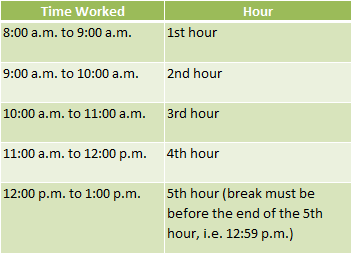
I’ve created this chart to help illustrate this point:


If an employee begins work at 8:00 a.m., the employee must start his break by 12:59, which is before the end of the 5th hour of work.

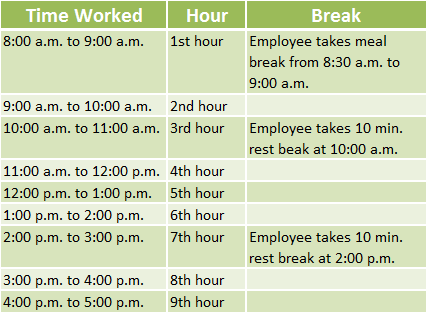
Another issue in the case was Brinker’s policy of “early lunching.” Early lunching is when employers allow the employees to take their meal break within the first hour or two of arriving for work. Once the employee is given this first meal period, then they would continue to work for six, seven, eight, or more hours without an additional meal break. The Court rejected Plaintiff’s argument that this policy violated the law. The Plaintiff argued that the law required employers had a duty to provide meal breaks on a “rolling five” hour basis, or every five hours.

Here is a chart that provides an example of an early lunching practice:


Before employers begin to employ an early lunching policy, they should do so with caution and some guidance. As Court cautioned employers that: “in the context of an eight-hour shift, ‘[a]s

a general matter,’ one rest break should fall on either side of the meal break. Shorter or longer shifts and other factors that render such scheduling impracticable may alter this general rule.”

Rest Breaks

As for of rest breaks, the Court set forth that, “[e]mployees are entitled to 10 minutes’ rest for shifts from three and one-half to six hours in length, 20 minutes for shifts of more than six hours up to 10 hours, 30 minutes for shifts of more than 10 hours up to 14 hours, and so on.” The Court’s holding can be summarized as follows:


In regards to when during the shift rest breaks should be taken, the Court held that “the only constraint of timing is that rest breaks must fall in the middle of work periods ‘insofar as practicable.’” The Court stopped short of explaining what qualifies as “insofar as practicable”, and employers should closely analyze whether they may deviate from this general principle.

Brinker Restaurant Corp. v. Superior Court (Hohnbaum) was finally decided by the California Supreme Court. The decision was anxiously awaited by many due to its clarifications of California employment laws regarding the duties employers have regarding offering meal and rest breaks, and when the breaks need to be taken.  The primary holding of the case is that employers do not need to ensure that no work is performed during meal breaks.  The Court, however, cautioned employers that they cannot undermine formal policies by pressuring employees to work during breaks.  Also of interest, as explained below, the Court provided a clarification of the rate that employees accrue rest breaks, which varies from how most employers interpreted the rest break requirement.

Meal Periods
Employers Have No Duty To Ensure Meal Breaks Are Taken

The Plaintiff in the case argued that Brinker had to “ensure that work stops for a the required thirty minute[]” meal period. Alternatively, Brinker argued that under California law employers only had to provide meal periods and would not incur any liability if the employee did not take the break. The Court explained:

[Plaintiff] Hohnbaum contends an employer is obligated to “ensure that work stops for the required thirty minutes.” Brinker, in a position adopted by the Court of Appeal, contends an employer is obligated only to “make available” meal periods, with no responsibility for whether they are taken. We conclude that under Wage Order No. 5 and Labor Code section 512, subdivision (a), an employer must relieve the employee of all duty for the designated period, but need not ensure that the employee does no work.

The Court clarified that employers do not need to ensure that employees do not perform any work during their break:

The difficulty with the view that an employer must ensure no work is done—i.e., prohibit work—is that it lacks any textual basis in the wage order or statute. While at one time the IWC’s wage orders contained language clearly imposing on employers a duty to prevent their employees from working during meal periods, we have found no order in the last half-century continuing that obligation. Indeed, the obligation to ensure employees do no work may in some instances be inconsistent with the fundamental employer obligations associated with a meal break: to relieve the employee of all duty and relinquish any employer control over the employee and how he or she spends the time.

The Court also provided further clarification as to what meal period obligations employers have:

[T]he wage order’s meal period requirement is satisfied if the employee (1) has at least 30 minutes uninterrupted, (2) is free to leave the premises, and (3) is relieved of all duty for the entire period.

Therefore, the Court held:

To summarize: An employer’s duty with respect to meal breaks under both section 512, subdivision (a) and Wage Order No. 5 is an obligation to provide a meal period to its employees. The employer satisfies this obligation if it relieves its employees of all duty, relinquishes control over their activities and permits them a reasonable opportunity to take an uninterrupted 30-minute break, and does not impede or discourage them from doing so. What will suffice may vary from industry to industry, and we cannot in the context of this class certification proceeding delineate the full range of approaches that in each instance might be sufficient to satisfy the law.
On the other hand, the employer is not obligated to police meal breaks and ensure no work thereafter is performed. Bona fide relief from duty and the relinquishing of control satisfies the employer’s obligations, and work by a relieved employee during a meal break does not thereby place the employer in violation of its obligations and create liability for premium pay under Wage Order No. 5, subdivision 11(B) and Labor Code section 226.7, subdivision (b).

However, the Court also provided a warning to employers that, “On the other hand, an employer may not undermine a formal policy of providing meal breaks by pressuring employees to perform their duties in ways that omit breaks.”

Meal Period Timing Requirements

The Court also clarified when meal periods must be provided. The Court rejected Plaintiff’s argument that Brinker’s policy of “early lunching” violated the Labor Code. Early lunching is which is when employers allow employees to take their meal break within the first hour or two of arriving to work, and then have the employees continue to work to the end of their shift without taking another meal period. The Plaintiff argued that the Labor Code requires that employees take a meal period every five consecutive hours of work. In rejecting the Plaintiff’s argument, the Court stated:

Hohnbaum contends section 512 should be read as requiring as well a second meal period no later than five hours after the end of a first meal period if a shift is to continue. The text does not permit such a reading.

The Court explained the timing requirements of meal periods as follows:

We conclude that, absent waiver, section 512 requires a first meal period no later than the end of an employee’s fifth hour of work, and a second meal period no later than the end of an employee’s 10th hour of work.


Rest Periods
Rate Rest Periods Accrue To Employees

The Court began its explanation of the rate at which rest breaks must be given to employees by examining Wage Order No. 5. The Court focused in on subdivision 12(A) of the wage order, which provides:

Every employer shall authorize and permit all employees to take rest periods, which insofar as practicable shall be in the middle of each work period. The authorized rest period time shall be based on the total hours worked daily at the rate of ten (10) minutes net rest time per four (4) hours or major fraction thereof. However, a rest period need not be authorized for employees whose total daily work time is less than three and one-half (3½) hours.

The Court explained that “major fraction thereof” as applied to the four hour period referenced in the Wage Order means “any amount of time in excess of two hours – i.e., any fraction greater than half.” Therefore, by applying this calculation under the wage order, the Court held:

Employees are entitled to 10 minutes’ rest for shifts from three and one-half to six hours in length, 20 minutes for shifts of more than six hours up to 10 hours, 30 minutes for shifts of more than 10 hours up to 14 hours, and so on.

Timing Of Rest Breaks

The Court disagreed with the Plaintiff’s argument that rest breaks had to occur before meal breaks under the law. The Court held that the only “constraint on timing is that rest breaks must fall in the middle of work periods ‘insofar as practicable.’” The Court explained:

Hohnbaum asserts employers have a legal duty to permit their employees a rest period before any meal period. Construing the plain language of the operative wage order, we find no such requirement and agree with the Court of Appeal, which likewise rejected this contention.


Either the rest period must fall before the meal period or it must fall after. Neither text nor logic dictates an order for these, nor does anything in the policies underlying the wage and hour laws compel the conclusion that a rest break at the two-hour mark and a meal break at the four-hour mark of such a shift is lawful, while the reverse, a meal break at the two-hour mark and a rest break at the four-hour mark, is per se illegal.


The entire decision can be read here.