
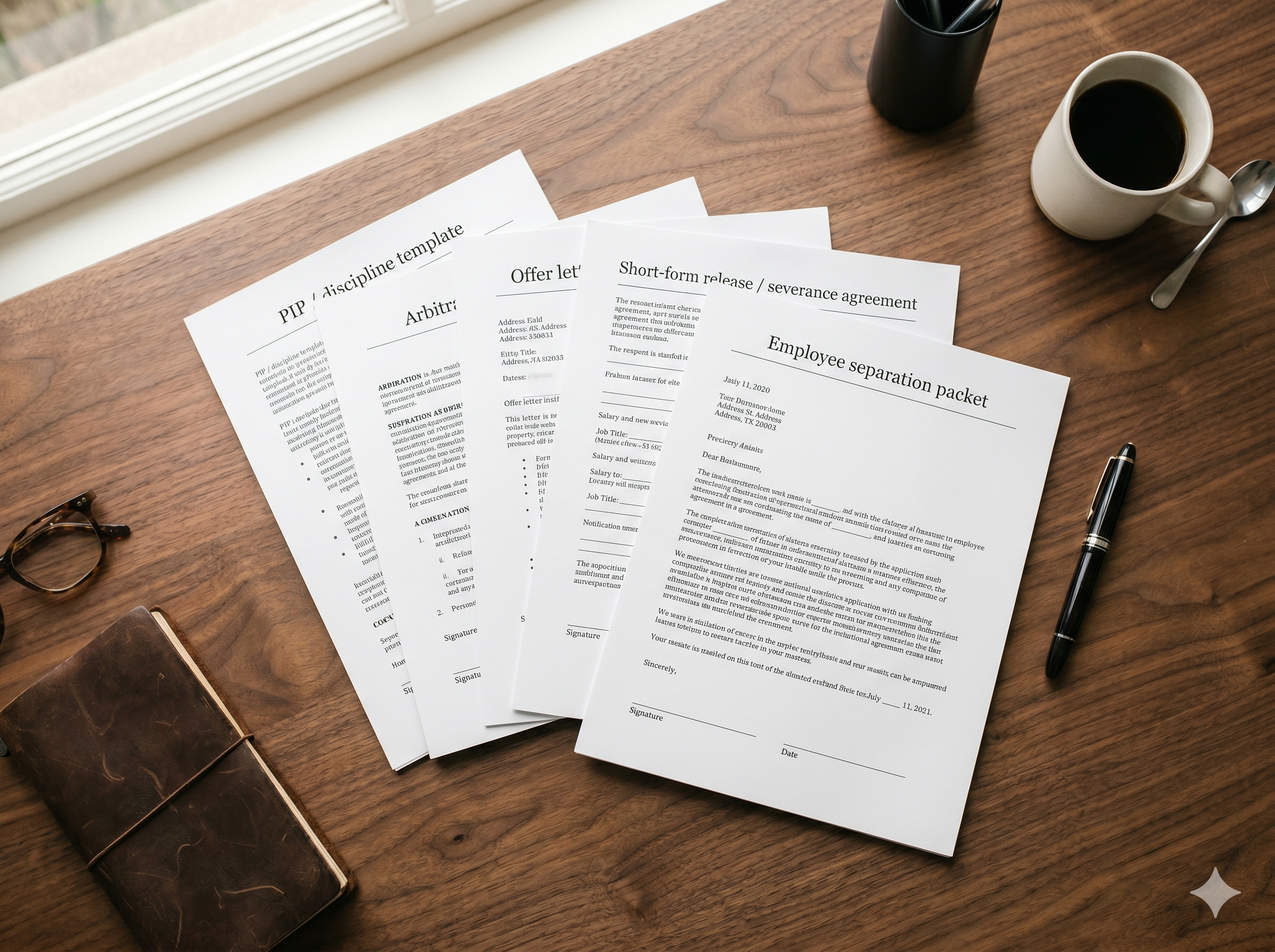
California employers face constant pressure to make personnel decisions quickly. Terminations, separations, performance issues, and new hires often cannot wait for a lawyer’s calendar. The most effective way to handle these routine but high-risk situations is to have a core set of documents drafted, reviewed, and approved by employment counsel in advance. When the situation arises, the employer reaches for a template counsel has already blessed rather than starting from scratch—and routine issues can be handled without burning time and legal fees on each one.
It goes without saying that an employee handbook should be on every California employer’s list and reviewed at least annually given the volume of new statutes, regulations, and case law each year. Beyond the handbook, here are five documents every California employer should have prepared, reviewed by counsel, and ready to deploy.
1. Performance Improvement Plan (PIP) and Discipline Template
California is an at-will employment state, but at-will rarely wins a case standing alone. Wrongful termination, discrimination, and retaliation claims usually turn on whether the employer’s stated reason holds up under scrutiny, and that depends on contemporaneous, consistent documentation of performance concerns. A pre-approved PIP and discipline template forces managers into the right format before urgency or emotion takes over.
A counsel-blessed template should prompt the manager to record the specific performance deficiency, the standard expected, a measurable benchmark, the timeframe for improvement, the support being offered, the consequences of failing to improve, and contemporaneous signatures from the employee and supervisor. The recurring documentation failures that show up in litigation—vague performance concerns, missing dates, no measurable goals, retroactive write-ups created after a complaint, and inconsistent application across employees—are largely eliminated when a standardized template is in use.
Two additional considerations are worth building into the template. First, when a known or suspected disability is in play, a PIP cannot substitute for the interactive process under FEHA. The template should include a checkpoint reminding the manager to assess whether an accommodation discussion is required before the PIP is issued. Second, consistency matters as much as content. Disparate discipline across protected classes is one of the most common pretext theories plaintiffs raise, so a brief HR or counsel sign-off step for higher-risk situations is worth including.
Bottom line: A pre-approved PIP and discipline template turns documentation from a manager’s afterthought into a defensible, repeatable practice.
2. Arbitration Agreement
A current, enforceable arbitration agreement remains one of the most effective risk-management tools available to California employers, but only if it has been updated to reflect the rapid evolution of case law in this area. The Supreme Court’s decision in Viking River Cruises v. Moriana, the California Supreme Court’s response in Adolph v. Uber Technologies, and the Ninth Circuit’s resolution of AB 51 in Chamber of Commerce v. Bonta have each reshaped what an enforceable agreement looks like.
Adolph in particular changed how PAGA representative actions interact with individual arbitration, and Iskanian-era language that was state-of-the-art a few years ago can now create more problems than it solves—especially where severability clauses fail to carry their weight. Federal Arbitration Act preemption issues, jury waiver language, attorney’s fees provisions, class action waivers, and the scope of claims covered all warrant regular review.
Employers should also remember that an arbitration agreement is only as good as the implementation around it. Tracking who signed, when, and which version was in force is a recurring weak point that surfaces when motions to compel arbitration are filed years after the agreement was executed.
Bottom line: An arbitration agreement is a living document. It should be revisited at least annually and rewritten whenever a major decision shifts the legal landscape.
3. Offer Letter and New Hire Packet
The offer letter is just the cover sheet. California stacks a series of mandatory disclosures and notices on top of every new hire, and the new hire packet is where those obligations are met. A complete, counsel-reviewed packet typically includes the Labor Code section 2810.5 wage notice, paid sick leave information, the sexual harassment prevention pamphlet, the workers’ compensation rights notice, EDD pamphlets, the CRD’s discrimination and harassment notice, and the SB 294 emergency contact opportunity that took effect in 2026.
The offer letter itself also needs current eyes. SB 642 redefined “pay scale” to mean the wage range the employer reasonably and in good faith expects to pay for the position upon hire, which may narrow the ranges employers post and quote. AB 692 broadly bans most “stay-or-pay” provisions in employment contracts entered into on or after January 1, 2026, which directly affects relocation reimbursement language, sign-on bonus clawbacks, and tuition assistance arrangements—areas that previously could be handled with boilerplate.
A pre-approved offer letter and new hire packet ensures hiring decisions can move at the speed the business needs without creating compliance gaps that surface years later in a class or PAGA claim.
Bottom line: A new hire packet is not a stack of paper. It is the employer’s first compliance checkpoint, and California adds new layers to it nearly every year.
4. Short-Form Release and/or Severance Agreement
A pre-approved short-form release agreement allows employers to handle routine separations on a same-day basis instead of waiting for counsel to draft custom language for each situation. The savings compound quickly: a counsel-blessed template can convert what would otherwise be a two-week lawyer engagement into a same-day decision for routine matters where modest separation pay is offered in exchange for a release of claims.
The legal scaffolding has shifted significantly. The Silenced No More Act (Code of Civil Procedure section 12964.5) restricts confidentiality and non-disparagement provisions covering claims of harassment, discrimination, and retaliation. AB 749 limits no-rehire clauses. The Older Workers Benefit Protection Act still requires the 21-day consideration and 7-day revocation periods for releases involving employees age 40 and over, and group reductions in force trigger additional disclosure obligations. Civil Code section 1542 waivers must be expressly invoked, and several categories of claims—workers’ compensation, unemployment, certain whistleblower retaliation, and indemnification rights, among others—cannot be waived even with the cleanest release language.
Templates also benefit from clear instructions on when they can be used as-is and when counsel involvement is required. Routine voluntary separations with low-risk profiles often fit the template; situations involving recent complaints, leaves of absence, suspected protected activity, or larger payouts should always come back to counsel.
Bottom line: A counsel-approved short-form release pays for itself the first time it lets the employer close a routine separation in hours instead of weeks.
5. Employee Separation Packet
Final pay timing under Labor Code sections 201 through 203 is one of the most common—and most preventable—sources of waiting-time penalty exposure. A pre-built separation packet, organized to be ready on the day of termination or the next business day in the case of a resignation without notice, eliminates most day-of mistakes.
A complete packet typically includes the final paycheck reflecting all wages earned, accrued vacation, and any required premium pay; the EDD’s “For Your Benefit” pamphlet; the change-in-relationship notice; COBRA and Cal-COBRA continuation notices; the HIPP notice; benefits termination information; final expense reimbursement; return-of-property documentation; and, where applicable, the short-form release described above. The separation packet is also where post-employment obligations such as confidentiality, trade secrets, and any enforceable restrictive covenants are confirmed in writing.
Bottom line: A separation packet is the difference between a clean exit and a section 203 waiting-time penalty claim or other litigation exposure.
Closing Thoughts
These five documents—the PIP and discipline template, arbitration agreement, offer letter and new hire packet, short-form release, and separation packet—cover moments when employers most often need to act quickly and where the cost of getting it wrong is highest. Having them prepared, reviewed by counsel, and ready to deploy is not a substitute for legal advice on novel or high-stakes matters; it is what frees counsel to focus on those matters when they arise. For employers managing day-to-day personnel decisions across a California workforce, this small library of pre-approved documents is one of the highest-leverage investments available.