Every wage and hour case that comes into our office starts the same way. Before we talk strategy and long before mediation, we ask the client for one thing: the raw time and payroll data. Not a summary. The punch-level time records, the payroll register with every pay code, and the wage statements. That data is going to testify in the case whether the employer likes it or not, and I would rather hear what it has to say before the plaintiff’s lawyer does.

I have written before about what executives should demand from their defense counsel once a lawsuit lands. This week I want to go behind the desk and show what we actually do with an employer’s records in the first days of a case using the Scaled Comp software, because that process reveals — better than any policy memo — which records matter, why speed matters, and what “reasonable steps” looks like when it is being tested rather than described. Full disclosure: I co-founded Scaled Comp, and Zaller Law Group uses it as a tool under counsel’s direction in our litigation and audit work. More on that at the end.

1. The clock may already be running before the PAGA notice arrives — and your records are the first thing it measures.

Under the 2024 PAGA reform, an employer that took “all reasonable steps” to comply before receiving a PAGA notice can have its penalties capped at 15% of the maximum, and an employer that takes those steps within 60 days after the notice can cap them at 30%. What many employers miss is that the statute ties the 15% cap not only to the PAGA notice but also to the employer’s receipt of a request for personnel or payroll records under Labor Code §§226, 432, or 1198.5 — whichever comes first. The innocuous letter from an employee’s attorney asking for a “copy of my client’s personnel file and pay records” is very often the starting gun, and by the time the PAGA notice follows, the window for the 15% cap may have already closed.

That is why one of the very first things we do is pull the records, and the first thing we learn is whether they exist in usable form. California requires employers to keep payroll records for at least three years (Labor Code § 1174(d)), to keep copies of wage statements for three years (§ 226(a)), and — under the Wage Orders — to record meal periods. When a client cannot produce a clean, punch-level export going back three years, that is the first finding of the case, and it is a bad one: under Hernandez v. Mendoza (1988) 199 Cal.App.3d 721, once an employee shows the employer’s records are inadequate, the burden shifts and the employee’s own recollection of hours worked can carry the day. An employer with no records is not defending a case; it is negotiating a surrender.

2. Within days — not months — we know the actual compliance rate, and that changes every decision that follows.

Here is what the software does once the data is loaded. It measures every shift against the rules: was a meal period started by the end of the fifth hour, was it at least 30 minutes, was a second meal provided by the end of the tenth hour, and — if rest breaks are recorded — were they provided based on hours worked. It flags each late, short, or missed break. It then does the step that most employers never do on their own: it matches each flagged shift against the payroll register to see whether a meal or rest premium was actually paid for that day. The output is a compliance rate — by location, by manager, by pay period — along with the count of pay periods and workweeks in the limitations period and an exposure model built on the employer’s actual numbers rather than the plaintiff’s assumptions. It also keeps two numbers that are easy to confuse: for PAGA penalty purposes, a shift with three flags is still one violation, while premium pay liability is calculated per missed break. Both numbers matter, and they are not the same.

The traditional way to get this analysis was to retain a damages expert months into the case, wait several more months for a report, and pay a fee that could rival a small settlement. The reason we built the software was to compress that to days. And the speed is not a convenience — it is the whole point. The 60-day window for the 30% cap is meaningless if you do not know where the violations are until day 90. The decision whether to push for early mediation — which, as I discussed in the mid-year 2026 PAGA data, cuts off the accrual of pay periods that otherwise add to the exposure every month — depends on knowing the number. A case where 3% of shifts show a late meal period with no premium paid is defended, budgeted, and settled completely differently than one where the figure is 35%. In the first week, we know which case we have.

3. Premium payments are the evidence — record them as though they will be Exhibit A, because they will be.

Under Donohue v. AMN Services, LLC (2021) 11 Cal.5th 58, time records showing a late, short, or missed meal period raise a rebuttable presumption that a violation occurred. That presumption is rebutted with evidence — that the employee was provided the break and chose to skip it, or that the employer recognized the issue and paid the premium. This is where the payroll register becomes the employer’s best witness or its worst. When the analysis shows a late meal punch on a given day and a § 226.7 premium paid on that same day, the story is that the employer’s system caught the problem and paid for it. That does not erase the underlying issue for every purpose, but it eliminates the unpaid-premium claim, it cuts off the derivative wage statement and waiting time claims that Naranjo v. Spectrum Security Services, Inc. (2022) 13 Cal.5th 93 makes available when premiums go unpaid, and it is the single strongest piece of evidence that the employer’s compliance program is real rather than aspirational.

But the software can only give the employer credit for what it can match. Three recordkeeping practices determine whether that credit is available:

  • Code premiums separately. Meal premiums and rest premiums should be their own pay codes and their own line items on the wage statement. Naranjo held that premium pay is wages that must be reported on wage statements; premiums buried in “other pay” or “adjustments” are invisible to the analysis and to the court.
  • Pay premiums at the regular rate, not the base rate. Ferra v. Loews Hollywood Hotel, LLC (2021) 11 Cal.5th 858. A premium paid at the wrong rate is a documented underpayment on every day it appears.
  • Tie the premium to the day. A lump-sum “true up” at the end of the month cannot be matched to the shift it was meant to cover. Pay it in the pay period of the missed break.

4. The analysis becomes the defense at every stage of the case — not just a number for mediation.

Employers sometimes assume the exposure analysis is a one-time exercise to set a settlement authority. It is not. The same data set is reused at nearly every stage:

  • The 60-day window. Location- and manager-level results tell the employer exactly where to direct corrective action within the 60 days after the notice, and the documentation of that action is the 30%-cap file.
  • Arguing the penalties down. The reform gives courts discretion to reduce penalties that would be unjust or oppressive, and provides a reduced penalty where a violation resulted from an isolated, nonrecurring event of short duration. Neither argument can be made in the abstract; both require showing the court what the records actually reflect.
  • The mediation brief. Compliance rates and the pay-period and workweek counts, benchmarked against comparable settlements on a per-pay-period and per-workweek basis, are the difference between negotiating from data and negotiating from fear.
  • Opposing certification. When compliance varies widely by location and manager, that variation is evidence that liability cannot be determined on a class-wide basis without individualized inquiries.
  • Rebutting the plaintiff’s expert. The plaintiff’s damages model will typically treat every 5:01 punch as a violation and ignore premiums paid, waivers, and shifts short enough that no meal period was required. Our analysis identifies each of those categories shift by shift.

Two structural notes. First, the analysis is run through counsel and at counsel’s direction so that it is protected as attorney work product; an employer that runs the same analysis on its own, outside of counsel, may be creating a discoverable document. Second, the report does not decide the legal questions — whether the employer’s conduct amounts to reasonable steps, and which cap applies, are judgments for counsel and ultimately the court. The data gives counsel something to argue with.

5. Run the same analysis when nobody is suing you. That is what “reasonable steps” looks like on paper.

The statute’s list of reasonable steps starts with “conducting periodic payroll audits and taking action in response to the results of the audit,” followed by disseminating lawful written policies, training supervisors, and taking corrective action with regard to supervisors — evaluated under the totality of the circumstances, including the employer’s size and resources and the nature, severity, and duration of the violations. I have covered the action items under the reform before. The point I want to make here is narrower: the audit the statute describes and the litigation analysis described above are the same analysis. The only difference is when it is run and who is asking.

An employer that runs it on a recurring basis — monthly or quarterly, depending on size — gets a report by location and manager, acts on it (retraining a manager, fixing a scheduling practice, paying the premiums the audit identifies), documents the action, and then runs it again. The trend line is the reasonable-steps story: 12% of shifts at one location showed late meal periods with no premium paid in the first quarter, the manager was retrained and the scheduling template changed, and the figure was 3% the next quarter. That is a narrative a court can evaluate, and it is far more persuasive than a declaration that the company “takes compliance seriously.”

The audit also does something the penalty caps do not: it reduces the exposure itself. Every violation caught and corrected is a premium paid now rather than a premium, a wage statement penalty, and a PAGA penalty litigated later. And because PAGA penalties accrue per aggrieved employee per pay period, shrinking the number of employees who experienced any violation directly shrinks the case a plaintiff’s firm can bring. Two cautions: the audit will identify premiums that are owed, and the employer needs to be prepared to pay them — that is the point of the exercise, not a reason to avoid it. And reasonable steps are proven with documents. The audit report, the memo directing corrective action, the training sign-in sheet, and the follow-up audit are the file. A sincere belief that the company was compliant is not.

The bottom line: in every PAGA case, the employer’s payroll records testify first, and they testify about the period before the employer knew it had a problem. The employers who fare best are the ones whose records already tell the right story — punch-level data that exists and can be exported, premiums that are paid, coded, and matched to the day they cover, a rest break reporting mechanism that leaves a trail, and a recurring audit with documented corrective action behind it. Get those in place now, and the first week of the case looks very different.


Most California employers think about their time and attendance records in only one context: the day a plaintiff’s lawyer subpoenas them. By then, the records are working against you — every late meal punch, every missing premium, every off-the-clock minute becomes a line item in someone else’s damages model. But the same data that creates exposure when you ignore it becomes one of your strongest defensive and operational assets when you actually use it. The difference between the two is simply whether you are reading your records on an ongoing basis or seeing them for the first time in discovery.

Here are five ways California employers can put their time records to work proactively.

1. Your records are the proof that you took the “reasonable steps” that cap PAGA penalties.

The 2024 PAGA reforms gave employers a defense that did not exist before: an employer that has taken “all reasonable steps” to comply with the Labor Code before receiving a PAGA notice caps its civil penalties at 15% of the amount otherwise recoverable, and an employer that takes those steps within 60 days after the notice caps them at 30%. Against a default exposure of $100 per pay period, per aggrieved employee (and up to $200 for subsequent violations), that cap is the difference between a seven-figure case and a five- or six-figure one. The statute expressly lists conducting periodic payroll audits and acting on the results as a reasonable step — and a payroll audit is only as good as the records behind it. The same is true of premium payments. Under Donohue v. AMN Services, LLC (2021), time records showing missed, short, or late meal periods create a rebuttable presumption that a compliant meal period was not provided. You rebut that presumption by showing you paid the one-hour premium — and your records are what prove you paid it, and when. Records you actually work with are the evidentiary backbone of the entire reasonable-steps defense. (For more on recording and reporting these issues, see our recent update on electronic timekeeping and pay stub compliance.) This is the primary reason I co-founded Scaled Comp – a software platform to help lawyers and employers analyze time records in an efficient process to decrease liability.

2. Your records tell you which managers understand the rules — before one gap becomes a systemic problem.

Aggregate compliance numbers hide more than they reveal. When you look at the underlying records, a cluster of late meal breaks at one store, or a manager whose location never records a single break premium, usually is not a workforce-wide problem — it is a training problem with a single supervisor. Catching that pattern in a monthly review lets you correct it with coaching and documentation while it is still small. This matters for two reasons. First, training supervisors on Labor Code and Wage Order requirements and taking appropriate corrective action with supervisors who fail to follow the law are both expressly named reasonable steps under the reformed PAGA — so the very act of identifying and correcting the manager builds your defense. Second, an issue you catch and fix in March is a handful of premium payments; the same issue discovered in litigation two years later is a class period.

3. Attendance and tardiness patterns are early intelligence on performance and risk.

Your time records are a performance-management tool, not just a compliance record. Chronic tardiness, employees performing work before they clock in, and punches that drift outside scheduled shifts are all visible in the data — if someone is looking. Two patterns deserve particular attention. Off-the-clock work, where an employee is regularly in the building and working before the clock-in punch, must be paid and addressed promptly, because an employee cannot waive the right to be paid or the right to minimum wage. And identical punch times day after day are a red flag: real human start times vary by a few minutes, and records showing everyone clocking in at exactly 8:00:00 every day invite the argument that the time was not actually recorded as worked. When you spot these patterns, pay what is owed, document the issue, and apply consistent discipline. That record of paying employees and correcting problems as you learn of them is exactly what demonstrates a policy with teeth — and it supports legitimate, well-documented employment decisions if performance ultimately becomes a separation issue. (See our recent post on termination best practices to reduce liability.)

4. Location-level data isolates your real exposure and tells you where to look first.

Running wage-and-hour compliance across a portfolio of locations is a fundamentally different challenge than running one — your exposure compounds with every site you add, and you cannot be everywhere at once. Records that can be sliced by location and ranked by issue type let you see at a glance where your biggest exposure sits, instead of working through site-by-site reports one at a time. If three of your twenty locations account for most of your missed-break premiums, that is where your audit time, your retraining, and your management attention belong. The goal is to drive your violation rate down to the point — generally a couple of percent or less — where the reasonable-steps defense is genuinely available and your residual exposure is simply not large.

5. The same data forecasts and prevents tomorrow’s violations — at the scheduling stage.

Everything above reads the records after the work happens. The highest-value use turns them around to look forward. California’s overtime structure alone is a forecasting problem: daily overtime after 8 hours, double time after 12, weekly overtime after 40, and overtime (then double time) on the seventh consecutive day in a workweek. Layer on split-shift premiums and reporting-time pay, and a schedule that looks fine on paper can carry premium obligations no one priced in. Historical records show you which shift patterns trigger these costs, so you can flag them while the schedule is still a draft — before it is published, when changing it is free — rather than discovering the overtime on the back end. That is both a compliance control and a budgeting tool: you are managing labor cost and legal exposure in the same moment, rather than reconciling both after payroll has already run. (Split-shift premiums and reporting-time pay each carry enough nuance to deserve their own treatment, and I will take them up in a future column.)

The throughline is simple: records you look at only in litigation are a liability, and records you work with every month are an asset. The cost of building that habit is modest, and in 2026 the technology to automate most of this by using software like Scaled Comp is very accessible for most employers. The cost of not building it tends to show up all at once, years later, in a demand letter.

California employers have extensive obligations under the Labor Code to create and maintain accurate time records and pay stubs. The Labor Code itself doesn’t prescribe a specific format or technology, but the way employers handle these records has only grown more important — particularly after the 2024 Private Attorneys General Act (PAGA) reform, which ties penalty caps to whether an employer can show “reasonable steps” toward compliance. Solid, accessible records are now one of the strongest pieces of evidence employers can put in front of a court or the Labor Commissioner.

This Friday’s Five covers five issues every California employer should think through when it comes to electronic timekeeping and pay stubs.

1. Is there a required type of timekeeping system?

No. California law does not mandate any particular timekeeping system, and pen-and-paper records remain legally permissible. The key requirement is that records be kept in “ink or other indelible form” — meaning entries cannot be erased, altered, or made to disappear.

That said, most employers — even those with only a handful of employees — have moved to electronic systems for good reason. Electronic timekeeping reduces calculation errors, creates a clear audit trail for any time edits, and integrates with meal break flagging, daily and weekly overtime calculations, and split shift premium tracking. In the current enforcement environment, the ability to pull a clean, organized report of every shift, break, and edit can make an enormous difference. A pen-and-paper record kept in a binder is legal, but it isn’t going to help much when a plaintiff’s firm requests four years of records.

2. Can time records be kept electronically?

Yes, with conditions. California Wage Orders require time records to be kept “in the English language and in ink or other indelible form.”

The Division of Labor Standards Enforcement (DLSE) addressed electronic storage in two Opinion Letters that don’t perfectly line up:

– A July 20, 1995 Opinion Letter concluded that electronic storage satisfies California law if the records (1) are retrievable in California and (2) can be printed in indelible format upon request of the employee or the Division.
– A November 10, 1998 Opinion Letter said the underlying electronic data could be maintained outside California, so long as a hard copy was kept at a central location within the state.

Because the two letters are not perfectly aligned, the conservative reading is to follow the Wage Orders themselves: records “shall be kept on file by the employer for at least three years at the place of employment or at a central location within the State of California.” As a practical matter, employers should be confident they can produce records — either electronically or on paper — that are stored in California at any time.

One additional practical recommendation: do not rely entirely on a vendor’s cloud. Download time records periodically and store a copy on your own system. If you change software providers, terminate a vendor relationship, or run into a billing dispute that interrupts access, you don’t want to discover that the records you need to defend a lawsuit are locked behind a portal you can no longer reach.

3. Electronic pay stubs

Labor Code section 226 contains language similar to the Wage Orders — deductions must be “recorded in ink or other indelible form, properly dated, showing the month, day, and year,” and a copy must be kept on file for at least three years at the place of employment or at a central California location.

The DLSE addressed electronic pay stubs in a July 6, 2006 Opinion Letter that approved electronic delivery if the employer meets specific conditions. The DLSE’s stated goal was to harmonize the “detachable part of the check” provision and the “accurate itemized statement in writing” requirement of Labor Code section 226(a) — permitting electronic statements so long as each employee retains the right to elect a paper version and electronic recipients can easily access and convert their statements at no expense.

In short, the DLSE expects employers to meet the following:

  • Employee election. Any employee may elect to receive paper pay stubs at any time.
  • Complete information by payday. All information required under Labor Code section 226(a) must be available on a secure website no later than payday.
  • Secure access. The website must be controlled by unique employee IDs and confidential PINs, protected by a firewall, and generally available (downtime only for system errors or maintenance).
  • Reasonable accessibility. Employees must be able to access records on their own computers or on company-provided computers, with terminals available at work.
  • Free printing. Employees can print at work, near the access point, at no cost — and may also save or print from home.
  • Three-year retention with continuing access. Electronic statements must be available to active employees for at least three years. Former employees must receive paper copies at no charge upon request.

The DLSE has not issued comparably detailed guidance specifically endorsing electronic time records, but the underlying analysis is similar. Employers moving in this direction should work with counsel and confirm their system covers each of the items above.

4. What time records must capture (it’s more than start and stop)

This is where many employers fall short. The Wage Orders require time records showing “when the employee begins and ends each work period. Meal periods, split shift intervals and total daily hours worked shall also be recorded. Meal periods during which operations cease and authorized rest periods need not be recorded.” (See, e.g., IWC Wage Order 5-2001(7)(a)(3).)

Labor Code section 1174 adds the requirement to keep records of hours worked daily, wages paid, number of piece-rate units earned, and the applicable piece rate.

A few practical points worth highlighting:

  • Record meal breaks to the minute. Recording the start and stop time of each meal period — not just total hours worked — is essential. Without those entries, recent case law has applied a presumption against the employer that a compliant break was not provided.
  • No rounding. With electronic timekeeping there is little practical reason to round time entries, and the California Supreme Court has signaled growing skepticism of rounding generally. Recording to the minute is the safer practice.
  • Track premium payments separately. When you pay a meal or rest break premium, identify it clearly on the pay stub. If a plaintiff’s firm later argues no premiums were ever paid, you want a clean record showing exactly when and why each one was issued.
  • Capture split shift intervals. The Wage Orders specifically call this out, but it is easy to overlook unless the system is set up for it.


5. Records must be maintained in California — and kept long enough to matter

The Wage Orders and Labor Code section 1174(d) both require records to be kept “at the place of employment or at a central location within the State of California” for at least three years.

Two practical notes on retention:

  • Three years is the floor, not the ceiling. The statute of limitations for many wage and hour class actions extends back four years under Business and Professions Code section 17200. Most employers should plan on retaining time records and wage statements for at least four years.
  • Make sure the data is actually usable. Saved records do an employer no good if they cannot be reproduced in a format that is accurate and readable. Periodically test your system by pulling a sample of records the way you would have to in litigation. If you cannot easily generate a clean report of clock-in/clock-out times, meal break start and stop times, premium payments, and time edits, fix that now — not after a PAGA notice arrives.

The bigger picture

The 2024 PAGA reform changed the calculus significantly. Employers who can demonstrate reasonable steps to comply with the Labor Code prior to receiving a PAGA notice can cap penalties at 15% of the total civil penalties. Employers who take corrective action within 60 days of receiving notice can cap penalties at 30%. Those caps can be the difference between a seven-figure case and a manageable one.

Reasonable steps don’t come from a single policy document. They come from the combination of lawful written policies, supervisor training, periodic payroll audits, prompt corrective action when issues come up, and — central to all of it — time and pay records that are accurate, complete, properly retained, and able to be produced when needed.

The technology to do this well is widely available in 2026, and using it has moved closer to an expectation than an option for California employers. If your current system cannot quickly tell you which employees were owed premiums last quarter, which meal breaks were short or late, or which managers have been editing time entries without documentation, those gaps are worth closing before someone else finds them first.

California employers continue to face heavy scrutiny and litigation regarding their meal and rest break practices. Since the Brinker Restaurant Group v. Superior Court decision in 2012, courts have reaffirmed that compliance is measured by strict timing rules, not just having written policies in place. Here are five key reminders on the timing requirements and related obligations for meal and rest breaks in California:

1. Timing of Breaks

Meal Breaks
The Brinker decision makes it clear:

  • First meal break must begin no later than the end of the fifth hour of work (for example, 4 hours and 59 minutes into the shift).
  • Second meal break must begin no later than the end of the tenth hour of work.

Rest Breaks

  • 10 minutes rest for shifts from 3.5 to 6 hours
  • 20 minutes for shifts of more than 6 up to 10 hours
  • 30 minutes for shifts of more than 10 up to 14 hours, and so on.

Rest breaks should generally fall near the middle of work periods “insofar as practicable.” Employers should only deviate from this principle after carefully analyzing operational needs and documenting the rationale.

2. Rules Regarding Waiver of Breaks

Meal Breaks

  • Can generally only be waived if the shift is less than 6 hours (but employers need to be careful about permitting employees to waive breaks)
  • However, as long as employers effectively allow an employee to take a full 30-minute meal break, the employee can voluntarily choose not to take the break and this would not result in a violation (but again, employers must be able to establish that the employee voluntarily waived their break, which can be difficult without the proper documentation). The Supreme Court explained in Brinker, “The employer that refuses to relinquish control over employees during an owed meal period violates the duty to provide the meal period and owes compensation [and premium pay] for hours worked. The employer that relinquishes control but nonetheless knows or has reason to know that the employee is performing work during the meal period, has not violated its meal period obligations [and owes no premium pay], but nonetheless owes regular compensation to its employees for time worked.”

Rest Breaks

  • Employees may voluntarily skip rest breaks only if they were properly authorized and permitted to take them.
  • Employers must not pressure or discourage employees from taking rest breaks.

3. Timekeeping Requirements

  • Employers must record all meal periods taken.
  • Employers are not required to record rest breaks, but must still ensure they are authorized and permitted.

4. Complaint Procedure for Missed Breaks

Even with compliant policies, employers can still be liable if they knew or should have known that employees were missing breaks.

  • Have a clear and accessible reporting procedure for employees to notify the company if they could not take a meal or rest break.
  • A documented, effective complaint process can be critical in defending against claims that breaks were not provided.

5. No Rounding Meal Periods

In Donohue v. AMN Services LLC, the California Supreme Court held:

  • Time rounding is not allowed for meal periods.
  • Meal period records must show actual, precise time taken.

Even small amounts of rounding could cut into the guaranteed 30 minutes. The Court also held that time records that show a missed, short, or late meal break create a rebuttable presumption of a meal period violation. The court explained that, “Employers can rebut the presumption by presenting evidence that employees were compensated for noncompliant meal period or that they had in fact been provided compliant meal periods during which they chose to work.”

Looking Ahead: AI-Powered Compliance Tools

The attorneys at Zaller Law Group are currently developing AI-powered compliance software designed to help employers track and enforce wage and hour compliance—with a special focus on meal and rest break rules.

This ties directly into Private Attorneys General Act (PAGA)’s 2024 reforms, which now reduce penalties for employers who can show they took “reasonable steps to comply” with the law:

  • 15% of the applicable penalties if reasonable steps were taken before receiving a PAGA notice or request for employment records
  • 30% of the applicable penalties if reasonable steps were taken within 60 days after receiving a PAGA notice

We are currently testing the software, but if you would like to join a waitlist to learn more when the software is available, submit your information here. 

Recently we have been litigating and answering basic issues about employers’ obligations to provide meal and rest breaks.  It has been a few years since the California Supreme Court issued its groundbreaking ruling in Brinker Restaurant Group v. Superior Court, and there is no indication that wage and hour litigation for California employers will lighten up, so employers should constantly monitor and audit their meal and rest break policies and practices. Here are five reminders for employers:

1. Timing of breaks.

Meal Breaks
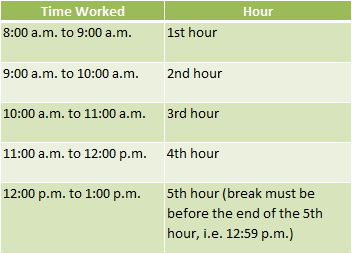
The California Supreme Court made clear in Brinker Restaurant Group v. Superior Court that employers need to give an employee their first meal break “no later than the end of an employee’s fifth hour of work, and a second meal period no later than the end of an employee’s 10th hour of work.” Here is a chart to illustrate the Court’s holding:

Rest Breaks
As for rest breaks, the Court set forth that, “[e]mployees are entitled to 10 minutes’ rest for shifts from three and one-half to six hours in length, 20 minutes for shifts of more than six hours up to 10 hours, 30 minutes for shifts of more than 10 hours up to 14 hours, and so on.” This rule is set forth in this chart:

In regard to when rest breaks should be taken during the shift, the Court held that “the only constraint of timing is that rest breaks must fall in the middle of work periods ‘insofar as practicable.’” The Court stopped short of explaining what qualifies as “insofar as practicable” and employers should closely analyze whether they may deviate from this general principle.

2. Rule regarding waiver of breaks.

Meal Breaks
Generally meal breaks can only be waived if the employee works less than six hours in a shift. However, as long as employers effectively allow an employee to take a full 30-minute meal break, the employee can voluntarily choose not to take the break and this would not result in a violation. The Supreme Court explained in Brinker (quoting the DLSE’s brief on the subject):

The employer that refuses to relinquish control over employees during an owed meal period violates the duty to provide the meal period and owes compensation [and premium pay] for hours worked. The employer that relinquishes control but nonetheless knows or has reason to know that the employee is performing work during the meal period, has not violated its meal period obligations [and owes no premium pay], but nonetheless owes regular compensation to its employees for time worked.

Rest Breaks
Rest breaks may also be waived by employees, as long as the employer properly authorizes and permits employees to take the full 10-minute rest break at the appropriate times.

3. Timekeeping requirements of meal breaks.

Meal breaks taken by the employees must be recorded by the employer. However, there is no requirement for employers to record 10-mintute rest breaks.

4. Implementing a procedure for employees to notify the company when they could not take a break.

If employers have the proper policy and practices for meal and rest breaks, the primary issue then becomes whether the employer knew or should have known that the employee was not taking the meal or rest breaks. Therefore, allegations that the employer was not providing the required breaks can be defended on the basis that the employer had an effective complaint procedure in place to inform the employer of any potential violation, but the plaintiff failed to inform the employer of these violations.

5. Time rounding for meal breaks is not permitted under California law.

In Donohue v. AMN Services LLC, the California Supreme Court held that employers may not use time rounding policies in context of meal periods, and time records for meal periods that are incomplete or inaccurate raise a rebuttable presumption of meal period violations.  The Court explained that rounding polices when used for meal breaks, an employee’s 30-minute meal break could lose 9 minutes due to rounding, which amounts to nearly a third of the meal break.  If an employee is not provided a full 30-minute meal break because of rounding, there is no mechanism that makes up for the premium pay owed to the employee that would average out over time.  The Supreme Court held, “The precision of the time requirements set out in Labor Code section 512 and Wage Order No. 4 — “not less than 30 minutes” and ‘five hours per day’ or ‘ten hours per day’ — is at odds with the imprecise calculations that rounding involves.  The regulatory scheme that encompasses the meal period provisions is concerned with small amounts of time.”

Recently we have been litigating and answering basic issues about employers’ obligations to provide meal and rest breaks.  It has been a few years since the California Supreme Court issued its groundbreaking ruling in Brinker Restaurant Group v. Superior Court, and there is no indication that wage and hour litigation for California employers will lighten up, so employers should constantly monitor and audit their meal and rest break policies and practices. Here are five reminders for employers:

1. Timing of breaks.

Meal Breaks
The California Supreme Court made clear in Brinker Restaurant Group v. Superior Court that employers need to give an employee their first meal break “no later than the end of an employee’s fifth hour of work, and a second meal period no later than the end of an employee’s 10th hour of work.” Here is a chart to illustrate the Court’s holding:


Rest Breaks
As for rest breaks, the Court set forth that, “[e]mployees are entitled to 10 minutes’ rest for shifts from three and one-half to six hours in length, 20 minutes for shifts of more than six hours up to 10 hours, 30 minutes for shifts of more than 10 hours up to 14 hours, and so on.” This rule is set forth in this chart:

In regard to when rest breaks should be taken during the shift, the Court held that “the only constraint of timing is that rest breaks must fall in the middle of work periods ‘insofar as practicable.’” The Court stopped short of explaining what qualifies as “insofar as practicable” and employers should closely analyze whether they may deviate from this general principle.

2. Rule regarding waiver of breaks.

Meal Breaks
Generally meal breaks can only be waived if the employee works less than six hours in a shift. However, as long as employers effectively allow an employee to take a full 30-minute meal break, the employee can voluntarily choose not to take the break and this would not result in a violation. The Supreme Court explained in Brinker (quoting the DLSE’s brief on the subject):

The employer that refuses to relinquish control over employees during an owed meal period violates the duty to provide the meal period and owes compensation [and premium pay] for hours worked. The employer that relinquishes control but nonetheless knows or has reason to know that the employee is performing work during the meal period, has not violated its meal period obligations [and owes no premium pay], but nonetheless owes regular compensation to its employees for time worked.

Rest Breaks
Rest breaks may also be waived by employees, as long as the employer properly authorizes and permits employees to take the full 10-minute rest break at the appropriate times.

3. Timekeeping requirements of meal breaks.

Meal breaks taken by the employees must be recorded by the employer. However, there is no requirement for employers to record 10-mintute rest breaks.

4. Implementing a procedure for employees to notify the company when they could not take a break.

If employers have the proper policy and practices for meal and rest breaks, the primary issue then becomes whether the employer knew or should have known that the employee was not taking the meal or rest breaks. Therefore, allegations that the employer was not providing the required breaks can be defended on the basis that the employer had an effective complaint procedure in place to inform the employer of any potential violation, but the plaintiff failed to inform the employer of these violations.

5. Time rounding for meal breaks is not permitted under California law.

In Donohue v. AMN Services LLC, the California Supreme Court held that employers may not use time rounding policies in context of meal periods, and time records for meal periods that are incomplete or inaccurate raise a rebuttable presumption of meal period violations.  The Court explained that rounding polices when used for meal breaks, an employee’s 30-minute meal break could lose 9 minutes due to rounding, which amounts to nearly a third of the meal break.  If an employee is not provided a full 30-minute meal break because of rounding, there is no mechanism that makes up for the premium pay owed to the employee that would average out over time.  The Supreme Court held, “The precision of the time requirements set out in Labor Code section 512 and Wage Order No. 4 — “not less than 30 minutes” and ‘five hours per day’ or ‘ten hours per day’ — is at odds with the imprecise calculations that rounding involves.  The regulatory scheme that encompasses the meal period provisions is concerned with small amounts of time.”

Employers have the burden to record and maintain accurate time records under California law. If the employer knows employees are not properly recording their time, the employer needs to enforce a policy to have employees accurately record their time, even if it requires disciplinary action. In addition, employers need to review their time records to ensure employees are following proper procedures.  Here are five reminders of best practices for time records for California:

1. Ensure the time records are accurate.

It goes without saying that the time records need to be accurate in the time that is being recorded for the employees.  For the employer, this means reviewing the use of electronic time keeping systems.  However, if an employer is relying upon the employee to record their time manually, or in a spreadsheet, these records must be audited to ensure that the employee is being accurate in the time they are recording.  For example, the employer needs to prevent an employee manually recording their start and stop time and the same time every day without any variations.  More information about electronic time records and storage requirements is available here.

2. Storing time records for the required amount of time.

The statute of limitations can reach back four years in wage and hour class actions under California law, and time records will be the primary evidence in most of these cases.  California law requires employers to track start and stop times for hourly, non-exempt employees, and record meal breaks as discussed below.  Employers need to ensure they are keeping these critical records for the amounts of time required under the law, and also long enough to defend against wage and hour claims.

3. Must record all required information.

Employers need to ensure their timekeeping system is recording the required information.  For example, while employers are not required to record 10-minute rest breaks, employers are required to record employee’s meal periods under the IWC Wage Orders (requirement is found section 7 – Records).

4. Maintaining time records in a usable format.

Maintaining records in a form that makes reviewing the records almost impossible is almost equivalent to not maintaining them in the first place. Some thought should be put into how an employer is storing time records and understanding how that data could efficiently be reviewed in the future if needed.  Electronic time records are easiest to analyze given that the data is digital.  However, employers should consider where the records are stored (electronic or paper), and how easy is it to pull information for individual employees, and for all employees, if needed.

5. Tracking employees’ signed waivers, acknowledgments, and time card adjustments.

Just like time records, employers need to consider a system for storing, indexing, and retrieving records related to the employee’s time records, such as any time adjustments, employee signed waivers (more information about meal break waivers is available here), and signed acknowledgments.  Documentation is critical but being able to track and retrieve documents for specific employees or for the workforce over a period of time is just as important.  Employers need to put just as much thought into this aspect as they do in training managers and supervisors to document issues in the first place.

The California supreme court provided further guidance on employer obligations to provide meal breaks as required under the Labor Code and applicable Wage Orders.  In Donohue v. AMN Services LLC, the California supreme court held that employers may not use time rounding policies in context of meal periods, and time records for meal periods that are incomplete or inaccurate raise a rebuttable presumption of meal period violations.  Here are five key takeaways from the opinion for California employers:

1. Reminder of meal break timing requirements

The California supreme court reiterated that, as it set forth in Brinker Restaurant Corp. v. Superior Court (2012), “employers must generally provide ‘a first meal period [of at least 30 minutes] no later than the end of an employee’s fifth hour of work, and a second meal period [of at least 30 minutes] no later than the end of an employee’s 10th hour of work.”  And that an employer “satisfies this obligation if it relieves its employees of all duty, relinquishes control over their activities and permits them a reasonable opportunity to take an uninterrupted 30-minute break, and does not impede or discourage them from doing so. . . .  [¶]  . . . [T]he employer is not obligated to police meal breaks and ensure no work thereafter is performed.”

Under Brinker, “[t]here is no meal period violation if an employee voluntarily chooses to work during a meal period after the employer has relieved the employee of all duty.”

2. Time rounding for meal breaks is not permitted under California law

The California Court of Appeal held in See’s Candy Shops, Inc. v. Superior Court (2012) that employers may use time rounding policies to calculate regular and overtime wages “if the rounding policy is neutral on its face and as applied.”  The supreme court noted that it has “never decided the validity of the rounding standard” set forth in See’s Candy, but even assuming the holding is valid, such a rounding policy in regards to meal periods “does not comport with its neutrality standard.”  The supreme court explained that in context of regular and overtime wages, a rounding policy “averages out” and it is possible that employees are “fully compensated over a period of time.”

In contrast, when viewed in the meal break context, an employee’s 30-minute meal break could lose 9 minutes due to rounding, which amounts to nearly a third of the meal break.  If an employee is not provided a full 30-minute meal break because of rounding, there is no mechanism that makes up for the premium pay owed to the employee that would average out over time.  The supreme court held, “The precision of the time requirements set out in Labor Code section 512 and Wage Order No. 4 — “not less than 30 minutes” and ‘five hours per day’ or ‘ten hours per day’ — is at odds with the imprecise calculations that rounding involves.  The regulatory scheme that encompasses the meal period provisions is concerned with small amounts of time.”

3. Rebuttable presumption against employer if time records show meal period violations

The supreme court explained that if an employer’s “time records show missed, short, or delayed meal periods with no indication of proper compensation, then a rebuttable presumption arises.”  The court explained that a rebuttable presumption arises against the employer if “time records show missed, short, or delayed meal periods with no indication of proper compensation.”  The “proper compensation” referred to by the court is the premium pay of one hour of pay at the employee’s regular rate of pay for each workday that the meal period is not provided.  The court explained that, “Employers can rebut the presumption by presenting evidence that employees were compensated for noncompliant meal period or that they had in fact been provided compliant meal periods during which they chose to work.”

What type of evidence could employers use to rebut this presumption?  The court explained that representative testimony, surveys and statistical analysis are some types of evidence that employers could present to rebut the presumption.  In addition, employee attestation forms that they received their meal breaks may also be evidence as explained below.

4. Potential use of employee acknowledgements confirming breaks were taken

The supreme court explained if an employer’s records do not show a compliant meal break was taken by the employee, it may be possible for the employer to use electronic attestations at the time an employee does not take a full meal break, a late meal break, or misses a break in order to ensure accurate tracking.

In Donohue, the employer’s timekeeping system provided a dropdown menu that prompted the employee to choose one of three options:

  1. “I was provided an opportunity to take a 30 min break before the end of my 5th hour of work but chose not to”;
  2. “I was provided an opportunity to take a 30 min break before the end of my 5th hour of work but chose to take a shorter/later break”;
  3. “I was not provided an opportunity to take a 30 min break before the end of my 5th hour of work.”

The employee was required to choose an option by the end of the pay period, and if the employee selected item #3, they were paid a premium wage for the missed break.  The supreme court explained that this procedure “would have ensured accurate tracking of meal period violations if it had simply omitted rounding.”

5. Potential use of biweekly certifications by employees that they received meal periods

The employer in Donohue also argued that its biweekly certifications signed by employees show there were no meal period violations.  The certification stated:

I was provided the opportunity to take all meal breaks to which I was entitled, or, if not, I have reported on this timesheet that I was not provided the opportunity to take all such meal breaks.

Because the employer used time rounding to record the meal periods, the plaintiff argued that these certifications were not valid as the employees were not on notice of potential violations.  In addition, plaintiff argued that the certification “should be discounted because employees had to sign them to get paid.”  The court did not rule on the effect that the certification would have in this case and left the issue to be addressed by the trial court on remand.  However, it does raise considerations for employers to review the use of certifications that can be used as evidence to rebut the presumption of any time records showing potential meal period violations.

Happy Friday.  Here is a refresher post for today’s Friday’s Five about some requirements about 10-minute rest breaks required for non-exempt employees:

1. Timing of rest breaks

The 10-minute rest break must be provided to employees who work over three and a half hours.  Employers must authorize and permit employees to take 10-minute rest breaks for every four hours worked, or “major fraction” thereof.  A “major fraction” of four hours is anytime more than two hours.  Insofar as practicable, the rest breaks should be in the middle of each four-hour work period.

2. Rest breaks must be paid and employees must be relieved of all duties

The rest period is considered time worked and must be paid.

Employees must be relieved of all duties during the rest break, and cannot be required to monitor a pager, phone, or other device during the rest break.  The Court in Augustus v. ABM Security Services, Inc., ruled that “one cannot square the practice of compelling employees to remain at the ready, tethered by time and policy to particular locations or communications devices, with the requirement to relieve employees of all work duties and employer control during 10-minute rest periods.” The Court made clear that the employee must be “free from labor, work, or any other employment-related duties. And employees must not only be relieved of work duties, but also freed from employer control over how they spend their time.”  Further analysis on the Augustus case can be read here.

3. Rest breaks need to be “authorized and permitted”

Employers are required to “authorize and permit” rest breaks, and there is no affirmative duty for employers to require that employees take rest breaks.  Employers need to ensure that they do not interfere with an employee’s ability to take the rest break, and if the demands of work are such that employees cannot take the rest break, employers should have a system in place to compensate the employee the applicable “wage premium” of one hour of pay at the employee’s regular rate of pay for any violations.

4. Rest breaks do not need to be recorded

Unlike the 30-minute meal break, the 10-minute rest break does not have to be recorded in the timekeeping system.

5. Piece rate employees must be paid separately for rest breaks

Employers who paid employees on a piece rate basis need to ensure they comply with Labor Code section 226.2, which took effect in January 2016.  Under Labor Code section 226.2, employers who paid employees on a piece rate basis must pay employees for “rest and recovery periods and other nonproductive time separate from any piece-rate compensation.”  The law requires employers to calculate the regular rate of pay for each workweek, and then pay the piece-rate employees the higher of this regular rate of pay or the applicable minimum wage for rest break time.  The law also requires employers to pay piece-rate employees for “nonproductive time” which is defined as “time under the employer’s control, exclusive of rest and recovery periods, that is not directly related to the activity being compensated on a piece-rate basis.”  The nonproductive time is required to be paid at a rate no less than the applicable minimum wage rate.  In addition, employers who pay employees on a piece-rate basis need to report the pay for rest breaks, recovery periods, and nonproductive time separately on the employees’ pay stubs.  Employers with piece rate employees should consult with experienced counsel to ensure the correct amounts of time are being calculated and paid for under this law.

In Rodriguez v. Taco Bell Corp., 896 F.3d 952 (9th Cir. 2018), an employee brought a putative class action alleging that Taco Bell’s discounted meal policy effectively denied employees the ability to take a duty free meal break.  At issue in this case was Taco Bell’s policy of offering a discounted meal from the restaurant during the employees’ meal breaks as long as the employees ate the meal on the company’s premises.  The ability to purchase discounted meals was voluntary.  The policy was implemented to prevent theft.  The employees argued that because they were required to remain on the company’s property in order to obtain the discounted meal they employees were not provided a duty free meal break.  The court rejected Plaintiff’s argument and held that Taco Bell’s policy complied with California law.  Here are five issues California employers should understand about the decision:

1. Meal and rest break requirements

The court in Rodriguez v. Taco Bell explained that California requires non-exempt employees be afforded rest breaks and meal periods after working a certain number of hours. See Cal. Labor Code §§ 226.7, 512.  At issue in this case is the Labor Code’s requirement that employees who work more than five hours in a day be afforded a meal period of “not less than 30 minutes” and employees who work more than ten hours in a day must be provided a second meal period of the same duration. Labor Code 512(a).  The court also noted that California Industrial Welfare Commission (“IWC”) Wage Order 5-2001 “requires employees be relieved of ‘all duty’ during the meal period. Cal. Code Regs., tit. 8, § 11050, subd. 11(A).”

The court also explained that if a meal or rest break is not provided according to California law, employees are entitled to the remedy of premium wages of “one additional hour of pay at the employee’s regular rate of compensation for each workday that the meal or rest or recovery period is not provided.” Cal. Labor Code § 226.7(c).

2. Discounted meal policy did not establish control over employees

The court found that Taco Bell’s meal policy was compliant under California law because the company relieved the employees of all duty and relinquished control over their activities.  Taco Bell did not require its employees to purchase the discounted meal, there was no evidence that Taco Bell pressured its employees to purchase the discounted meals, employees were free to purchase meals and full price and leave the company premises.  In addition, there was no evidence to show that employees were required or pressured to work while on premises during the meal period.  In fact, Taco Bell had a policy prohibiting this, “as employees were required to take rest breaks and meal periods away from ‘[t]he food production area’ and ‘[t]he cash register service area.’”

3. Voluntary nature of the discounted meal policy was key issue in case

Plaintiff argued that employers must pay employees whenever they control the employees, even if the employee is not required to work, as set forth in Morillion v. Royal Packing Co., 22 Cal.4th 575 (2000). In Morillion, the employer required employees to travel to work on employer-provided buses, and the employees had no option to drive themselves.  There, the court held that employer’s work rules “prohibited employees from using their own transportation to get to and from the fields” where they worked, and therefore this time was considered work time and the employees had to be paid.  The court in Taco Bell also noted however that the Morillion court made it clear that if the employer provided optional transportation that the employee was not required to use, the travel time would not need to be compensated.  The court in Taco Bell explained that this scenario is more similar to Taco Bell’s voluntary discount meal program.

4. Employers must relieve employees of all duty during breaks

The court in Taco Bell did note that “an employer may so burden the use of employee’s break time that the employees must be considered ‘on duty.’”  The court explained:

In Augustus, the employees were required to carry a device so that the employer could reach the employee during the break if services were needed. Augustus, 211 Cal.Rptr.3d 634, 385 P.3d at 832. The California Supreme Court said that such an arrangement was “irreconcilable with employees’ retention of freedom to use rest periods for their own purposes.” Id. In Madera, the employees were not only on call, but were forbidden to conduct any personal business. See Madera, 204 Cal.Rptr. 422, 682 P.2d at 1089.

5. Remember to record meal breaks

Although not an issue in the case, the Wage Orders require that meal breaks taken by the employees must be recorded by the employer. See Wage Order No. 5 (7)(A)(3) (“Meal periods, split shifts intervals and total daily hours worked shall also be recorded.”).  The California Supreme Court held in Brinker Restaurant Corp. v. Superior Court that, “[i]f an employer’s records show no meal period for a given shift over five hours, a rebuttable presumption arises that the employee was not relieved of duty and no meal period was provided.”  Brinker Restaurant Corp. v. Superior Court, 53 Cal.4th 1004, 1053 (2012).

However, there is no similar requirement for employers to record 10-mintute rest breaks.

For more information about meal and rest breaks, see my prior article here.